Family-dessert planners
If you are making a trifle, crumble or fruit salad, the fruit mix and cut need to suit the dish. Princes presents its fruit cocktail as a trifle ingredient, while M&S describes uses for tinned grapefruit and rhubarb.


For a family dinner, choose tinned fruit by the dish and its packing liquid: juice or water if you do not want syrup, or syrup when its sweetness is part of the recipe. Check the fruit type, drained weight and opened-pack instructions too; total pack weight includes liquid and does not tell you how much fruit you can serve.
If you are making a trifle, crumble or fruit salad, the fruit mix and cut need to suit the dish. Princes presents its fruit cocktail as a trifle ingredient, while M&S describes uses for tinned grapefruit and rhubarb.
If you would rather not use syrup for a routine family dessert, compare packing liquids and ingredient lists. A label saying fruit is packed in juice does not, by itself, describe every ingredient.
If one dinner will not use a whole tin, consider the pack size and what you will do with the remainder. Opened-pack instructions matter as well as the amount of fruit you plan to serve.
Start with the dish and the people eating it, then compare the fruit you can use and how you will handle any leftovers.
| Concern | What to check | Who this matters to |
|---|---|---|
| Packing liquid and sweetness | Read the packing-liquid description and ingredients; compare the nutrition panel if sweetness matters to your dish. | For an everyday family dessert, I may want to avoid syrup without assuming all fruit in juice has the same ingredients. About 31% of consumers would put packing liquid and sweetness first. |
| Fruit and recipe fit | Choose the fruit type and cut the recipe needs; check the ingredients if selecting a mixed cocktail. | If a trifle needs mixed fruit, a cocktail may work, but I would choose a single fruit when the recipe calls for one. Recipe fit would be the primary concern for about 31% of consumers. |
| Usable fruit quantity | Compare drained weight, where stated, rather than treating total pack weight as fruit weight. | When I need enough fruit for a dessert, liquid included in the tin’s total weight does not help me judge the yield. About 23% of consumers would put usable fruit quantity first. |
| Leftovers and labels | Check opened-pack storage instructions and, where relevant, the current ingredients and allergen information. | For a smaller dinner, I need a plan for unused fruit; if someone has an allergy, I also need to check their tin’s label. These would be the main concerns for about 15% of consumers. |
The total includes packing liquid. Sainsbury's lists a 415g Del Monte peach tin with 250g drained, so the front-of-pack weight is not its fruit yield.
Check drained weight when a recipe calls for a particular amount of fruit.
The packing description is not a substitute for the ingredient list or nutrition panel.
Read the current label on the particular tin, especially when the liquid or sweetness will affect your recipe.
Opened-pack handling varies by product. The ASDA Peach Slices in Fruit Juice 411g instructions say to transfer unused contents to a suitable non-metallic container, cover, refrigerate and use within four days.
Choose a pack you can use and follow its own storage instructions after opening.
Ingredients can vary between products. GOV.UK says food businesses must declare any of the 14 regulated allergens when they are ingredients.
If an allergy is relevant to your household, check the current product’s ingredients and allergen information each time.
A branded option for fruit such as peaches and fruit cocktail, with packing liquid varying by product.
Its fruit cocktail with juice offers a ready-mixed option for desserts.
An own-label route that includes portion-style fruit pieces alongside other tinned-fruit formats.
An own-label option to consider alongside branded tins when choosing fruit and cut for a recipe.
An own-label option illustrated by ASDA Peach Slices in Fruit Juice 411g.
A reference point when a dessert calls specifically for grapefruit or rhubarb.
These selections cover peaches and pineapple in juice, a mixed fruit cocktail, peaches in light syrup and separate peach pots. Choose among them by the dessert you are making and the pack format you can use.
 No image available
Consider peach halves when a dessert needs a single fruit in larger pieces rather than a mixed cocktail.
The 415g figure is total pack weight. Check the drained weight for recipe yield, and follow the pack’s instructions if you keep any after opening.
 No image available
Choose pineapple chunks when the recipe calls for pineapple pieces rather than slices or mixed fruit.
The pack is 432g including juice. Check its drained weight if the amount of pineapple is important, and follow its instructions for any leftovers.
 No image available
A mixed fruit cocktail is useful when a topping or dessert does not need a precise single-fruit cut.
This pack is 415g including juice. Read the current ingredients if particular fruits matter to your household, and check drained weight when planning recipe yield.
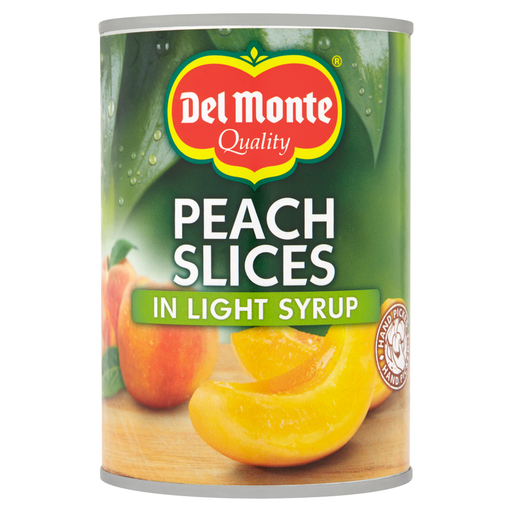 No image available
Consider these peach slices for a pudding whose recipe calls for syrup-packed fruit, rather than substituting them without adjusting the dish.
The 420g pack weight includes light syrup. Check drained weight for the amount of peach and read the ingredients if the syrup matters to your choice.
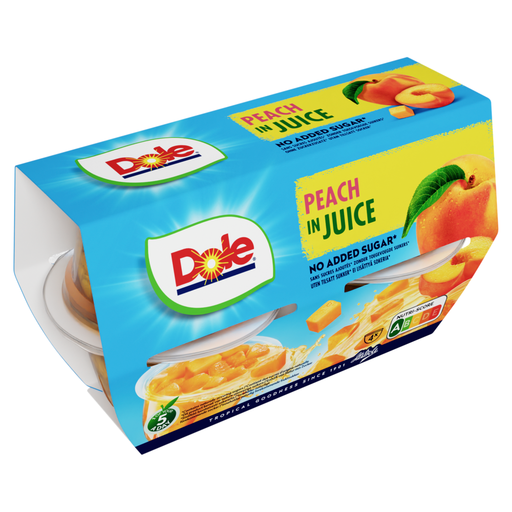 No image available
Four separate peach pots may suit dinners where opening one larger tin would leave fruit unused.
Each pot is labelled 113g. Check the ingredients and the opened-pot instructions on the current pack before serving or storing it.
Yes. The NHS says 80g of canned fruit counts as one portion of 5 A Day. Use the amount of fruit, not the tin’s total weight including liquid, when judging what you will serve.
Do not rely on those words alone. Read the ingredients and nutrition panel on the exact product to understand its packing liquid and sugars.
Follow the individual pack’s instructions. For ASDA Peach Slices in Fruit Juice 411g, Asda instructs shoppers to transfer unused contents to a suitable non-metallic container, cover, refrigerate and use within four days; do not apply that period to every product.
Use drained weight when you need to know how much fruit a recipe will yield. Total weight includes the liquid, so two tins of similar size need not provide the same amount of fruit.
Check the current product’s ingredient and allergen information. GOV.UK says food businesses must declare any of the 14 regulated allergens when they are ingredients; a familiar brand name is not a substitute for checking the particular product.