Low-fat dessert planners
If a pudding, fruit salad or yoghurt topping needs to meet a low-fat requirement, use the fat value on the exact tin rather than a general impression of tinned fruit.


For an Easter dessert, check the exact tin’s fat content per 100g rather than judging by the fruit or packing liquid: UK government guidance sets the low-fat claim criterion for solid foods at no more than 3g of fat per 100g. If avoiding added sugar also matters, the NHS advises choosing tinned fruit in natural juice or water with no added sugar or salt. Light syrup may suit a recipe that calls for its sweeter liquid, but check the ingredients and sugars on that particular pack.
If a pudding, fruit salad or yoghurt topping needs to meet a low-fat requirement, use the fat value on the exact tin rather than a general impression of tinned fruit.
If the packing liquid matters as well as fat content, check the ingredients. NHS advice for canned fruit favours natural juice or water with no added sugar or salt.
If the fruit will go straight onto a dessert table, consider whether slices, halves, segments or a fruit mix suit the dish, and what you will do with any leftovers.
Start with the nutrition panel for the low-fat requirement, then choose a packing liquid and fruit format that suit the dessert.
| Concern | What to check | Who this matters to |
|---|---|---|
| Fat content | Read fat per 100g and whether the figures refer to drained fruit or net contents. UK government guidance sets a maximum of 3g per 100g for a low-fat claim on solid foods. | If my Easter dessert has a low-fat requirement, I need a fat value for the particular tin before choosing it. About 42% of consumers put that verification first. |
| Packing liquid and sugars | Read the ingredients and sugars declaration; do not treat “in juice” or “light syrup” as proof of no added sugar. | If I want to avoid added sugar, the liquid around the fruit matters to my choice as well as the fruit itself. For about 33% of consumers, checking the packing liquid and ingredients is the primary need. |
| Dessert format and leftovers | Match the fruit shape and pack quantity to the dish, then check the opened-pack storage instructions. | When I am serving several Easter desserts, I want fruit that fits the presentation without leaving more than I can use as directed. Portioning and format come first for about 25% of consumers. |
Fruit packed in juice can still have sugars declared on its nutrition panel. The NHS recommendation is specifically for canned fruit in natural juice or water with no added sugar or salt.
Use “in juice” as a starting point, then read the ingredients and sugars line on the exact pack, particularly when comparing it with light syrup.
ASDA Groceries gives figures per 100g drained for its researched mandarin segments and pear halves, while Sainsbury’s lists Del Monte Fruit Cocktail values per 100g of net content. Those are different bases.
Check whether each figure covers drained fruit, net contents or a serving before making a like-for-like comparison.
A fruit format and pack size that work for one dessert may leave unused contents after serving.
Choose a quantity you can use and follow the pack’s instructions for transferring, refrigerating and using leftovers.
Unused fruit may go to waste if it cannot be used within the pack’s stated period after opening.
Its researched range includes fruit cocktail and single-fruit tins in juice, alongside light-syrup options.
Its canned-fruit range includes pineapple in several formats, as well as other fruit types.
Its tinned-fruit category brings together own-label and branded products with different packing liquids.
Its category includes own-label fruit in juice and alternatives in light syrup.
Its researched own-label examples offer single-fruit formats in juice with nutrition figures stated for drained fruit.
Its researched grapefruit segments offer a fruit format for shoppers considering a sharper-tasting dessert topping.
These tins cover single-fruit slices, halves and segments, plus a mixed-fruit option. Choose the shape for your dessert, then check the current pack’s fat, sugars and ingredients if those determine your purchase.
 No image available
Consider the sliced format when the dessert calls for pieces to arrange or add to a fruit salad.
The tin is 435g. Check fat and sugars on the current pack, including the basis used for its nutrition figures.
 No image available
Consider mixed fruit for a dessert bowl or fruit salad when uniform slices are not needed.
The tin is 415g. Compare its nutrition figures on the declared net-content basis and check the current ingredients if added sugar matters.
 No image available
Choose halves if you plan to serve pieces whole or cut them for a dessert.
The tin is 415g. Read the pack’s fat and sugars declarations, serving information and opened-tin instructions.
 No image available
Consider pear halves for a plated dessert or for cutting into a fruit salad.
The tin is 415g. Check the current nutrition-panel basis and ingredients before comparing it with other fruit in juice.
 No image available
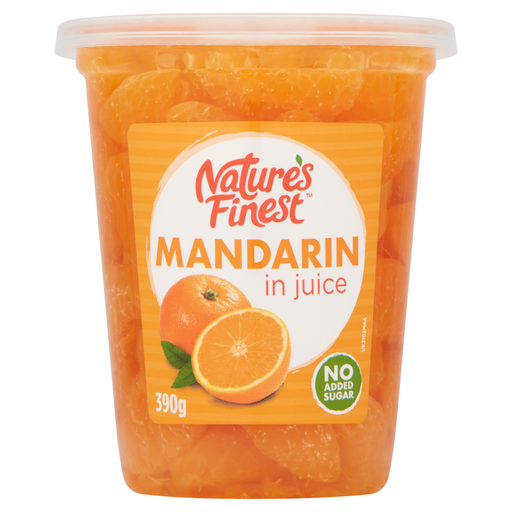
Consider mandarin segments when you want individual pieces for a topping or fruit salad.
The tin is 390g. Check fat per 100g, the sugars declaration and the ingredients on the current pack.
Check the individual product. UK government guidance sets the low-fat claim criterion for solid foods at no more than 3g of fat per 100g; a fruit type or an “in juice” description does not establish the value for every tin.
Choose by both the recipe and the ingredients. The NHS advises canned fruit in natural juice or water with no added sugar or salt; light syrup is an option if your recipe specifically calls for a sweeter packing liquid, but “light” does not establish its fat or sugar content.
The NHS states that 80g of canned fruit counts as one portion of 5 A Day. When planning dessert servings, also check the tin’s stated quantity and serving information.
Follow that product’s storage instructions, including any direction to transfer unused fruit to a suitable non-metal container and refrigerate it. Check its stated use-within period before choosing a tin that will leave leftovers.
Use the online listing to narrow your choice, then check the label on the product you receive before eating it. Retailers note that ingredients and allergy information can change.