Low-fat dessert planners
If low fat is your priority, read the nutrition panel on the particular can rather than relying on its fruit or packing-liquid description. Check sugars and the amount you plan to eat as separate questions.


Choose by fat per 100 g rather than assuming fruit in juice is lower in fat than fruit in syrup: the UK Government’s published nutrition-claims legislation sets a ceiling of 3 g fat per 100 g for a low-fat claim on solid food. Compare sugars separately, and if you cannot chill leftovers, choose a can you can finish or share when opened. Check your festival’s rules before packing tins.
If low fat is your priority, read the nutrition panel on the particular can rather than relying on its fruit or packing-liquid description. Check sugars and the amount you plan to eat as separate questions.
If you cannot refrigerate food after opening, choose an amount you can finish or arrange to share it. The checked Sainsbury’s and Del Monte labels instruct shoppers to refrigerate leftovers.
Check your named event’s current campsite and arena rules for food containers and openers. Reading Festival says glass is not allowed anywhere on its site; that restriction does not establish whether tins are allowed there or at another festival.
For solid tinned fruit, the UK Government’s published nutrition-claims legislation sets the low-fat claim ceiling at 3 g fat per 100 g. Use the nutrition panel for that decision, then consider the packing liquid and whether you can finish the can after opening.
| Concern | What to check | Who this matters to |
|---|---|---|
| Fat content | Read fat per 100 g on the exact product; compare sugars separately. | I want to know whether my dessert meets the low-fat criterion, not just whether it contains fruit. About 33% of consumers put confirming fat content first. |
| Leftovers without cooling | Check the can’s serving count and its instructions for storage after opening. | If I cannot chill an opened can at camp, I need to finish or share it straight away. Roughly 27% of consumers prioritise avoiding leftovers they cannot refrigerate. |
| Amount to carry | Compare net and drained weight where stated, and plan who will eat the contents. | For a solo trip, I want a manageable amount to carry and eat; a group can plan around a larger can. About 20% of consumers make portion size and packability their main concern. |
| Juice or syrup | Read the ingredients and compare sugars per 100 g and per serving; check fat on either option. | If I am choosing between juice and syrup for a dessert, sweetness matters to me independently of fat. Around 20% of consumers put the packing liquid and sugars first. |
A fat figure does not tell you how much sugar a portion contains. The checked juice-packed fruit labels also list sugars.
Compare fat per 100 g for the low-fat decision, then read sugars and serving size on the same can.
Checked Del Monte and Sainsbury’s labels instruct shoppers to refrigerate leftovers. That matters if you have no dependable way to keep an opened portion chilled.
Choose a can you can finish, or agree to share a larger one when you open it.
Otherwise, you may have fruit left over that you cannot keep as directed on the label.
A dietary filter helps narrow a range, but it does not establish the current nutrition, ingredients or storage instructions for an individual can. Tesco tells shoppers to check the label.
Use filters to shortlist products, then read the exact can’s nutrition panel, ingredients and storage directions.
Entry restrictions are event-specific. Reading Festival states that glass is not allowed anywhere on its site, which does not tell you whether a tin or opener is permitted.
Check your named festival’s current official campsite and arena rules before packing.
Princes lists pineapple slices in juice in 227 g and 432 g sizes, giving solo campers and groups different quantities to consider.
Del Monte fruit cocktail and pineapple chunks in juice are among the tinned-fruit varieties listed by Sainsbury’s.
Tesco’s tinned-and-pot-fruit range includes own-brand fruit varieties and pack formats.
Sainsbury’s lists peaches in fruit juice in both 213 g and 411 g cans.
M&S lists grapefruit segments in grapefruit juice in a 540 g pack.
These cans offer fruit in juice and one fruit-in-syrup option for a festival dessert. Compare each label’s fat and sugars, then choose a quantity you can finish or share when opened.
 Image unavailable
Consider this 432 g can if others can share it when opened. Check the label’s fat and sugars per 100 g, and plan for any contents left after serving.
 Image unavailable
This 415 g fruit cocktail is an option when several campers want to share a fruit mix. Sainsbury’s listing for the 415 g variety instructs shoppers to cover and refrigerate leftovers.
 Image unavailable
Choose peach halves in juice if that fruit suits your dessert plans. Before taking a 415 g can to camp, check how much fruit you intend to serve and the label’s instructions for leftovers.
 Image unavailable
This 415 g pear-in-juice can is worth considering if your group can eat it after opening. Read the current nutrition panel for fat and sugars, and check the serving and storage directions.
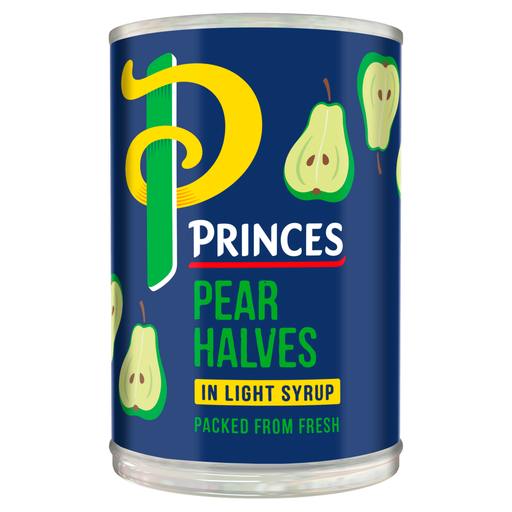 Image unavailable
If you prefer pears in syrup, compare this 410 g can’s fat and sugars per 100 g with the juice-packed options rather than judging by packing liquid alone. Plan to finish or share it when opened if you cannot refrigerate leftovers.
Under the UK Government’s published nutrition-claims legislation, a solid food must contain no more than 3 g fat per 100 g to carry a low-fat claim. That criterion concerns fat; check sugars and serving size separately.
Do not decide from the packing liquid alone. Compare fat per 100 g on the particular cans, then read their ingredients and sugars if sweetness matters to you. The checked juice-packed examples are low in fat but still list sugars.
Do not plan to keep opened leftovers in an unchilled tent when the can instructs you to refrigerate them. The checked Sainsbury’s and Del Monte labels require refrigeration after opening; without dependable cooling, choose an amount you can finish or share straight away.
Check how your chosen can opens before you leave. If it needs an opener, check that your festival permits you to bring one into the area where you plan to eat.