Pancake makers avoiding added sugar
If you want to avoid syrup, the packing medium is a useful starting point. Check the ingredients and total-sugars line as well: a no-added-sugar label does not mean sugar-free.


For a Pancake Day topping where avoiding added sugar matters, check the ingredients on fruit in juice before choosing a syrup-packed tin; an individual pot may suit a smaller serving. Neither juice packing nor a no-added-sugar label establishes a reduced-sugar claim or a lower total-sugars figure. Compare sugars per 100g, then consider how much fruit and packing liquid you will serve.
If you want to avoid syrup, the packing medium is a useful starting point. Check the ingredients and total-sugars line as well: a no-added-sugar label does not mean sugar-free.
A larger tin of sliced fruit can be divided between pancakes. Compare drained fruit quantity and the stated serving size, not just the weight printed on the front of the can.
Fruit pots offer separate portions with little preparation. Check each pot’s size, sugars and ingredient list if sweeteners affect your choice.
For Pancake Day fruit toppings, narrow the choice by packing medium, then compare the nutrition panel and the amount of fruit you expect to use.
| Concern | What to check | Who this matters to |
|---|---|---|
| Avoiding added sugar or syrup | Check whether the fruit is packed in juice or syrup, then read the ingredients and any sugar claim on the exact pack. | If I want fruit without syrup on my pancakes, I need the packing medium and ingredients to guide the choice, rather than assuming a front-of-pack phrase settles it. About 33% of consumers put avoiding added sugar or syrup first. |
| Total sugars and portions | Compare sugars per 100g and per stated serving where available; decide how much fruit and juice will go on each pancake. | For a carefully sized topping, the amount I serve matters as much as the number on a per-100g panel. Keeping total sugars and portions in view is the primary concern for about 27% of consumers. |
| Preparation and format | Compare slices or chunks for sharing with individual pots; check drained weight when comparing tins. | When several pancakes need topping at once, I may prefer a tin of ready-cut fruit; for one portion, a pot may be easier to use. About 20% of consumers prioritise preparation and portion format. |
| Usable fruit and leftovers | Compare drained quantity and serving information, then check the opened-storage instructions. | If I am opening a tin for a household meal, I want enough fruit for the pancakes and a plan for what remains. Usable quantity and leftovers come first for about 20% of consumers. |
These phrases answer different questions. For a UK “reduced sugar” claim, the food-claim rule published by legislation.gov.uk requires at least 30% less sugar than a similar product; juice packing alone does not establish that comparison.
Read the ingredients and sugars per 100g. Use a reduced-sugar claim only when it appears on the product and the required comparison applies.
Tesco Groceries lists 9.7g sugars per 100g for its peach slices in juice, while Sainsbury’s lists 11.0g per 100g for its juice-packed peach slices. The amount spooned onto a pancake still determines the size of the serving.
Compare the panels on the products you are considering, then decide how much fruit and packing liquid you will use.
A sharing-size tin may leave fruit after the pancakes are served. Opened-storage instructions vary by product.
Check the can label, transfer leftovers to a suitable covered container and refrigerate them as instructed.
Fruit left unused beyond the pack’s opened-storage period may go to waste.
A branded range with juice-packed fruit options, including peach slices listed by Sainsbury’s.
Princes lists peach slices with juice in 410g and 220g sizes.
Tesco’s 410g peach slices in juice are one own-brand option for a shared topping.
Sainsbury’s lists a 411g own-brand peach tin in fruit juice.
Asda lists 411g peach slices in fruit juice as an own-brand tin.
The M&S tinned-fruit category lists rhubarb chunks and grapefruit segments.
These Joybuy options cover juice-packed peach slices, individual peach pots, pineapple chunks and mixed fruit. Choose by the fruit and portion format you want, then check the current pack if a sugar claim or serving figure is decisive.
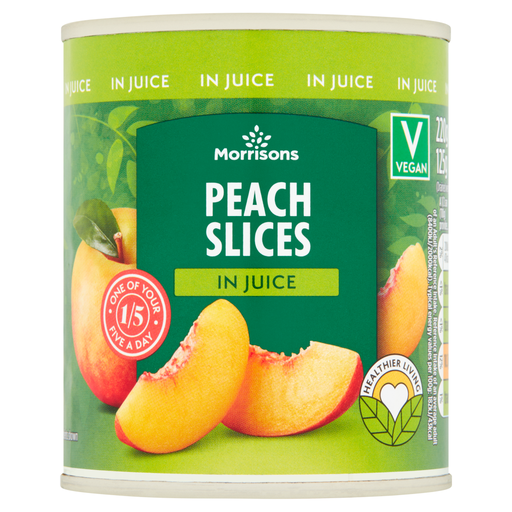 Image unavailable
The 220g tin is a smaller sliced-peach option for a few pancakes. Check its sugars panel and drained quantity if either will determine your serving.
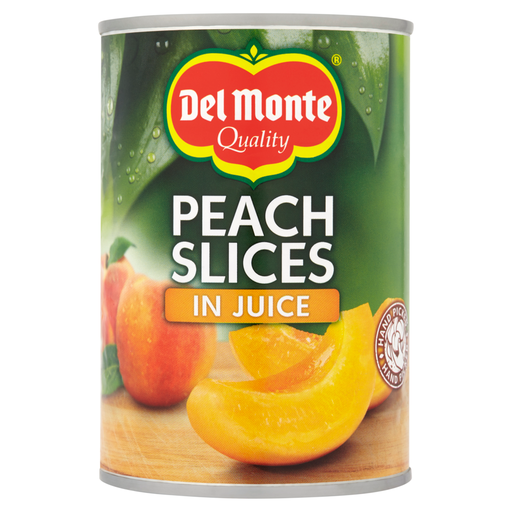 Image unavailable
This 415g tin provides sliced peaches for a shared pancake topping. Compare the drained quantity and serving information on the can before deciding how much to use.
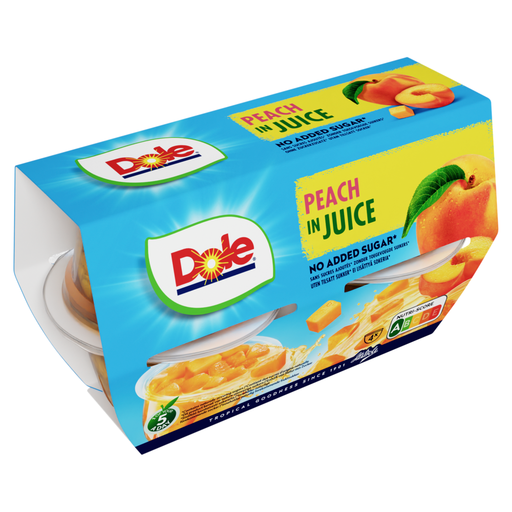 Image unavailable
Four separate 113g pots may suit pancakes served one portion at a time. If choosing them for no-added-sugar wording, check the current ingredients for sweeteners and compare total sugars too.
 Image unavailable
Choose this 432g tin if pineapple chunks appeal more than peach slices as a pancake topping. Check the drained quantity and sugars on the can when comparing it with other fruits.
 Image unavailable
This 415g tin is an option when you want mixed fruit rather than one fruit type on the pancakes. Use the current label to compare sugars and decide on a serving size.
No. Tesco Groceries lists Nature’s Finest peaches as no added sugar while showing 12.1g sugars per 100g. Read the total-sugars line and ingredients alongside the claim.
The food-claim rule published by legislation.gov.uk requires at least 30% less sugar than a similar product for a “reduced sugar” claim. A tin being packed in juice rather than syrup does not, by itself, establish that comparison.
No such conclusion follows from the packing medium alone. Compare sugars per 100g on the exact products and consider the juice you will serve; the NHS notes that sugars in fruit juice count as free sugars.
Follow the opened-storage instructions on that product’s label. Transfer unused fruit from the can to a suitable covered container, refrigerate it and use it within the period stated for that product.