Lunch packers avoiding added sugar
Parents, carers and pupils looking for fruit in juice or water rather than syrup. They also need to compare total sugars, since fruit and juice can contain sugars without added sweetening ingredients.


For a secondary-school packed lunch, start with fruit in juice or water rather than syrup if avoiding added sugar is the priority; this follows NHS guidance on canned fruit. Check the ingredients and sugars per 100g as well, because “no added sugar” does not mean sugar-free. Sealed pots avoid decanting, while larger tins need portioning and careful storage after opening.
Parents, carers and pupils looking for fruit in juice or water rather than syrup. They also need to compare total sugars, since fruit and juice can contain sugars without added sweetening ingredients.
Anyone who would rather pack a sealed, individual portion than open and decant a tin in the morning. Fruit pots still need a check of their packing liquid: juice, jelly and syrup are different options.
People happy to portion fruit at home and use the remainder as directed on the pack. A clean, leak-resistant lunch container and a plan for refrigerating opened fruit matter more with this format.
For a packed lunch, settle the packing liquid first, then choose a fruit and portion format the pupil can use. The NHS advises choosing canned fruit in juice rather than syrup; the label gives the detail needed to compare individual products.
| Concern | What to check | Who this matters to |
|---|---|---|
| Added sugar and syrup | Identify the packing liquid and read the ingredients. Compare sugars per 100g between comparable products; a no-added-sugar claim does not describe total sugars. | If avoiding added sugar is my main aim, I want to know what surrounds the fruit, not rely on the word “light” on a syrup label. About 34% of consumers put avoiding added sugar and syrup first. |
| Portioning and spills | Check the size and contents of each sealed pot. For a tin, plan a clean, leak-resistant container for the portion going into lunch. | On mornings when there is little time to prepare lunch, I need fruit that is straightforward to pack and carry; about 33% of consumers put ready-to-pack portioning first. |
| Fruit choice | Choose the fruit or mix the pupil prefers, then check whether that version is packed in juice. Read the ingredients and any product-specific serving warnings. | If the pupil prefers peaches to a mixed fruit cocktail, finding a fruit they will eat matters most to me. Roughly 20% of consumers put fruit choice first. |
| Leftovers and waste | Consider how much of an opened tin will be used and follow its storage instructions. A sealed pot avoids leaving an opened larger tin for an occasional lunch. | When I pack fruit only occasionally, I do not want the rest of a tin left unused; around 13% of consumers put managing leftovers first. |
Fruit and juice can still contribute sugars. A Sainsbury's listing for Nature's Finest mandarins marked no added sugar gives 12.8g sugars per 100g.
Use the claim to screen for added sweetening, then compare the ingredients and nutrition panels of the exact products you are considering.
“Light” does not mean unsweetened. Princes lists sugar in its light-syrup fruit cocktail; its declared sugars are 15.0g per 100g, against 9.0g per 100g for its fruit cocktail with juice. Those figures describe these two products, not every fruit in syrup or juice.
If avoiding added sugar takes priority, look for the fruit you want in juice or water before considering a syrup version.
A tin needs portioning, and the remainder must be stored according to its label. Choose its size with the next use of the fruit in mind.
Use a clean, leak-resistant container for lunch and check the on-pack instructions for the opened tin.
Fruit left unused after opening can go to waste, and portioning requires a separate container.
GOV.UK school-food guidance is directed at food provided by schools. A school may also have its own packed-lunch, allergen or packaging rules.
Check the pupil's school policy before choosing a product whose ingredients or packaging might matter locally.
These ranges offer examples of fruit types, packing liquids and formats to compare. Check the individual product rather than assuming every item from a brand has the same ingredients.
Del Monte has peach and pear products in juice, alongside fruit sold in other packing liquids.
Princes offers fruit cocktail with juice and a separate light-syrup version.
Tesco lists both tinned fruit and individual fruit pots, giving shoppers a choice of lunch-packing formats.
Sainsbury's lists tinned fruit in juice, including a Nature's Finest mandarin product marked no added sugar.
M&S lists tinned fruits including grapefruit segments and rhubarb.
These options include individual peach pots and larger tins of fruit in juice. Choose the format according to whether lunch needs to be ready-portioned or can be prepared at home; check the current label for ingredients, nutrition and storage instructions.
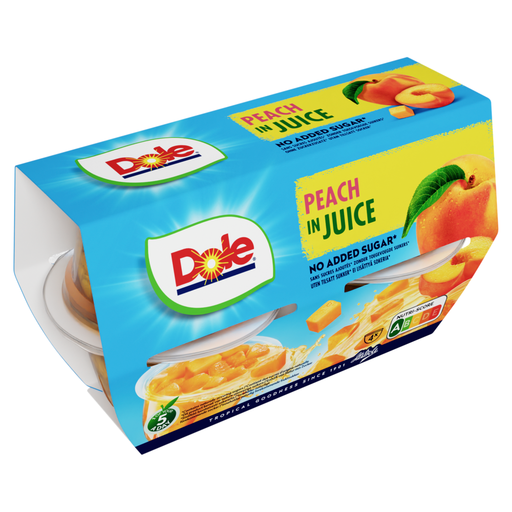 No image available
Individual pots suit a lunch that needs a ready-portioned fruit option. If avoiding added sweeteners as well as added sugar matters, check the ingredients for steviol glycosides; compare the current nutrition panel for total sugars.
 No image available
A mixed-fruit tin suits a household that can portion fruit before school. Pack the lunch portion in a clean, leak-resistant container and follow the tin's instructions for storing what remains after opening.
 No image available
Choose this tin if peach halves are the preferred fruit and portioning at home is practical. Transfer the lunch portion to a suitable container, and check the label for storage directions after opening.
 No image available
This pineapple tin fits a packed lunch when there is time to portion it into a leak-resistant container. Check the current pack for its ingredients and instructions for storing unused fruit.
 No image available
This pear-halves tin is an option when pears are preferred and the household can use the opened tin as directed. Portion fruit into a clean lunch container and check the pack's post-opening storage instructions.
No. The claim addresses added sweetening, while fruit and juice can still contain sugars. Sainsbury's lists 12.8g sugars per 100g for its Nature's Finest mandarins marked no added sugar, so check the nutrition panel for the product you plan to pack.
Fruit in juice or water is the more appropriate starting point: the NHS advises choosing canned fruit in juice rather than syrup. Princes lists sugar among the ingredients of its light-syrup fruit cocktail, so compare the exact products if fruit type or format might change your choice.
The NHS states that 80g of canned fruit counts as one 5 A Day portion. Check the amount of fruit in the portion you pack rather than assuming that a whole pot or tin is one portion.
Yes, if you can follow that product's instructions after opening and use the remaining fruit within its stated period. Refrigerate it as directed and put each lunch portion in a clean, leak-resistant container rather than an opened tin.
GOV.UK school-food guidance concerns food provided by schools; it is not a substitute for checking a school's packed-lunch policy. Ask the school about any relevant ingredient, allergen or packaging rules before packing a product.