Everyday dessert shoppers
If you prefer fruit packed in juice or water, compare the ingredients and sugars per 100g on the exact tins you are considering. NHS advice is to choose canned fruit in natural juice or water with no added sugar or salt.


For a cupboard dessert after pie and mash, choose the fruit and packing liquid separately: juice-packed fruit suits a preference to avoid added sugar in the packing liquid, while light syrup is an option when you want a sweeter dessert. Then choose slices, halves, chunks or fruit cocktail for the way you plan to serve it, and check the drained weight and instructions for any leftovers on the exact tin.
If you prefer fruit packed in juice or water, compare the ingredients and sugars per 100g on the exact tins you are considering. NHS advice is to choose canned fruit in natural juice or water with no added sugar or salt.
After pie and mash, you may want fruit that needs little preparation. Single-fruit pieces offer a particular fruit and cut; fruit cocktail offers a mix whose proportions can vary.
If one tin is more than you will serve, compare drained weight as well as can size. Check the selected product’s instructions for transferring, refrigerating and using the remainder.
Decide how you will serve the fruit, then compare the packing liquid and the amount of fruit you can use. These checks apply whether it is for a quick dessert or a baking plan.
| Concern | What to check | Who this matters to |
|---|---|---|
| Packing liquid and sweetness | Read the ingredients to distinguish juice, water and syrup; compare sugars per 100g on the exact products. | If I keep fruit for an everyday dessert, the choice between juice and syrup matters more to me than the shape of the pieces. About 40% of consumers put packing liquid and sweetness first. |
| Fruit and serving format | Choose a single fruit or cocktail, and a cut that suits serving or baking; check ingredient and stone or pip warnings. | For a dessert straight after the main meal, I want pieces that suit how I will serve them, or a fruit mix rather than one fruit. Serving format is the primary need for about 40% of consumers. |
| Quantity and leftovers | Compare drained weight with can size, and read the selected tin’s after-opening storage instruction. | If I am unlikely to finish a larger tin at once, I need a quantity I can use within its stated refrigerated period. Roughly 20% of consumers prioritise pack size and leftovers. |
The named Princes fruit cocktails have different ingredients and nutrition figures: Princes lists sugar in the light-syrup version, with 15.0g sugars per 100g, against 9.0g per 100g for its juice version. That comparison does not describe every tinned fruit.
Check the packing liquid, ingredients and per-100g nutrition on the variants you are choosing between.
A tin packed in liquid includes both fruit and liquid. GOV.UK states that solid foods packed in liquid must show a drained net weight.
Use drained weight to work out whether a tin provides enough fruit for the portions or recipe you have in mind.
After-opening instructions vary: Sainsbury’s peach slices specify use within one day after transfer and refrigeration; Del Monte pineapple chunks specify 3–4 days, and M&S grapefruit segments specify two days.
Choose a pack you can use within its own labelled period, and follow its transfer and refrigeration directions.
A larger pack may leave fruit unused if you cannot finish it within that period.
Sainsbury’s warns that stones may remain in its peach slices, while M&S says its grapefruit segments may contain pips.
Read the selected product’s warning and inspect the fruit before serving, particularly to children.
Princes offers fruit cocktail in juice and in light syrup, making these named products useful for comparing packing liquids.
Tesco Groceries lists Del Monte juice-packed fruit formats, including fruit cocktail and peach slices.
Tesco Groceries lists own-label tinned fruit in juice alongside branded choices.
Sainsbury’s lists own-label peach slices in fruit juice among its tinned-fruit options.
M&S lists tinned rhubarb chunks for pies and crumbles, alongside grapefruit segments.
These tins cover juice-packed pineapple and peach, peach in light syrup, and fruit cocktail in juice for a cupboard dessert after pie and mash. Choose by packing liquid and fruit format, then check the current pack for quantities and leftover instructions.
 No image available
Consider these pineapple slices when you want one fruit in juice for serving after the meal. The tin is labelled 435g; check its drained weight if the amount of pineapple matters for your portions.
 No image available
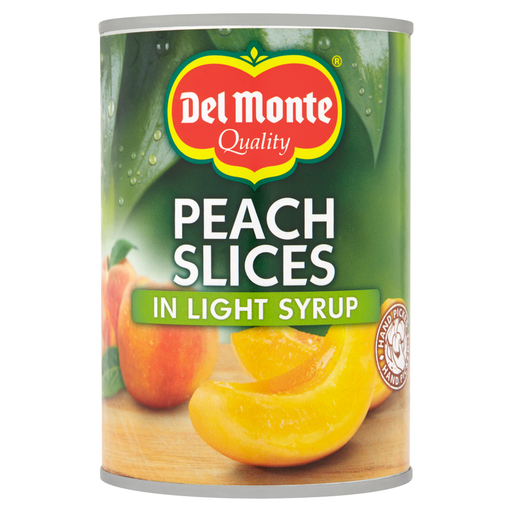
Choose this format if peach slices in light syrup suit the dessert you plan to serve. The tin is labelled 420g; compare its ingredients and per-100g sugars with a juice-packed alternative if sweetness is a deciding factor.
 No image available
These peach halves provide a single-fruit option in juice when halves suit your serving plan. The tin is labelled 415g; read its current warning information and inspect the fruit before serving.
 No image available
Consider fruit cocktail when a mixed-fruit dessert appeals more than serving one fruit. This juice-packed tin is labelled 415g; read the ingredients if the exact fruit mix matters, and compare drained weight when planning portions.
 No image available
These pineapple chunks suit a plan to spoon fruit into dessert bowls or mix it into a pudding. The tin is labelled 432g and packed with juice; check the drained weight for the usable fruit quantity and follow the pack’s after-opening directions.
Yes. The NHS says 80g of canned fruit or vegetables counts as one portion of 5 A Day and advises choosing canned fruit in natural juice or water with no added sugar or salt.
No: the packing liquids can have different ingredients and sugars figures. Princes lists sugar and 15.0g sugars per 100g for its fruit cocktail in light syrup, compared with 9.0g per 100g for its fruit cocktail with juice. Compare the exact tins rather than assuming those figures apply to other fruit.
Follow the instruction on the particular tin. Sainsbury’s peach slices specify transfer to a non-metallic container, refrigeration and use within one day; Del Monte pineapple chunks specify 3–4 days, while M&S grapefruit segments specify two days. There is no single period to apply to every product.
Use drained weight when you need to know how much fruit is available apart from the packing liquid. GOV.UK states that solid foods packed in liquid must show their drained net weight; the total can weight includes the liquid.
Yes, for some products. Sainsbury’s warns that stones may remain in its peach slices, and M&S says its grapefruit segments may contain pips. Check the warning on your chosen tin and inspect the fruit before serving, particularly to children.