For a reduced-sugar tinned-fruit purchase, choose fruit packed in juice rather than syrup, as Diabetes UK advises. Juice-packed fruit still contains carbohydrate and sugars, so compare the label’s per-100g figures with the amount you plan to eat; a stated serving may be less than a whole tin.
Who needs which checks?
Consumers who count carbohydrate
If you use carbohydrate information as part of your own meal plan, check the nutrition basis and serving size before deciding how much fruit to have. Diabetes UK advises spreading fruit intake through the day rather than eating a lot of carbohydrate at once.
Consumers avoiding syrup
If you keep tinned fruit for breakfasts or desserts but want to avoid syrup, check the packing liquid in the product description and ingredients. Diabetes UK advises choosing fruit in natural juice rather than syrup.
Consumers planning smaller portions
If you are unlikely to use a whole tin at once, compare its stated servings with the portion you want and check how the label says to store any leftovers.
What matters when choosing a tin?
Start with the packing liquid, then read the nutrition figures on the basis used by that tin and work out the portion you intend to eat.
| Concern |
What to check |
Who this matters to |
| Carbohydrate per portion |
Check carbohydrate and sugars per stated serving and per 100g, including whether the figures describe drained fruit or net contents. |
If I plan a portion around carbohydrate information, a per-100g figure alone does not tell me what is in my bowl. About 36% of consumers put portion-level carbohydrate planning first. |
| Packing liquid |
Check whether the fruit is in juice or syrup, including light syrup; read the ingredients for the exact tin. |
For a cupboard fruit I can use at breakfast or in dessert, I want to avoid syrup as my main priority. About 29% of consumers primarily look for that distinction. |
| Comparable labels |
Compare sugars and carbohydrate using the same measurement basis, and check the fruit type and ingredients. |
When two tins both say they contain juice, I still want to compare their actual labels rather than rely on the wording on the front. For about 21% of consumers, that label comparison is the primary need. |
| Portions and leftovers |
Check the serving count and the tin’s instructions for transferring, refrigerating and using leftovers. |
If I only need some of the tin today, I want a portion and storage plan that works for the rest. Leftover handling comes first for about 14% of consumers. |
Common mistakes to avoid
-
Assuming fruit in juice is sugar-free
Juice describes the packing liquid, not the absence of sugars or carbohydrate. For example, Princes lists 11.8g sugars and 11.8g carbohydrate per 100g for its Peach Slices with Juice.
Use the packing liquid to narrow the choice, then read the nutrition declaration for the exact tin and your planned portion.
-
Treating the whole tin as one serving
Serving sizes differ even between peach tins: Sainsbury's lists two servings in its 411g tin, while ASDA suggests three servings in its 411g tin. Their per-serving sugar figures therefore describe different amounts of fruit.
Decide how much you will serve before using a per-serving figure; check the label’s measurement basis when comparing tins.
-
Treating light syrup as juice
Diabetes UK advises avoiding fruit tinned in syrup, including light syrup, when choosing tinned fruit with sugar in mind.
Look for fruit explicitly packed in juice. If you are using fruit already packed in syrup, Diabetes UK suggests draining and washing it before use.
-
Using one storage deadline for every tin
Post-opening instructions vary by product. M&S says to transfer its Grapefruit Segments to a non-metallic container, refrigerate them and eat them within two days.
Read the instruction on your tin, transfer and refrigerate leftovers as directed, and choose a pack size you can use within its stated period.
Fruit left unused beyond the tin’s stated period may need to be discarded.
Relevant brands and product lines
Princes
Princes Peach Slices with Juice is a grape-juice-packed peach product listed in 410g and 220g sizes.
- Princes lists peaches, grape juice from concentrate, water, citric acid and ascorbic acid in the ingredients.
- Its label lists 11.8g sugars and 11.8g carbohydrate per 100g; check the amount you intend to serve.
Del Monte
Del Monte Fruit Cocktail in Juice 415g offers a mixed-fruit option packed in clarified pineapple juice from concentrate.
- The Tesco-listed product contains a five-fruit mix and lists 11g sugars per 100g of net content.
- Check the current tin’s ingredients and nutrition rather than applying this fruit cocktail’s figures to other Del Monte products.
Tesco
Tesco Peach Slices in Juice 410g are described as peach slices in pear juice from concentrate.
- The product description identifies juice rather than syrup as the packing liquid.
- Tesco advises reading the current label because food products can be reformulated.
Sainsbury's
Sainsbury's Peach Slices in Fruit Juice 411g are packed in refined grape juice.
- Sainsbury's lists 11g sugars and 11.2g carbohydrate per 100g, with two servings per tin.
- The listed half-tin serving contains 22.6g sugars, so check it against the portion you plan to eat.
Asda
ASDA Peach Slices in Fruit Juice 411g provide another juice-packed peach option.
- ASDA lists 10g sugars and 11g carbohydrate per 100g drained, and suggests three servings per tin.
- Its stated one-third-tin serving contains 8.5g sugars; keep the drained basis in mind when comparing labels.
M&S
M&S Grapefruit Segments 540g are packed in grapefruit juice for consumers who want grapefruit rather than peaches or mixed fruit.
- Marks & Spencer lists 7.3g sugars and 7.3g carbohydrate per 100g for this grapefruit product.
- Do not treat its figures as a like-for-like peach comparison. The product may contain pips, and Marks & Spencer says to eat it within two days of opening.
Juice-packed fruit on Joybuy
These tins offer pineapple, mixed fruit, peaches or pears packed in juice. Choose the fruit and pack size you want, then use the current label to assess your intended portion.
 No image available
Princes Pineapple Chunks With Juice 432g
For a pineapple option packed in juice, this tin gives a stated half-tin portion. The product information identifies pineapple and pineapple juice, lists carbohydrate and sugars per 100g and per half-tin serving, and states two servings per pack. Refrigerate leftovers and use them within two days of opening, as directed.
View on Joybuy
 No image available
Del Monte Fruit Cocktail in Juice 415g
For a mixed-fruit choice, this five-fruit cocktail is packed in clarified pineapple juice. It lists 11g carbohydrate and 11g sugars per 100g of net content, not per serving. Check the amount you intend to eat; the product instructions say to transfer leftovers to a non-metallic container, refrigerate them and use them within 3–4 days.
View on Joybuy
 No image available
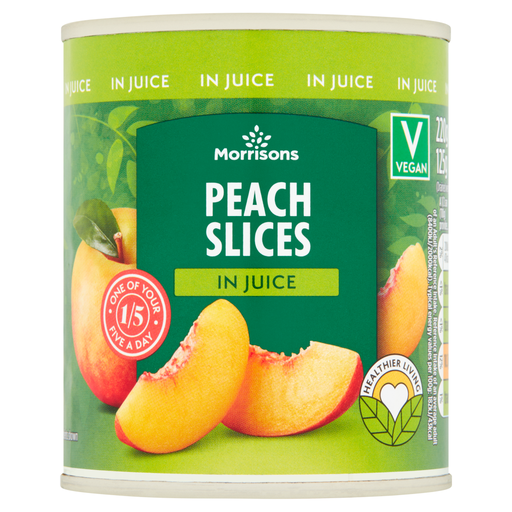
Morrisons Peach Slices In Juice 220g
For a smaller peach tin, the product information describes a 110g half-tin serving and lists peaches with clarified grape juice. Its carbohydrate and sugars figures are per 100g, so check the label’s measurement basis before applying them to that serving. Occasional stone fragments may remain; transfer leftovers to a non-metallic container, refrigerate and use within two days.
View on Joybuy
 No image available
Del Monte Peach Halves In Juice 415g
For peach halves rather than slices, this 415g tin is packed in clarified pineapple juice. Carbohydrate and sugars are listed per 100g; use the current label and the amount you serve to assess your portion. Refrigerate unused fruit after opening as directed on the product.
View on Joybuy
 No image available
Del Monte Pear Halves in Juice 415g
For pear halves packed in juice, this 415g tin lists pears and clarified pineapple juice. Its carbohydrate and sugars information is given per 100g rather than for your chosen portion, so read the current label when deciding how much to serve. Refrigerate unused fruit after opening as directed.
View on Joybuy
Frequently asked questions
Is fruit tinned in juice automatically suitable if I have diabetes?
No. Juice-packed fruit still contains carbohydrate and sugars. If you use carbohydrate information in your own eating plan, check the exact tin’s nutrition basis, stated serving and the portion you intend to eat.
Should I choose juice or light syrup?
Choose fruit in juice when avoiding syrup is your priority. Diabetes UK advises choosing tinned fruit in natural juice rather than syrup and specifically cautions that even light syrup contains a lot of sugar.
Does draining the packing liquid remove the need to check portions?
No. Draining the liquid does not remove the carbohydrate in the fruit itself. Check whether the tin’s nutrition figures describe drained fruit or net contents, then consider the amount of fruit you will serve.
How long can I keep fruit after opening the tin?
Follow the instruction on the particular tin rather than using one deadline for every product. For example, Marks & Spencer says to transfer its Grapefruit Segments to a non-metallic container, refrigerate them and eat them within two days of opening.


