Salt-first party planners
Parents and hosts who want to compare the salt declaration on tins before choosing fruit for children. The NHS publishes age-specific daily salt guidance, so the figure on a party food is worth reading in context.


Start with the salt figure per 100g on the exact tin, then check whether the fruit is packed in natural juice or water rather than choosing by a front-of-pack phrase alone. For a children’s party, the fruit cut and amount you will open matter too: a shared tin may suit a platter, while smaller formats can make portions and leftovers easier to manage.
Parents and hosts who want to compare the salt declaration on tins before choosing fruit for children. The NHS publishes age-specific daily salt guidance, so the figure on a party food is worth reading in context.
Hosts who want fruit packed in natural juice or water with no added sugar or salt, as advised by the NHS for canned fruit.
Hosts deciding between a shared tin and smaller formats according to guest numbers, serving method and how much fruit may remain after opening.
For party fruit, check the exact tin’s nutrition and ingredients first, then choose a cut and quantity that fit the way you will serve it.
| Concern | What to check | Who this matters to |
|---|---|---|
| Salt on the exact tin | Compare salt per 100g on the current label, using the same basis for each product. Bristol City Council describes 0.3g or less per 100g as low in salt. | If salt is my main concern, I need the figure for the tin I will actually serve, not a different pack or flavour. About 42% of consumers put that exact-product salt check first. |
| Packing liquid | Read the ingredients for natural juice, water or syrup; compare sugars per 100g if choosing between similar fruits. The NHS advises choosing canned fruit in natural juice or water with no added sugar or salt. | I would rather serve fruit packed in juice or water than choose a syrup-packed tin by habit. For about 33% of consumers, the packing liquid is the primary consideration. |
| Serving and leftovers | Check the fruit cut, pack size, drained weight where shown, and storage instructions after opening. | If guests will take individual portions, I need a cut I can serve conveniently without opening far more fruit than needed. Serving format and leftovers come first for about 25% of consumers. |
Packing liquid and salt are separate checks. NHS guidance favours canned fruit in natural juice or water with no added sugar or salt, but the salt figure still needs its own comparison.
Use the packing liquid as an initial filter, then read salt per 100g on the exact tin.
Sainsbury’s and Joybuy display different salt figures for Del Monte peach-slice listings. Do not transfer either figure to another pack or variant.
Check the current label of the tin you plan to serve before treating it as a lower-salt choice.
A shared tin may work for a platter, but storage instructions vary. M&S says its grapefruit segments should be transferred to a non-metallic container, refrigerated and eaten within two days of opening.
Choose an amount that fits the guest count and have a suitable container ready for any remainder.
Fruit left beyond the product’s stated storage period may have to be discarded.
Ingredients matter when guests need to check what is in a food. GOV.UK states that prepacked foods with two or more ingredients must list them and highlight allergens where present.
Keep each can or a clear photograph of its label available during the party.
M&S Food lists Eat Well Grapefruit Segments in a 540g tin, packed in grapefruit juice.
Princes lists Pineapple Slices in Juice in 227g and 432g formats.
Tesco Groceries lists juice-packed own-brand pineapple slices and mandarin segments, alongside other tinned-fruit formats.
Del Monte peach slices in juice are listed in UK grocery channels, including a 415g tin with 250g drained weight at Sainsbury’s.
These juice-packed tins offer mixed fruit, chunks, slices and halves for different ways of serving a party platter. Compare the current can labels for salt and ingredients before deciding which to serve.
 No image available
Consider this mixed-fruit tin for a shared party bowl. It contains 415g; check the current can’s salt figure and ingredients before serving, particularly as the product information gives conflicting colour descriptions.
 No image available
Consider pineapple chunks when you want a cut fruit format for a shared bowl or individual servings. This is the 432g juice-packed tin; check its own salt and ingredients label rather than using figures for Princes pineapple slices.
 No image available
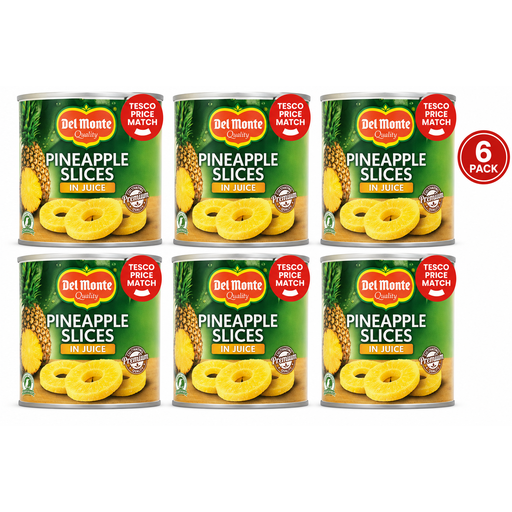
Consider this six-pack if you plan to open tins as needed for a larger gathering. Each tin is described as 435g; pineapple slices may need cutting for individual portions. Check the label on the cans for salt, ingredients and storage instructions.
 No image available
Consider peach halves for a platter if you can portion them to suit the serving plan. This 415g tin is packed in juice; compare its own salt declaration and follow its instructions for any fruit left after opening.
 No image available
Consider pear halves for a shared fruit dish when you can portion the fruit before serving. This is a 415g juice-packed tin; read its current salt and ingredients declarations and plan for any leftovers.
Compare salt per 100g on the exact tin. Bristol City Council describes 0.3g salt or less per 100g as low in salt; a different pack’s nutrition panel cannot confirm the figure for the one you buy.
Yes. The NHS says 80g of canned fruit counts as one portion and advises choosing fruit in natural juice or water with no added sugar or salt. Check the serving amount rather than assuming a whole tin is one portion.
Follow that product’s storage instructions. For example, M&S Food says its grapefruit segments should be transferred to a non-metallic container, refrigerated and eaten within two days; other tins may specify a different period.
Yes, keep the can or a clear photograph so guests can check the ingredients of the exact product served. GOV.UK states that prepacked foods with two or more ingredients must list them and highlight allergens where present.