Salt-conscious lunch packers
If reduced salt is your starting point, compare the declaration and ingredients on the exact pack. The NHS advises choosing canned fruit in natural juice or water with no added sugar or salt.


For an office packed lunch, start with tinned fruit in natural juice or water with no added sugar or salt, as the NHS advises, and check the salt figure on the exact pack rather than relying on a reduced-salt search term. If you cannot refrigerate leftovers, a smaller individual pot may be easier to manage, but check its packing liquid and ingredients: a fruit pot is not necessarily the same product as a tin.
If reduced salt is your starting point, compare the declaration and ingredients on the exact pack. The NHS advises choosing canned fruit in natural juice or water with no added sugar or salt.
If you cannot keep leftovers refrigerated, consider whether a single portion would be easier than opening a full tin. An opened tin needs a storage plan, even if you take only one serving to work.
If you pack fruit for several lunches, compare the fruit, cut and drained quantity of the exact product. Tesco and Sainsbury's list several fruit-in-juice formats, so the tin size alone need not decide which portion works for you.
For an office lunch, check the exact pack's salt and ingredients, then choose a portion you can carry and store appropriately.
| Concern | What to check | Who this matters to |
|---|---|---|
| Salt and ingredients | Compare salt per 100g and read the ingredients on the exact pack; check whether it is in natural juice or water. | If I am choosing fruit with no added salt for lunch, I need the actual label rather than a reduced-salt search result. About 42% of consumers put the salt declaration and ingredients first. |
| Portioning and storage | Check the drained quantity or individual pot size, and follow the product's instructions for opened leftovers. | Without a dependable office fridge, I would rather take a portion than open a tin I cannot finish. Roughly 33% of consumers make portioning and leftover handling their primary concern. |
| Fruit and packing liquid | Choose a cut that works for your lunch and compare juice, water and syrup using the ingredients and per-100g label. | For lunches packed regularly, I want a fruit format I will use and a packing liquid I have chosen deliberately. Around 25% of consumers put those product choices first. |
Princes lists 0.01g salt per 100g for its Fruit Cocktail with Juice, while Tesco lists 0.1g per 100g for Del Monte Fruit Cocktail in Juice. Packing liquid alone does not tell you the declared salt value.
Compare salt per 100g and the ingredients on the current pack of the fruit you intend to buy.
Princes lists 0.01g salt per 100g for both its Fruit Cocktail with Juice and Fruit Cocktail in Light Syrup. Its listed sugars differ: 9.0g and 15.0g per 100g respectively. That comparison applies to these named products, not every fruit tin.
Check the packing liquid and sugars alongside salt when comparing versions for a regular lunch.
Sainsbury's instructions for Del Monte Mandarins in Juice say to move unused fruit to a suitable non-metal container, cover and refrigerate it, then use it within 3–4 days. The Food Standards Agency also advises against storing food in an opened tin.
Take a portion in a leakproof container and refrigerate the remainder, or choose a smaller format if you cannot manage leftovers.
Princes offers Fruit Cocktail with Juice and Fruit Cocktail in Light Syrup.
Del Monte products in the supplied retailer listings include fruit cocktail in juice and mandarins in juice.
Tesco's own-label fruit-in-juice listings include apricot halves and mandarin segments.
Sainsbury's own-label listings include peach slices and mandarin segments in fruit juice.
These selections include larger fruit-in-juice tins to portion for lunch and a separate-pot option for taking one portion at a time. Check the current pack when salt, ingredients or drained quantity determine your choice.
 Image unavailable
Sliced pineapple in a 435g tin is an option if you plan to pack a serving and keep the rest. Check the drained quantity for your portion; after opening, transfer unused fruit to a suitable container, refrigerate it and follow the product's stated 3–4-day use period.
 Image unavailable
Pear halves in a 415g tin suit a lunch you can portion before leaving home. Check the drained quantity if serving size matters; transfer any unused fruit to a covered, suitable container, refrigerate it and follow the product's stated 3–4-day use period.
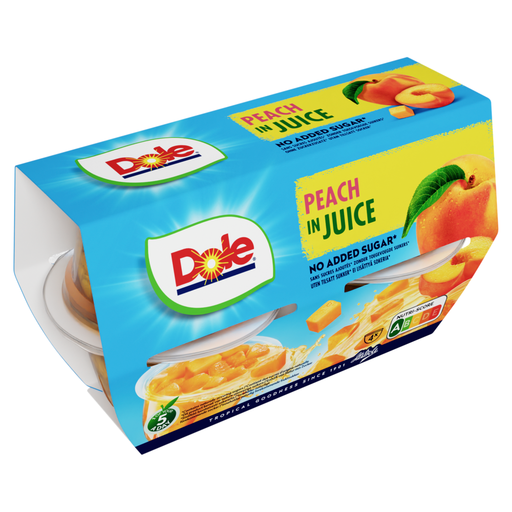 Image unavailable
Four separate 113g peach pots offer a way to take one portion without opening a full tin. This is a pot multipack, not tinned fruit; check its ingredients if you want to avoid added sweeteners. Refrigerate an opened pot and use it within the stated 2 days.
 Image unavailable
A 415g fruit-cocktail tin offers mixed fruit to portion across lunches. Tesco lists 0.1g salt per 100g for this named product; compare the current pack if salt is your priority. Transfer leftovers to a suitable covered container, refrigerate them and follow the stated 3–4-day use period.
 Image unavailable
Pineapple chunks in a 432g tin may suit lunches where you want pieces ready to portion. Check the salt declaration on this product's label rather than using the figure for Princes Fruit Cocktail. Refrigerate unused contents in a sealed container and follow the stated 2-day use period.
No. Check salt per 100g and the ingredients on the exact pack. The NHS advises choosing canned fruit in natural juice or water with no added sugar or salt, while named fruit-in-juice products can have different declared salt values.
Yes. The NHS includes canned fruit in its 5 A Day guidance and advises choosing it in natural juice or water with no added sugar or salt. Check the product's drained quantity when planning the fruit you will pack.
Move unused fruit to a suitable covered container and refrigerate it, following the exact product's use period. Sainsbury's listing for Del Monte Mandarins in Juice specifies a non-metal container and use within 3–4 days; the Food Standards Agency advises against storing food in an opened tin.
Read the nutrition information on the current pack and compare salt on the same per-100g basis. GOV.UK's food-label guidance says nutrition information is required on the back of food packaging; the ingredients list helps you check whether salt has been added.