Menu planners comparing salt declarations
When salt is a menu consideration, compare the figure per 100g on each product’s nutrition panel. Fruit type and juice packing alone do not establish its declared salt content.


For care home menus, compare the exact product’s declared salt per 100g, then check whether its fruit and format meet each resident’s assessed needs; “in juice” is not a salt declaration. Stone warnings, portions and instructions for opened packs can also change which product is practical to serve.
When salt is a menu consideration, compare the figure per 100g on each product’s nutrition panel. Fruit type and juice packing alone do not establish its declared salt content.
The Care Quality Commission’s guidance for regulated services in England requires nutritional needs to be assessed and food to meet those needs. A salt figure cannot replace checks against a resident’s eating requirements and preferences.
Pack size needs to fit the number of portions served and the product’s instructions after opening. Sainsbury’s, for example, instructs buyers to refrigerate unused peach slices in a non-metallic container and use them within two days.
Start with the resident’s assessed needs, then compare suitable products’ salt declarations and the way each pack will be served. Check whether nutrition figures refer to drained fruit when comparing labels.
| Concern | What to check | Who this matters to |
|---|---|---|
| Declared salt | Compare salt per 100g on the exact variant; note whether the figure is for drained fruit. | When salt is the deciding menu criterion, I need a label figure I can compare with other suitable fruit. About 33% of consumers put the lowest declared salt first. |
| Individual eating needs | Check the resident’s assessed needs and whether the fruit format, stones or pips affect serving it. | If a resident needs a particular fruit texture or has other dietary requirements, those needs determine what I can serve. Individual suitability comes first for about 42% of consumers. |
| Portions and opened-pack use | Match pack size to planned portions and follow its decanting, refrigeration and use-within instructions. | With only a few portions needed, I want to use an opened pack within its label timeframe rather than discard fruit. Handling and waste are the primary concern for about 25% of consumers. |
Juice describes the packing medium, not the salt declaration. ASDA lists less than 0.01g salt per 100g drained for its pear halves in juice, but 0.05g per 100g drained for its peach slices in juice.
Compare the exact products’ nutrition panels on the same basis when salt matters to the menu.
A lower declared salt figure does not establish that the fruit meets an individual resident’s eating needs. The Care Quality Commission’s guidance for regulated services in England puts assessment of nutritional needs at the centre of food provision.
Check the resident’s care plan and relevant dietary or swallowing instructions before choosing among suitable products.
Del Monte Prunes in Juice are described as containing stones, while Sainsbury’s warns that stones may remain in its peach slices. Halves, slices and chunks also need to be considered against an individual’s eating requirements.
Read the warning on the exact pack and check the appropriate serving format for the resident.
Post-opening instructions vary. Sainsbury’s Peach Slices in Fruit Juice 411g instructs users to transfer unused contents to a non-metallic container, refrigerate them and use them within two days.
Plan portions before opening and follow the timeframe printed on the product being served.
Fruit left over beyond its label timeframe may have to be discarded.
Its Peach Slices in Fruit Juice 411g provide a labelled option for comparing salt declarations.
Its pear halves and peach slices show why the exact fruit and label matter within one own-label range.
Prunes and pineapple offer different fruit formats, with separate salt declarations to check.
Pineapple Slices in Juice are an option to examine when the menu calls for pineapple slices specifically.
These pineapple, pear, mango and peach products offer different fruit formats and pack sizes to assess for care home menus. The peach product is labelled as a bottle rather than a tin; check each product’s nutrition panel and serving instructions before choosing it for a resident.
 Image unavailable
Consider this 435g pack when pineapple slices are wanted. Check its exact salt declaration and whether slices meet the resident’s serving requirements.
 Image unavailable
The 415g pear-halves format may suit a menu that calls for pears. Check the label’s salt figure and assess whether halves are an appropriate format for the resident.
 Image unavailable
Consider this 425g pack if the menu calls for sliced mango; it is packed in light syrup rather than juice. Check that the packing medium and fruit format suit the resident, and compare salt figures on the same stated basis.
 Image unavailable
This 432g pack offers pineapple chunks with juice rather than slices. Check whether chunks suit the resident and what the nutrition panel’s salt figure measures before comparing it with drained-fruit declarations.
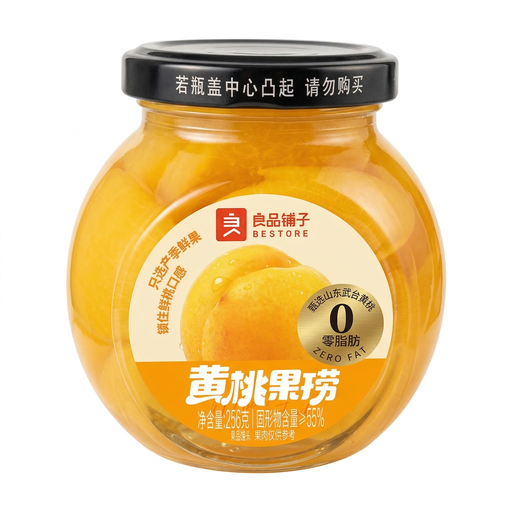 Image unavailable
This 256g bottled peach product is packed in syrup, so confirm that both the bottle format and packing medium fit the service plan. Check the nutrition panel and whether the peach pieces meet the resident’s eating needs.
No. “In juice” identifies the packing medium, not a salt claim. For example, ASDA declares less than 0.01g salt per 100g drained for its pear halves in juice and 0.05g per 100g drained for its peach slices in juice. Compare the exact labels.
No single salt figure establishes suitability for every resident. In England, the Care Quality Commission’s Regulation 14 guidance requires regulated providers to assess nutritional needs and provide food that meets them. Check the individual care plan, relevant eating instructions and preferences before selecting a product.
Follow that product’s label rather than applying one timeframe to all fruit. Sainsbury’s instructs users of its Peach Slices in Fruit Juice 411g to move unused contents to a non-metallic container, refrigerate them and use them within two days.
Do not apply an England-specific rule across the UK. The Care Quality Commission’s Regulation 14 guidance concerns regulated services in England; care homes elsewhere should check the requirements and food-safety procedures that apply in their location.