Hosts making a shared fruit dessert
If you are filling a bowl, topping a cake or assembling a trifle, the amount of drained fruit and its cut matter more than the tin’s total weight.


Choose by the amount of fruit you can serve, not just the weight on the front of the tin: compare drained weight where it is shown. A fruit cocktail suits a mixed bowl, while a single fruit can be easier to arrange in a dessert. Check the exact ingredients and packing liquid before serving, and follow the tin’s instructions for any leftovers.
If you are filling a bowl, topping a cake or assembling a trifle, the amount of drained fruit and its cut matter more than the tin’s total weight.
Match the fruit you can serve to expected attendance. Any unused fruit will need to be stored according to the opened tin’s instructions.
Compare the exact fruit, juice or syrup and other ingredients before making a shared dessert, especially when a guest has identified an allergy or intolerance.
For a book-club dessert, work out the fruit needed for the dish, then choose a cut and packing liquid that fit how you will serve it.
| Concern | What to check | Who this matters to |
|---|---|---|
| Usable fruit | Compare drained weights for the exact tins where shown; plan what you can serve rather than counting the packing liquid as fruit. | If I am filling a bowl for the group, I need enough fruit without opening more than we can use. About 31% of consumers would put usable quantity and leftovers first. |
| Fruit and cut | Choose a named fruit cocktail for variety or check whether slices, halves or chunks fit the dessert. | For a trifle layer, I may want regular pieces; for a communal bowl, I may prefer a mix. Roughly 25% of consumers would make fruit variety or presentation their primary concern. |
| Packing liquid | Check whether the exact variant is in juice or light syrup, then read its ingredients and nutrition panel. | When the surrounding liquid will go into the dessert, I want to choose it deliberately rather than assume juice and syrup are interchangeable. Around 25% of consumers would prioritise that ingredient choice. |
| Serving information | Keep the exact ingredients available for guests and check the tin’s instructions for opened fruit. | If guests need ingredient information, I want to check every part of the finished dish; I also need a plan for unused fruit. About 19% of consumers would put those serving checks first. |
Packing liquid is included in the total weight. Sainsbury’s lists its Del Monte Fruit Cocktail in Juice 415g tin as containing 250g of drained fruit; that figure should not be assumed for another listing or tin.
Use the drained weight on the exact product when planning a bowl or topping. If it is not shown, check the pack before relying on a particular serving quantity.
The packing liquid is only part of the ingredient choice. Fruit cocktail in juice and fruit in light syrup are distinct variants, so one product’s details do not describe the other.
Read the current ingredients and nutrition panel for the size and variant you intend to serve.
Sainsbury’s instructions for Del Monte Fruit Cocktail in Juice 415g specify transferring unused contents to a suitable non-metallic container, covering and refrigerating them, then using them within 3–4 days.
Follow the instructions on your exact tin. If fruit remains after book club, decant and refrigerate it as directed rather than storing it in the opened can.
The finished dessert may contain ingredients beyond the tin. GOV.UK guidance says required allergens in pre-packed food must be emphasised in its ingredients list.
Check the label for each ingredient used and keep that information available when serving the shared dish.
Consider its fruit-cocktail formats if a mixed bowl is the aim.
Its fruit-cocktail listings include different tin sizes for hosts considering how much to open.
Its own-label peach slices offer a single-fruit alternative to a cocktail.
Its own-label tinned fruit includes peach slices in fruit juice for a single-fruit dessert.
Grapefruit segments offer a more specific fruit choice than a peach or mixed-fruit tin.
These tins cover mixed fruit for a communal bowl and single-fruit slices, halves or chunks for arranging or adding to a dessert. Choose between juice and light syrup using the exact product label.
 No image available
Choose the slice format if the dessert calls for pieces of pineapple rather than assorted fruit. The 435g tin is packed in juice; check its drained weight for portion planning and its current ingredients before serving.
 No image available
Choose a cocktail when the shared dish benefits from several fruits in one tin. Joybuy’s product information names peaches, pears, pineapple, grapes and cherries in fruit juice from concentrate; check the current pack if a guest avoids any of these fruits, and use its drained weight for portions.
 No image available
Peach halves suit a dessert where you want to arrange or cut a single fruit yourself. This 415g variant is packed in juice; check the pack’s drained weight and opened-fruit instructions when planning for the group.
 No image available
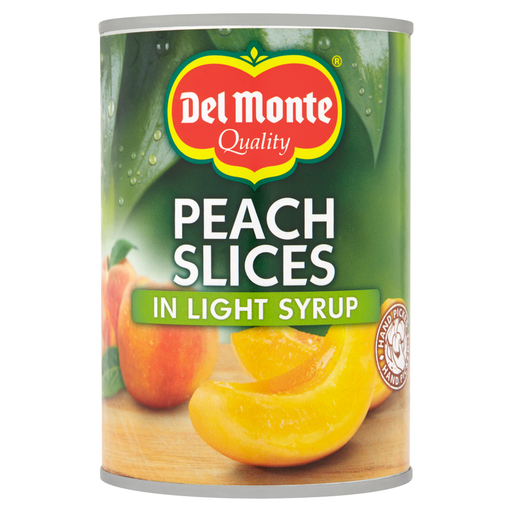
Use the sliced-peach format when regular pieces suit the dessert and light syrup suits the recipe. This 420g tin is not a juice-packed variant; compare its current ingredients and nutrition panel with the needs of the group.
 No image available
Pineapple chunks offer a single-fruit option for a bowl or dessert that does not need regular slices. The tin is 432g and packed with juice; check its drained weight on the pack before deciding how many tins to open.
Follow the instructions on the exact tin. For Del Monte Fruit Cocktail in Juice 415g, Sainsbury’s says to transfer unused fruit to a suitable non-metallic container, cover and refrigerate it, and use it within 3–4 days.
No. Choose the packing liquid for the dessert you are making, then compare the exact variants’ ingredients and nutrition panels rather than assuming their contents are equivalent.
Keep the ingredients information for the fruit and anything added to it available for guests. GOV.UK guidance says required allergens in pre-packed food must be emphasised in the ingredients list; check the exact labels when a guest has an allergy or intolerance.
The total tin weight alone cannot answer that: it includes packing liquid. Compare the drained weight of the exact tin with the amount your dish needs. Sainsbury’s lists 250g drained fruit for its Del Monte Fruit Cocktail in Juice 415g tin, but that figure does not apply to every similarly sized product.