Low-fat dessert hosts
You want fruit for a dinner-party dessert without judging the finished dish by the fruit alone. Compare the tin’s fat and sugars with your planned portion, then consider accompaniments such as cream or pastry.


Start with tinned fruit in natural juice or water if following NHS guidance, then check the fat and sugars on the particular tin and consider anything you will serve with it. Fruit cocktail suits a mixed dessert, while slices or halves give you recognisable pieces for individual plates. Plan quantities using drained weight where it is shown, and follow the tin’s instructions for leftovers.
You want fruit for a dinner-party dessert without judging the finished dish by the fruit alone. Compare the tin’s fat and sugars with your planned portion, then consider accompaniments such as cream or pastry.
You need fruit that works in a trifle, fruit salad or plated dessert. A mixed cocktail and a tin of consistent slices or halves serve different presentation needs.
You need enough fruit for guests without opening more tins than you can use. Drained weight, stated servings and the instructions for storing opened fruit help you plan.
For a dinner-party dessert, check the nutrition label, choose a fruit shape that fits how you will serve it, then work out how much usable fruit you need.
| Concern | What to check | Who this matters to |
|---|---|---|
| Fat and sugars | Check the packing liquid, then compare fat and sugars per 100g and for the portion you plan to serve. | If I want the fruit component to be low in fat, I still need to consider its sugars and the rest of the dessert. About 46% of consumers would put these label checks first. |
| Fruit format | Choose a mixed cocktail for a layered or mixed dish, or check for slices, chunks or halves when the shape matters. | For a plated dessert, I want pieces I can arrange consistently; for a trifle, a fruit mix may suit the recipe. About 36% of consumers would make presentation and recipe fit their main concern. |
| Usable quantity | Compare drained weight or stated servings, and read the exact tin’s post-opening storage instructions. | When serving several guests, I need enough fruit rather than just enough liquid-inclusive tin weight, with a plan for anything left over. About 18% of consumers would prioritise portions and leftovers. |
A low fat figure says little about sugars or ingredients served alongside the fruit. Tesco Groceries lists less than 0.1g fat but 27.7g sugars for its full 227g tin of pineapple slices in juice.
Check the portion you intend to serve and consider toppings and other dessert ingredients separately.
The liquid counts towards the tin’s weight. Sainsbury’s lists a 415g Del Monte fruit cocktail tin with 250g drained fruit; Tesco Groceries lists 136g drained fruit in its 227g pineapple-slices tin.
Use drained weight, when given, to work out how many tins your recipe needs.
If the usable fruit falls short, you may need to open another tin or change the planned portions.
A mixed cocktail can be convenient in a trifle, whereas slices and halves give you more control over individual plates.
Decide whether the dessert will be layered, mixed, self-serve or plated before selecting the format.
Opened-fruit instructions vary by product. Joybuy’s listing for Princes Pineapple Chunks with Juice, for example, says to transfer unused fruit to a sealed container, refrigerate it and consume it within two days.
Read the instructions on the tin you buy and plan when you will use any remaining fruit.
Princes lists fruit cocktail and single-fruit formats that could serve different dinner-party recipes.
Del Monte’s fruit cocktail in juice is an option when a mixed-fruit tin suits the dessert.
Tesco’s pineapple slices in juice offer a defined slice format for plating or garnish.
Sainsbury’s pear halves in juice provide a single-fruit shape for individual desserts.
These juice-packed fruit selections cover slices and halves for plating, chunks for mixed desserts, and fruit cocktail for a shared dish. Compare the label on the exact pack before deciding how it fits your recipe.
 No image available
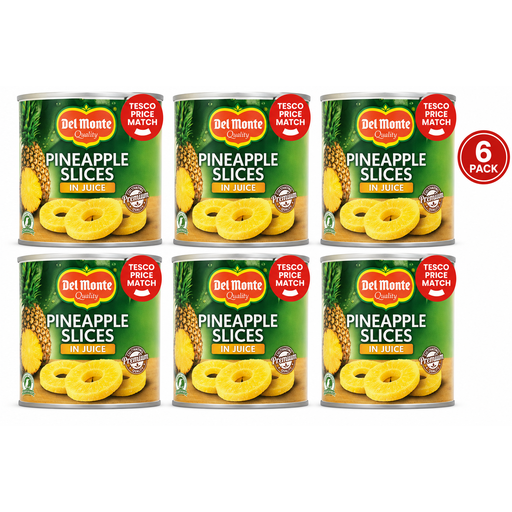
Consider the slice format if you want recognisable pineapple pieces on dessert plates. The pack contains six 435g tins; check the drained amount on the tins when planning portions.
 No image available
A single 435g tin is a way to choose the slice format without buying the six-pack. Use the drained amount and your planned serving size to decide how many tins to open.
 No image available
Peach halves provide a recognisable shape for a plated dessert. Check how many halves and how much drained fruit the 415g tin provides for your guest count.
 No image available
Chunks suit a fruit salad or another dessert in which the pieces will be mixed. Joybuy’s product information states two servings and says to refrigerate unused fruit in a sealed container and consume it within two days; check the drained amount for your recipe.
 No image available
Choose a mixed-fruit format if you are assembling a shared dessert or fruit salad. Check the ingredient list for the fruits you want and the drained amount needed for your servings.
Not by itself: the finished dessert also depends on its portion size and other ingredients, such as cream, custard or pastry. Check fat and saturates on the exact tin, then consider the full recipe. Tesco Groceries also lists 27.7g sugars for its full 227g tin of pineapple slices in juice, showing why fat is not the only label figure to read.
For the fruit choice described in its 5 A Day guidance, the NHS recommends canned fruit in natural juice or water with no added sugar or salt. If a recipe calls for syrup’s sweetness, check the packing liquid and nutrition label rather than treating the two formats as interchangeable.
The NHS states that 80g of fresh, canned or frozen fruit and vegetables counts as one portion of 5 A Day. For dinner-party planning, check the drained amount as well as the portion you intend to put in each dish.
Follow that product’s storage instructions. Joybuy’s Princes Pineapple Chunks with Juice listing says to transfer unused fruit to a sealed container, refrigerate it and consume it within two days; the instructions for another tin may differ.