Salt-label-first snack shoppers
If salt is your priority, compare the value per 100g on the exact tin. NHS food-label guidance places the low-salt threshold at 0.3g or less per 100g.


Start with the salt value per 100g: NHS food-label guidance describes 0.3g or less per 100g as low salt. If you also want to avoid added sugar, NHS advice favours canned fruit in natural juice or water with no added sugar or salt; juice on the front of a tin does not replace checking its nutrition panel. Choose the pack size around how much your movie-night group will eat and follow that product’s instructions for leftovers.
If salt is your priority, compare the value per 100g on the exact tin. NHS food-label guidance places the low-salt threshold at 0.3g or less per 100g.
If the packing liquid matters as well as salt, look for natural juice or water with no added sugar or salt, as advised by the NHS for canned fruit. Check the ingredients of the variety you choose.
If only a few people will share the fruit, choose a pack size you can use comfortably. Read its post-opening directions before relying on leftovers for another day.
For movie night, check the labelled salt value before deciding between juice and syrup; then match the quantity to the people eating it.
| Concern | What to check | Who this matters to |
|---|---|---|
| Salt level | Compare salt per 100g on the exact pack with the NHS low-salt threshold of 0.3g or less per 100g. | If salt is my priority, I want a labelled value I can compare rather than relying on the words on the front of the tin. About 42% of consumers put confirming the salt level first. |
| Packing liquid | Read whether the fruit is in juice, water or syrup, and check the ingredients for added sugar or salt. | For a fruit snack instead of a syrup-led dessert, I would choose the packing liquid deliberately. About 33% of consumers put that choice first. |
| Pack size and leftovers | Check the pack quantity and its instructions for storage and use after opening. | When only a few of us are watching, I do not want to open more fruit than we can use within the stated storage period. Avoiding leftovers comes first for about 25% of consumers. |
The packing liquid and salt value are separate checks. Princes lists 0.05g salt per 100g for its Pineapple Chunks in Juice; that figure comes from the product nutrition information, not the word “juice”.
Read salt per 100g on the exact pack and use the NHS threshold of 0.3g or less per 100g when looking for a low-salt option.
Fruit of a similar type can be sold in juice or light syrup. NHS advice for canned fruit favours natural juice or water with no added sugar or salt.
Choose the packing liquid to suit what you want to serve, and check the ingredients and salt value whichever format you prefer.
Post-opening directions differ. Marks & Spencer says to refrigerate its Grapefruit Segments and eat them within two days, while the Dole pineapple jar listed by Asda specifies five days after opening.
Choose a quantity your group is likely to eat and follow the storage instructions on the product you open.
Fruit left unused beyond its stated storage period may be wasted.
Princes Pineapple Chunks in Juice is a specific option to compare when you want pineapple for sharing.
Grapefruit Segments offer a sharper-tasting alternative to peach or pineapple for movie night.
Del Monte appears in tinned-fruit ranges with products packed in juice as well as light syrup.
Its own-brand tinned-fruit range includes juice-packed and light-syrup choices.
Tesco lists own-brand peach slices in both juice and light syrup.
These juice-packed Del Monte tins offer pineapple, mixed fruit, peaches and pears for a movie-night snack. Compare the current salt value on each pack before choosing.
 No image available
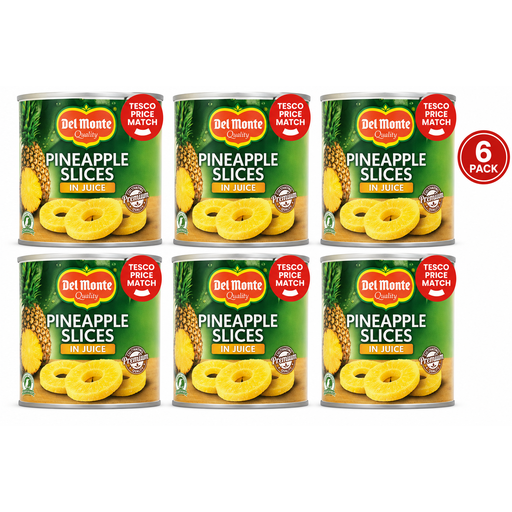
The six-pack is a format to consider when several people will share pineapple or you want unopened tins for later. Each tin is labelled 435g; check the current nutrition panel and plan how you will use any opened fruit.
 No image available
Choose the single 435g tin if pineapple slices suit your serving plans better than a multipack. Check salt per 100g on the current label and follow the pack’s directions for leftovers.
 No image available
For guests who would rather have mixed fruit than one variety, this is a 415g fruit cocktail in juice. Check the current ingredients if the particular fruit mix matters to you, as well as the salt value per 100g.
 No image available
If you prefer peach halves for serving, this tin contains 415g of fruit in juice. Compare its current salt value per 100g and check the storage directions if you expect leftovers.
 No image available
For a pear option rather than pineapple or peach, this is a 415g tin of halves in juice. Read the current salt figure on the pack and choose the quantity with your serving plans in mind.
Compare salt per 100g: NHS food-label guidance defines low salt as 0.3g or less per 100g. Use the figure for the exact product and pack you intend to buy.
If avoiding added sugar is part of your decision, follow NHS advice to look for canned fruit in natural juice or water with no added sugar or salt. You can choose syrup for a sweeter dessert-style serving, but check its ingredients and salt value rather than assuming either liquid determines the salt level.
Follow the directions on the exact product. Marks & Spencer instructs shoppers to transfer its Grapefruit Segments to a non-metallic container, refrigerate them and eat them within two days; the Dole pineapple jar listed by Asda specifies use within five days after opening.