Everyday juice-first shoppers
New parents looking for cupboard fruit for household breakfasts or snacks who want to follow NHS advice to choose tinned fruit in natural juice or water with no added sugar or salt.


For everyday household use, start with fruit tinned in natural juice or water with no added sugar or salt, in line with NHS guidance. Then compare the drained weight with the amount your household is likely to finish after opening. A larger tin is not necessarily a better fit if fruit will be left unused, while syrup-packed fruit does not meet that NHS selection advice.
New parents looking for cupboard fruit for household breakfasts or snacks who want to follow NHS advice to choose tinned fruit in natural juice or water with no added sugar or salt.
Shoppers comparing how much usable fruit different tins and packs contain, rather than judging a pack by its total weight alone.
Parents who use fruit over several occasions and need a pack size that fits the product's instructions for storage after opening.
For a new-parent household buying cupboard fruit, decide on the packing liquid, then check usable quantity and the instructions for leftovers.
| Concern | What to check | Who this matters to |
|---|---|---|
| Packing liquid | Check for natural juice or water, and read the ingredients for added sugar or salt. The NHS recommends this choice for tinned fruit. | If fruit is going into regular household breakfasts or snacks, I want its packing liquid to match that NHS advice; about 36% of consumers put this need first. |
| Usable fruit | Compare drained weights where stated, especially when pack sizes or fruit forms differ. | When choosing between tins for the household cupboard, I want to know how much fruit each contains once drained. This is the primary concern for about 29% of consumers. |
| Pack fit after opening | Check the likely amount used at one sitting and the label's refrigeration and open-life instructions. | If I serve fruit only occasionally, I need a pack I can finish within its stated open life; roughly 21% of consumers prioritise avoiding unused leftovers. |
| Fruit and preparation | Choose the fruit and form—such as slices, chunks or halves—that suit the intended meal. | For a particular breakfast, recipe or dessert, I need the right fruit form rather than just any tin. Around 14% of consumers make that their main consideration. |
Part of the stated weight is packing liquid, so tins of similar size can contain different amounts of drained fruit.
Compare drained weights when they are stated, then consider whether the household will use the contents after opening.
The packing liquid matters if you are following NHS advice to choose tinned fruit in natural juice or water with no added sugar or salt.
Read the packing-liquid description and ingredients rather than relying on the fruit name.
Opened-storage instructions vary by product. Food Standards Scotland advises checking the label; M&S, for example, instructs shoppers to refrigerate its grapefruit segments and eat them within two days of opening.
Choose a size that fits likely use, and follow the instructions on the tin you buy.
A retailer's online category can show products that are not available for a particular store or delivery location.
Check the selected store or delivery location before planning a shop around a specific tin.
A branded range to consider when comparing fruit type and packing liquid with retailer own-label tins.
A branded option for shoppers choosing pineapple in a cupboard tin.
An own-label range with fruit and packing-liquid options that can be compared within one retailer.
An own-label range in which the packing liquid deserves attention when choosing between tins.
A retailer option to check when comparing peach slices in fruit juice.
A range to consider when a particular fruit type or local Foodhall option matters.
These options cover pineapple and peaches in juice, including single tins, a six-pack and a smaller peach tin. Choose the fruit form and pack size for your household use, and check each product's label for drained weight and opened-storage directions.
 No image available
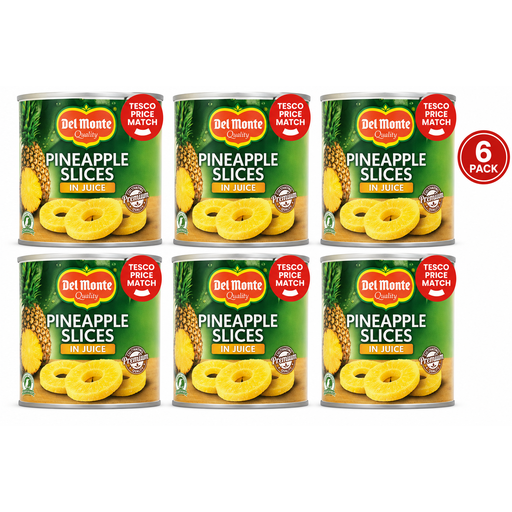
For a household that uses pineapple slices on separate occasions, this bundle contains six 435g tins. Check the drained weight and storage directions on the individual tins to judge how the pack fits your use.
 No image available
This single 435g tin suits a household choosing pineapple slices without a multi-tin bundle. Check its drained weight and instructions for any fruit left after opening.
 No image available
Choose this 415g tin if peach halves, rather than slices or pineapple, fit the intended household meal. Compare drained weight when considering another peach tin, and follow the label after opening.
 No image available
The chunk format makes this 432g tin an option when pieces suit the intended snack or recipe. Check the drained weight before comparing its usable fruit quantity with other pineapple tins.
 No image available
This 220g peach-slices tin is a smaller pack to consider when a larger opened tin might leave unused fruit. Check its stated drained weight and the label's storage and serving information before use.
Yes. The NHS states that 80g of fresh, canned or frozen fruit and vegetables counts as one portion. For tinned fruit, it advises choosing products in natural juice or water with no added sugar or salt.
If you want to follow NHS selection advice, choose fruit in natural juice or water with no added sugar or salt. Read the ingredients on the particular tin rather than assuming that all juice-packed or syrup-packed products have the same composition.
Follow the instructions on the particular product. Food Standards Scotland advises checking whether the label requires refrigeration and specifies an open life. For its grapefruit segments, M&S instructs shoppers to transfer leftovers to a non-metallic container, refrigerate them and eat them within two days.
Check the ingredients to identify the packing liquid, the stated drained weight to assess usable fruit, and the storage instructions for what remains after opening. Food Standards Scotland advises following product-specific label directions for opened food.