Hosts avoiding added sweetening
If you are putting together a shared fruit dessert, topping or snack, a no-added-sugar label may help you narrow the choice. You still need the nutrition panel to compare total sugars.


For festival food, check the exact packing medium, ingredients and sugars per 100g rather than assuming fruit in juice is low in sugar. A no-added-sugar label helps identify a product without added sweetening, but fruit and juice still contain sugars. Choose a pack size and fruit cut for the planned servings, and check how any leftovers must be stored.
If you are putting together a shared fruit dessert, topping or snack, a no-added-sugar label may help you narrow the choice. You still need the nutrition panel to compare total sugars.
If attendance or refrigeration is uncertain, match the pack to what you expect to serve. Food Standards Scotland advises checking the label for storage instructions after opening.
If you need enough fruit for several servings, check the drained weight where it is stated. The net weight also includes the packing liquid.
Decide whether avoiding added sweetening, serving convenience, usable fruit quantity or managing leftovers is your main concern. Then compare the exact variants that meet it.
| Concern | What to check | Who this matters to |
|---|---|---|
| Added sweetening and total sugars | Check the no-added-sugar claim or ingredients, then compare sugars per 100g on the nutrition panels of the exact variants. | I want fruit for a shared dessert without added sweetening, but I also need to know its total sugars. About 33% of consumers put that distinction first. |
| Serving format | Check whether the fruit is in slices, halves, chunks or segments, and whether the pack fits the planned servings. | For a topping or fruit salad, I want pieces I can serve with little preparation. Serving format is the primary concern for about 25% of consumers. |
| Usable fruit quantity | Compare drained weights where stated, as well as net pack weights. | When several people will share the fruit, I need to know how much remains after the liquid is drained. About 25% of consumers make usable quantity their main concern. |
| Opened-pack storage | Read the specific refrigeration and consume-within instructions before choosing a pack likely to leave leftovers. | If some fruit will remain after serving, I need a way to store and use it as the label directs. For about 17% of consumers, that is the first consideration. |
The claim concerns added sweetening; fruit and juice can still contribute sugars. It is not a statement that the product has no total sugars.
Use the claim to identify the type of recipe you want, then compare the “of which sugars” figures per 100g.
A shared tin can be convenient during serving, but any remaining fruit must be handled according to that product's opened-pack instructions.
Check the label and whether refrigeration will be available; otherwise, choose a pack closer to the amount you plan to serve.
Del Monte lists prepared pear variants in juice, light syrup and syrup. A familiar fruit name alone does not identify the recipe.
Read the full variant name and ingredients when selecting fruit for a dessert, topping or snack.
Princes lists juice-packed peaches and pineapple in different sizes, offering fruit cuts to consider for shared servings or recipes.
Del Monte offers prepared fruit in different packing media, so the exact variant matters as much as the fruit type.
Tesco lists own-label tinned fruit in juice alongside products with other packing media.
Sainsbury's lists own-label fruit in juice as well as branded tinned fruit.
These juice-packed fruit products offer different cuts and pack sizes for festival desserts, toppings and fruit salads. Check each pack's ingredients, nutrition panel and opened-pack instructions against your plans.
 Image unavailable
Consider the chunk format if you plan to spoon pineapple over a shared dessert or into a fruit salad. The pack is 432g and described as packed with juice; check its nutrition panel and opened-pack instructions for your serving plan.
 Image unavailable
The sliced format may fit a dessert that calls for whole pineapple slices rather than chunks. This is a 435g juice-packed product; compare the exact pack's sugars per 100g if total sugars matter to your choice.
 Image unavailable
Peach halves offer larger pieces for a plated dessert or a topping you intend to cut yourself. This juice-packed variant is 415g; check the pack if your recipe requires a particular drained quantity.
 Image unavailable
Choose the pear-halves format if your planned dessert calls for larger pear pieces. Del Monte lists this 415g variant in juice; check that you are selecting the juice version rather than one of its syrup alternatives.
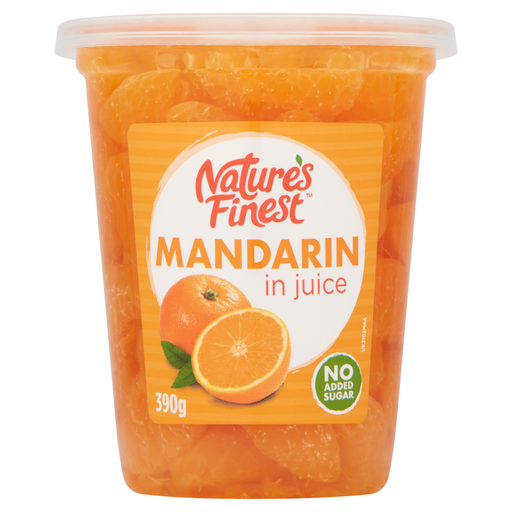 Image unavailable
Mandarin segments can be served in a fruit salad without cutting larger pieces. This 390g product is described as being in juice; check the exact pack for any no-added-sugar claim and its total sugars per 100g.
No. The food-claim wording published on legislation.gov.uk concerns added sugars and ingredients used for sweetening, not sugars naturally present in fruit or juice. Read the nutrition panel for the product's total sugars per 100g.
No. For example, Princes lists 11.8g sugars per 100g for its peach slices with juice and 12.2g per 100g for its pineapple slices in juice. Check the figures for the specific fruit and variant you intend to serve.
Follow the opened-pack storage and consume-within instructions for that product. Food Standards Scotland advises checking the label to establish whether refrigeration is needed after opening, so consider those instructions before choosing a pack that may leave leftovers.
No. GOV.UK explains that a best-before date concerns quality, while a use-by date concerns safety. Check the date mark and storage directions on the particular pack rather than treating the two date types as interchangeable.