Hosts avoiding added sweetening
If you are serving fruit with coffee and would rather avoid syrup, the packing liquid is a useful starting point. Check the exact tin: retailer ranges include fruit in juice as well as syrup and light syrup.


For coffee with friends, start with fruit in juice or an explicitly no-added-sugar product if avoiding syrup is your priority; a syrup-packed tin makes more sense only if you want its sweetened liquid. Neither juice-packed fruit nor a no-added-sugar claim means sugar-free, so check the exact ingredients and nutrition panel. Use drained weight and the post-opening instructions to decide how much to serve.
If you are serving fruit with coffee and would rather avoid syrup, the packing liquid is a useful starting point. Check the exact tin: retailer ranges include fruit in juice as well as syrup and light syrup.
If several friends will share the fruit, compare the amount of fruit you can serve with the amount you are likely to keep afterwards. A drained weight, where given, is more useful for planning portions than total pack weight alone.
If you want to understand a no-added-sugar claim, read it alongside the ingredients and nutrition declaration. Fruit in juice can still show sugars on the per-100g panel.
For fruit served with coffee, decide whether avoiding syrup, planning portions or comparing labels will drive your choice; then check that detail on the exact product.
| Concern | What to check | Who this matters to |
|---|---|---|
| Packing liquid | Look for juice, syrup or light syrup in the product name and ingredients. Check any no-added-sugar wording on the exact pack. | If I want fruit alongside coffee without serving syrup, the liquid matters more to me than the fruit variety; about 50% of consumers put avoiding syrup and added sweetening first. |
| Servable quantity | Compare drained weight where supplied, then read the post-opening storage instruction before choosing a large container or smaller pots. | When several friends are coming over, I want enough fruit to share without opening more than we can use; roughly 30% of consumers make portion planning and leftovers their primary concern. |
| Nutrition wording | Read the ingredients and compare sugars and carbohydrate per 100g on the nutrition panels of the products you are considering. | A no-added-sugar label does not tell me the total sugars in the fruit I am serving. For about 20% of consumers, understanding the figures on the exact pack comes first. |
The wording does not mean that the fruit contains no sugars. For instance, the Sainsbury's listing for Nature's Finest Mandarin in Juice pairs a no-added-sugar statement with a sugars figure on its nutrition panel.
Read the ingredients and compare nutrition figures per 100g rather than relying on the front-of-pack wording alone.
Retailer ranges contain both juice-packed and syrup-packed fruit. NHS guidance includes sugars in syrups among free sugars, so the packing liquid matters when avoiding syrup is the aim.
Check whether the exact peaches, pears or other fruit you are buying are packed in juice, light syrup or syrup.
Total pack weight can include a substantial amount of liquid. A Sainsbury's listing, for example, gives a separate 250g drained weight for a 415g Del Monte peach tin.
Use drained weight where it is supplied to plan portions for your guests.
Opening more containers than the gathering will use can leave fruit to store or discard.
A shareable container still needs a plan for what remains. The listed 700g Nature's Finest Mandarin in Juice product instructs shoppers to refrigerate it after opening and consume it within five days; instructions for another product may differ.
Read your pack's storage directions before opening it, particularly if only a few guests will have fruit.
Del Monte lists juice-packed fruit as well as syrup variants, so its name alone does not identify the packing liquid.
Princes lists pineapple chunks and slices in juice within its pineapple range.
Tesco's tinned-fruit range includes different packing liquids and formats, including small fruit pots.
Sainsbury's lists own-label fruit in juice alongside products from other brands.
M&S lists tinned fruit such as grapefruit segments and rhubarb chunks for store-cupboard use.
These products are fruit-in-juice formats to consider for coffee with friends, from a shareable tin to individual pots. Compare the current labels if no added sugar or the exact sugars figure is important to your choice.
 No image available
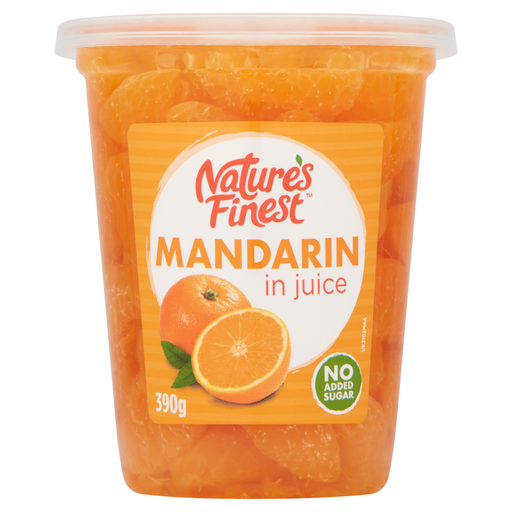
A 390g mandarin-in-juice format to consider when you want to put out one container for a small gathering. Check the current pack for its ingredients, nutrition and instructions for any fruit left after opening.
 No image available
Choose this 435g pineapple-slice tin if you want fruit in juice for guests to share. For portion planning, check the drained weight on the pack rather than treating the full tin weight as fruit.
 No image available
This 415g fruit cocktail offers a mixed-fruit option in juice for the table. If you need to work out servings, check the drained weight on the tin; also read its ingredients rather than assuming “in juice” means no added sugar.
 No image available
A 415g peach-halves tin is an option if you prefer peaches to a mixed-fruit serving. Check its drained weight to judge how much peach you can put out, and follow the current pack's directions for leftovers.
 No image available
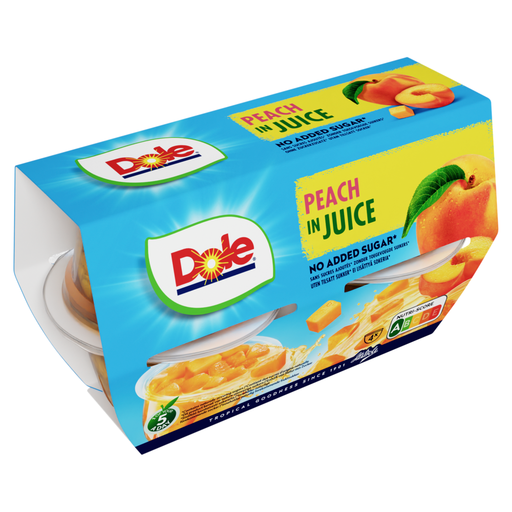
Four individual 113g pots may suit a gathering where you want to open portions separately. If avoiding added sweeteners matters as well as avoiding syrup, read the ingredients on this variant before choosing it.
No. Fruit can still have sugars declared on its nutrition panel: Sainsbury's lists Nature's Finest Mandarin in Juice with a no-added-sugar statement and 12.8g sugars per 100g. Read the ingredients and nutrition declaration if the distinction matters to your choice.
Choose fruit in juice if your aim is to avoid syrup when serving coffee guests. NHS guidance counts sugars in syrups among free sugars, but fruit in juice is not sugar-free; compare the exact products' ingredients and per-100g nutrition rather than assuming every juice-packed tin is the same.
Start with the number of guests and the drained weight, where it is stated, because total pack weight includes liquid. Then choose between a container to share and smaller portions according to how much you expect to serve and whether you can use any leftovers.
Follow the storage instruction on the exact pack. The Sainsbury's listing for the 700g Nature's Finest Mandarin in Juice product says to refrigerate it after opening and consume it within five days; do not apply that period to a different tin or pot without checking.