Canteen buyers planning usable fruit yield
If you serve fruit across repeated lunches, the drained weight helps you plan portions without counting the packing liquid as fruit.


For workplace canteen lunches, choose tinned fruit by the amount of fruit you can serve, the packing liquid and whether you can use the tin after opening—not by its total weight alone. For routine fruit servings, the NHS advises choosing fruit in natural juice or water with no added sugar or salt; a smaller tin may suit a service with variable demand even when a larger one provides more fruit.
If you serve fruit across repeated lunches, the drained weight helps you plan portions without counting the packing liquid as fruit.
If tinned fruit is a regular menu option, check the exact ingredients to distinguish natural juice or water from syrup and to see whether sugar has been added. This follows the NHS guidance on choosing tinned fruit.
If demand changes from one lunch service to the next, a tin you can finish may be more practical than a larger format that leaves opened fruit to store.
For workplace lunch service, establish the usable fruit quantity first, then check the ingredients and whether the pack size fits expected portions.
| Concern | What to check | Who this matters to |
|---|---|---|
| Usable fruit yield | Check the exact tin’s drained weight, where stated, and plan portions from the fruit rather than the total tin weight. | When I need enough fruit for repeated lunch servings, packing liquid cannot count towards the portions I serve. About 42% of consumers put usable fruit yield first. |
| Packing liquid | Read the ingredients for the exact tin; check whether it contains natural juice, water or syrup and whether sugar has been added. | If fruit is a routine lunch option, I want to know what it is packed in before adding it to the menu. About 33% of consumers make the packing liquid their primary concern. |
| Opened-tin planning | Match pack size to expected portions and follow the product’s after-opening instructions; keep its current ingredient and allergen information available. | With variable demand, I need to manage leftovers and answer customers’ ingredient questions accurately. About 25% of consumers prioritise these service needs. |
The weight on the front includes packing liquid, so two similarly sized tins need not provide the same amount of fruit to serve.
Check the drained weight for each exact product and plan portions from that figure where it is available.
The NHS advises choosing tinned fruit in natural juice or water with no added sugar or salt. A description on the front of a tin is not a substitute for its ingredients list.
For routine fruit servings, inspect the current label before choosing a packing liquid; a syrup-packed tin may instead be chosen for a particular dessert recipe.
An unfinished tin needs product-specific handling. Marks & Spencer instructs buyers of its grapefruit segments to transfer leftovers to a non-metallic container, refrigerate them and eat them within two days; that instruction is not a rule for every tin.
Match tin size to expected servings and follow the after-opening directions on the product you use.
Leftovers also take up refrigerated storage space until they are served or discarded.
For food businesses, GOV.UK requires allergen information for prepacked and non-prepacked food and drink; Food Standards Scotland sets out the corresponding requirement in Scotland. How the fruit or a prepared dish is presented affects what information staff need to provide.
Keep the current product label and any recipe information accessible, and make allergen information available for the food as served.
A branded option to consider when the menu calls for fruit cocktail or other tinned fruit in juice.
A branded range with fruit cocktail and single-fruit formats listed by Tesco Groceries.
An own-label option for canteens selecting a particular fruit or presentation.
A reference point when a menu calls for one of its listed tinned-fruit formats, including grapefruit segments.
These tins offer single-fruit and mixed-fruit options in juice, including a smaller 220g format for canteens planning fewer portions. Compare the current label, drained weight and after-opening directions for the exact tin before ordering for lunch service.
 Image unavailable
Consider the sliced format when a lunch menu calls for pineapple rather than mixed fruit. The tin is labelled 435g; check its drained weight when planning portions, and follow its after-opening directions for any remainder.
 Image unavailable
The peach-half format suits a menu that calls for pieces of a single fruit. This 415g tin is labelled as fruit in juice; use its drained weight, rather than the total tin weight, to plan servings.
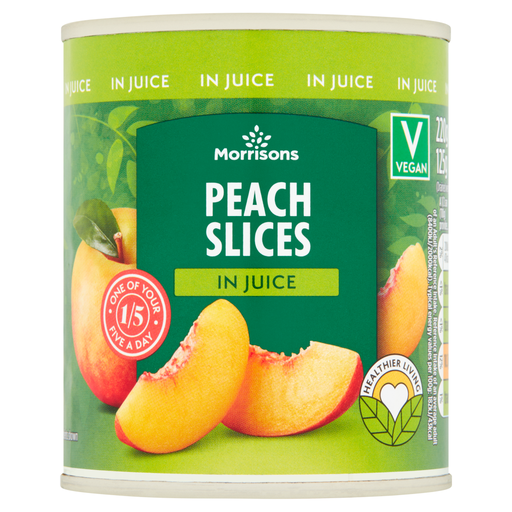 Image unavailable
A 220g tin is worth considering when lunch demand is variable and a smaller opened pack is easier to use. The product is peach slices in juice; confirm its drained weight and follow the exact label’s storage directions.
 Image unavailable
Choose a fruit cocktail format when the lunch menu needs mixed fruit rather than one fruit type. This tin is labelled 415g and packed in juice; check the current ingredients and drained weight for portion planning.
 Image unavailable
Pear halves provide another single-fruit presentation for a planned lunch menu. The tin is labelled 415g and packed in juice; check its drained weight and after-opening directions for the exact product.
No. The total weight includes packing liquid, so use the exact product’s drained weight where stated and plan portions around the fruit available to serve.
For routine fruit servings, the NHS advises choosing tinned fruit in natural juice or water with no added sugar or salt. Check the exact ingredients rather than assuming that every product described as being in juice has the same formulation.
Follow that product’s storage instructions. Marks & Spencer, for example, instructs buyers of its grapefruit segments to transfer leftovers to a non-metallic container, refrigerate them and eat them within two days; do not apply that product-specific limit to other tins.
A food business must provide allergen information for prepacked and non-prepacked food and drink, according to GOV.UK and Food Standards Scotland. Keep the current tin label and any recipe information available so staff can give information for the fruit or prepared dish as actually served.