For a roast-dinner dessert or recipe, choose the fruit and packing liquid that suit the dish, then compare salt on the exact tin’s nutrition label. Fruit in juice is not, by itself, a confirmed reduced-salt choice; check the figures per 100g and per serving, and consider salt in the rest of the meal separately.
Who is this for?
Salt-conscious roast-dinner planners
If salt across the meal matters to you, compare the fruit tin’s stated salt with the labels on the other ingredients. The NHS advises adults to have no more than 6g of salt a day, including salt already in food and salt added during cooking.
Juice-versus-syrup dessert shoppers
If the fruit is going into a dessert or recipe, the packing liquid matters alongside the fruit itself. Sainsbury's listings for Del Monte fruit cocktail show different ingredients and carbohydrate figures for the juice and light-syrup variants.
Households planning for leftovers
If one recipe will use only part of a tin, check its drained weight and after-opening instructions before choosing a pack size. Storage periods differ between the Tesco and Sainsbury's peach tins and the Del Monte prunes listing.
What matters when choosing?
Start with the dish: fruit type and packing liquid determine whether a tin fits the recipe. Then compare the exact product’s salt declaration and the amount you are likely to use.
| Concern |
What to check |
Who this matters to |
| Stated salt |
Compare salt per 100g and per serving on the exact tin; do not treat “in juice” as a reduced-salt claim. |
If I am watching salt across a roast dinner, I need a figure I can compare rather than relying on the packing liquid. About 37% of consumers put that label check first. |
| Recipe fit |
Check the fruit, packing liquid and ingredients; compare drained weight if the recipe specifies an amount of fruit. |
For a planned dessert, I want the fruit and liquid to suit what I am making. That is the primary concern for about 36% of consumers. |
| Portions and leftovers |
Check the serving count and the tin’s instructions for storing and using fruit after opening. |
If my household will not use the whole tin at once, I need an amount we can finish within its stated storage period. About 27% of consumers prioritise that practical fit. |
Sainsbury's lists 11g carbohydrate per 100g for Del Monte Fruit Cocktail in Juice and 14g per 100g for its Light Syrup variant. Both listings state salt as less than 0.5g per 100g, which does not establish a precise salt difference between those two products.
Checks that are easy to miss
-
Assuming fruit in juice is reduced salt
The packing liquid describes the product format, not a salt comparison with another tin. Juice-packed products can carry different stated salt figures.
Read salt per 100g and per serving on the current label, and check the basis of any comparative claim.
-
Choosing juice or syrup by name alone
The checked Del Monte fruit cocktails have different ingredients and carbohydrate declarations. Their shared “less than 0.5g” salt declaration cannot distinguish them precisely on salt.
Choose the format your dish needs, then compare the exact variants’ ingredients, nutrition panels and drained weights.
-
Opening more fruit than you can use
Tesco and Sainsbury's instruct shoppers to transfer leftovers from their checked peach tins to a non-metallic container, refrigerate and use within two days. ASDA's Del Monte Prunes in Juice listing gives three to four days after transfer and refrigeration.
Check the instructions on your tin and plan how to use the remainder before opening it.
Fruit left beyond the tin’s stated storage period may go to waste.
-
Checking the fruit but not the rest of the meal
The NHS notes that daily salt includes what is already in food and what is added during cooking. A fruit tin’s figure does not describe the whole roast dinner.
If you are comparing salt across the meal, read the labels on the stock, gravy and sauces you plan to use as well.
Brands to compare
Sainsbury's
Own-label fruit in juice includes Peach Slices in Fruit Juice 411g.
- Sainsbury's declares less than 0.01g salt per 100g and per half-can serving for that peach tin.
- The figure applies to this product, not to every fruit tin in the range.
Tesco
Own-label fruit in juice includes Peach Slices in Juice 410g.
- Tesco lists 0.03g salt per 100g and 0.06g per half-can serving for this tin.
- Its after-opening instructions specify refrigeration and use within two days; check the current pack before planning leftovers.
Princes
Princes Foods lists Pineapple Chunks in Juice in 432g and 227g sizes.
- The Princes product information lists 0.05g salt per 100g for Pineapple Chunks in Juice.
- That figure does not establish a reduced-salt comparison or describe other Princes fruit products.
Del Monte
The checked products include prunes in juice and fruit cocktail in juice or light syrup.
- ASDA lists 0.02g salt per 100g for Del Monte Prunes in Juice.
- Sainsbury's declares salt as less than 0.5g per 100g for both checked fruit-cocktail variants, so those declarations do not establish a precise salt difference between them.
M&S
The M&S tinned-fruit category included Grapefruit Segments and Rhubarb Chunks.
- Grapefruit segments offer a different fruit choice from the peach and pineapple examples above.
- Check the individual product label for its nutrition declaration and whether its pack size suits the dish.
Tinned fruit selections on Joybuy
These tins offer pineapple, peaches or pears for a roast-dinner dessert or recipe, in juice or light syrup. Choose the fruit and format your dish calls for, and use the current pack label for a salt comparison.
 No image available
Del Monte Pineapple Slices in Juice 435g
Consider the sliced format if your dessert or recipe calls for pineapple pieces of this shape. The tin is 435g and packed in juice; check its current salt declaration and after-opening instructions before buying.
View on Joybuy
 No image available
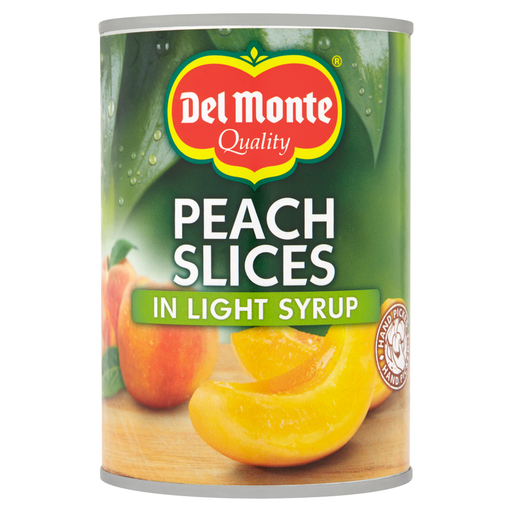
Del Monte Peach Slices in Light Syrup 420g
Choose this 420g peach tin when light syrup suits the planned dessert. It is a different packing format from fruit in juice, so compare the exact label’s ingredients and salt declaration rather than applying figures from another Del Monte product.
View on Joybuy
 No image available
Princes Pineapple Chunks With Juice 432g
The chunk format may suit a recipe needing pineapple pieces rather than slices. Princes Foods lists 0.05g salt per 100g for its Pineapple Chunks in Juice; compare that declaration with the current 432g tin’s label.
View on Joybuy
 No image available
Del Monte Pear Halves in Juice 415g
Consider pear halves if that fruit and shape fit your planned dessert. This 415g tin is packed in juice; check its own nutrition label for salt rather than borrowing a figure from another fruit or Del Monte tin.
View on Joybuy
 No image available
Morrisons Peach Slices in Juice 220g
This 220g tin offers a smaller peach-in-juice pack for a recipe that needs less fruit. If you need a numerical salt comparison or an exact drained quantity, check those details on the current pack.
View on Joybuy
Common questions
Does fruit packed in juice count as reduced salt?
Not on the strength of “in juice” alone. That wording describes the packing liquid; compare salt on the exact tin and check what product any reduced-salt claim is being compared with.
How should I store tinned fruit after opening?
Follow the instructions on the tin you open. Tesco and Sainsbury's specify transferring leftovers from their checked peach tins to a non-metallic container, refrigerating and using within two days; ASDA's Del Monte prunes listing specifies three to four days after transfer and refrigeration.
Does a low salt figure on the fruit tin cover the whole roast dinner?
No. The NHS says salt already in foods and salt added during cooking both count towards daily intake, so compare the labels on other ingredients you are using, including stock, gravy and sauces.
Are reduced-salt food claims regulated in Great Britain?
Yes. GOV.UK guidance explains that nutrition claims are regulated in Great Britain. For an individual fruit tin, do not infer a comparative reduced-salt claim from a small stated salt figure or from juice packing; check the claim and its comparison basis on the product.


