Salt-conscious home cooks
If you use tinned fruit for winter breakfasts or puddings, the salt figure per 100g gives you a product-specific check that the phrase “reduced salt” does not.


For a low-salt tinned fruit choice, compare the salt declaration per 100g on the exact product rather than relying on a “reduced salt” description. NHS inform uses 0.3g salt or less per 100g as its low-salt reference point; the packing liquid is a separate choice, with fruit in juice giving you a different starting point from fruit in light syrup. For winter breakfasts and desserts, also choose a fruit cut that suits the dish and check how you will store any leftovers.
If you use tinned fruit for winter breakfasts or puddings, the salt figure per 100g gives you a product-specific check that the phrase “reduced salt” does not.
For crumbles, cakes or compotes, choosing between fruit in juice and fruit in light syrup helps you decide how much sweetness should come from the tin.
Fruit cut and drained weight matter when a recipe needs a particular amount or shape. If you will not use the whole tin, check its instructions for storage after opening.
| Concern | What to check | Who this matters to |
|---|---|---|
| Salt declaration | Compare salt per 100g on the exact product. NHS inform uses 0.3g or less per 100g as its low-salt reference point. | If keeping salt low is my priority, I want a figure I can compare across different tin sizes rather than a vague description. About 40% of consumers put that label check first. |
| Packing liquid | Check whether the fruit is in juice or light syrup, and whether your recipe uses or drains the liquid. | When making a pudding, I want to decide whether sweetness comes from the tinned liquid or from ingredients I add myself. For about 30% of consumers, control over that starting point is the main concern. |
| Fruit cut and leftovers | Match slices, halves, chunks or prunes to the dish; check drained weight and instructions for storing unused fruit. | If I need fruit for a topping or a measured baking recipe, its shape and usable quantity matter, especially when some will be left over. Roughly 30% of consumers chiefly need a practical format they can store and use. |
Fruit type and packing liquid do not tell you the salt value of every tin. The nutrition declaration is the useful comparison.
Read salt per 100g on the product you intend to buy; NHS inform’s low-salt reference point is 0.3g or less per 100g.
The liquid contributes to the finished dish, so a pudding made with light syrup may need a different approach to added sweetness from one made with fruit in juice.
Choose the packing liquid deliberately, then decide whether to use or drain it. Check salt separately on the nutrition panel.
A tin that supplies more fruit than your recipe needs also leaves you with opened fruit to store.
Check the quantity needed and follow the exact pack instructions after opening. The Sainsbury’s listing for Del Monte pineapple chunks in juice says to cover and refrigerate unused fruit and use it within 3–4 days.
Fruit left unused beyond its stated storage period may have to be discarded.
A tinned-fruit brand with both juice-packed and syrup-packed options listed by UK grocers.
Princes lists pineapple chunks in juice in 227g and 432g formats.
Tesco lists tinned and pot fruit, including its own-label apricot halves in juice.
Sainsbury’s lists own-label peach slices in fruit juice and in light syrup.
The Marks & Spencer tinned-fruit range includes rhubarb presented for pies and crumbles.
These juice-packed pineapple, peach, pear and prune options are relevant to winter breakfasts and desserts. Compare their fruit cuts and the exact pack labels to choose for your recipe and salt requirement.
 Image unavailable
Consider the slices when you want pieces of pineapple for a fruit-topped dessert. Check the pack’s salt declaration and drained weight against your recipe. If fruit remains after opening, follow the pack’s refrigeration and use-within instructions.
 Image unavailable
Peach halves are an option when you want larger fruit pieces for a dessert. The tin is 415g; check its drained weight if the recipe specifies a quantity of fruit, and compare salt per 100g on the pack. Follow its instructions for refrigerating leftovers.
 Image unavailable
Choose chunks if you want pineapple pieces for porridge or a recipe rather than whole slices. Princes declares 0.05g salt per 100g for its pineapple chunks in juice. Check the drained weight for recipe planning; the product guidance says to refrigerate leftovers in a sealed container and use them within 2 days.
 Image unavailable
Pear halves offer another larger-piece option for a fruit-topped pudding. Compare the pack’s salt per 100g and check its drained weight if your recipe specifies a fruit quantity. Follow the on-pack instructions for any leftovers.
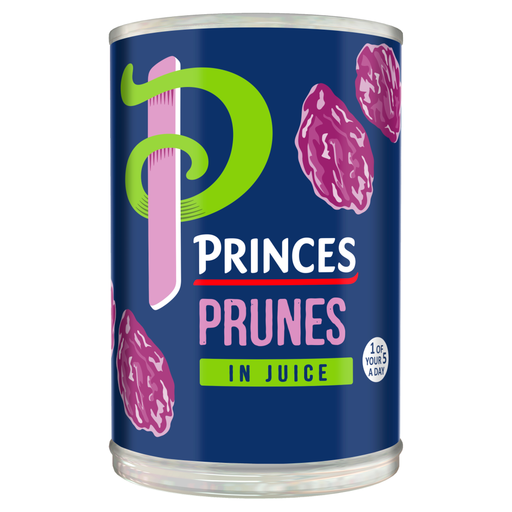 Image unavailable
Consider prunes when their flavour and texture suit your porridge or compote. The product description warns that they contain plum stones, so take care when preparing or serving them. It also says to refrigerate leftovers in a sealed container and use them within 2 days; check the pack’s salt declaration for your comparison.
Not on its own: check the declared salt per 100g for the exact tin. NHS inform describes 0.3g salt or less per 100g as low; Sainsbury’s lists Del Monte sliced pineapple in juice at less than 0.1g per 100g, while Princes declares 0.05g per 100g for its pineapple chunks in juice.
Choose fruit in juice if you want to decide how much sweetness to add to the finished pudding; light syrup is an option when you intend to use a sweeter fruit liquid. Check the individual salt declaration either way, and consider whether the recipe uses or drains the liquid.
Follow the instructions on the particular tin. The Sainsbury’s listing for Del Monte pineapple chunks in juice says to cover and refrigerate unused contents and use them within 3–4 days; other products can give different use-within periods.