Salt-conscious Sunday-roast hosts
If you are choosing fruit for dessert and want to keep salt in view, the figure per 100g is more useful than assuming “reduced salt” means “low salt”. The NHS provides a low-salt threshold for reading food labels.


Choose the fruit and serving format for your Sunday-roast dessert, then compare salt per 100g on the current tin rather than looking only for a “reduced salt” claim. The NHS describes 0.3g salt or less per 100g as low; a reduced-salt claim makes a comparison with another product, not a statement of the tin’s actual salt content. Packing liquid, drained weight and how you will use leftovers also affect the choice.
If you are choosing fruit for dessert and want to keep salt in view, the figure per 100g is more useful than assuming “reduced salt” means “low salt”. The NHS provides a low-salt threshold for reading food labels.
If the fruit is going into a salad, trifle, crumble or pie, choose a form and packing liquid that suit the dish. Check the quantity of fruit you can drain from the tin when planning servings.
If you are serving several people, total tin weight does not tell you how much fruit will reach the bowl. Drained weight and the pack’s instructions for opened fruit help you plan the meal and any leftovers.
For a Sunday-roast dessert, check the fruit’s intended use alongside its salt figure and the amount you can serve.
| Concern | What to check | Who this matters to |
|---|---|---|
| Actual salt content | Compare salt per 100g on similar tins. The NHS describes 0.3g or less per 100g as low. | If salt is my priority when choosing dessert fruit, I want the figure on the tin rather than relying on a front-of-pack phrase; about 50% of consumers put the actual salt figure first. |
| Dessert fit | Check the fruit’s form and whether it is packed in juice or syrup; compare sugars per 100g if sweetness matters to the dish. | For a fruit salad or a baked crumble, I need fruit that works in the dish I have planned; about 30% of consumers make dessert fit their primary concern. |
| Usable quantity | Look for drained weight and read the instructions for storing fruit after opening. | When I am serving a smaller group, I want enough fruit without leaving more than I can use; around 20% of consumers prioritise usable quantity and leftovers. |
Reduced salt compares a product with a similar one. It does not, by itself, tell you the product’s salt value per 100g.
Read the nutrition panel and compare similar tins. The NHS low-salt threshold is 0.3g salt or less per 100g.
The labelled weight includes the packing liquid, so two tins of similar size may provide different amounts of fruit.
Check drained weight against the number of servings you need, particularly if some fruit will be left after the meal.
A tin can meet your salt preference yet have a packing liquid that does not suit the dessert. M&S Rhubarb Chunks, for example, are packed in light syrup and presented for pies and crumbles.
Match the fruit and packing liquid to the dish, then compare the ingredients and sugars per 100g as well as salt.
Ingredients and nutrition information can change, so a listing used to shortlist fruit may differ from the pack you buy.
Check the current tin’s nutrition panel, ingredients and post-opening storage instructions before serving or storing it.
These examples show how particular tinned fruits differ; their details should not be assumed to apply to every product from the same brand.
Pineapple in juice is an option for a cold dessert or fruit salad.
The checked pineapple chunks in juice come in a 227g tin for shoppers planning a smaller quantity.
Tesco’s checked pineapple chunks in juice offer another fruit-salad or cold-dessert format.
Asda’s checked pineapple chunks in fruit juice are presented as a tin providing three suggested servings.
M&S Rhubarb Chunks provide a different route when the Sunday-roast dessert is a pie or crumble.
These pineapple slices, chunks and pieces are options to assess for a Sunday-roast dessert. Choose the serving form you need, then check each tin’s salt figure, packing liquid and usable quantity.
 No image available
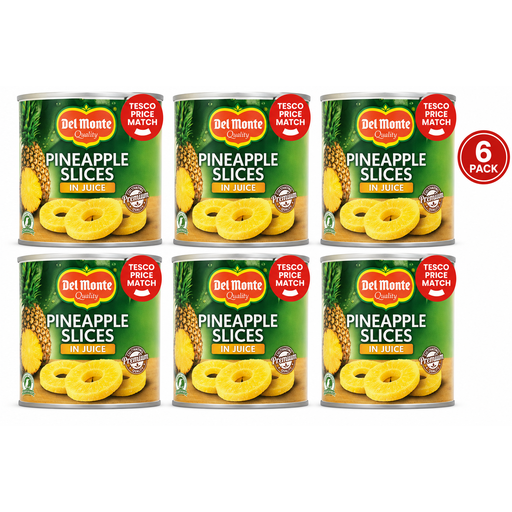
Consider pineapple slices if you want defined pieces for serving with dessert. This is a 435g tin packed in juice; check its current salt figure and drained weight when planning portions.
 No image available
Consider the six-pack if you are planning more than one occasion for pineapple slices in juice. Each tin is labelled 435g; decide whether you need the bundle and check the current salt figure and drained weight per tin.
 No image available
Chunks are a format to consider when the pineapple will be spooned into a fruit dessert. This tin is labelled 432g and packed with juice; check its salt per 100g and drained weight before deciding how many servings it will provide.
 No image available
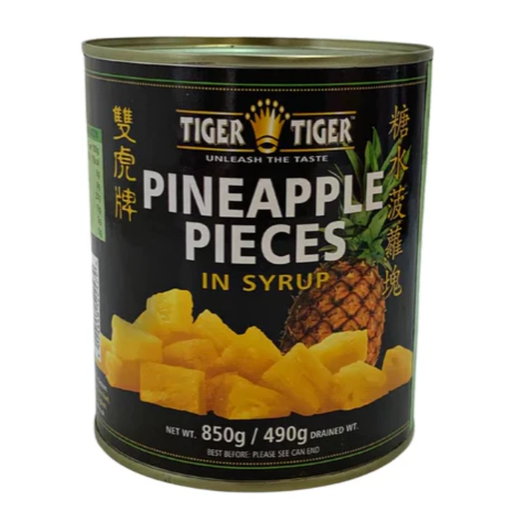
Consider pineapple pieces if that form suits the dessert you plan to serve. The tin is labelled 830g; check its packing liquid, salt per 100g and drained weight to judge the usable quantity.
No. “Reduced salt” compares a product with a similar one; it does not give you its actual salt content. For a low-salt check, read the nutrition panel: the NHS describes 0.3g salt or less per 100g as low.
Compare salt per 100g across similar tins. The NHS low-salt threshold is 0.3g or less per 100g, but check the current pack rather than assuming that a different fruit, tin size or formulation has the same figure.
Look for drained weight, because total tin weight also includes juice or syrup. For example, Sainsbury’s lists 260g drained for the checked Del Monte pineapple chunks, while Tesco lists 136g drained for the checked 227g Princes pineapple chunks; those quantities apply to those particular products.
Follow the tin’s post-opening instructions. Transfer leftovers from the opened can to a suitable container, refrigerate them and use them within the period stated for that product.