Salt-conscious second-home stockers
If salt is your main consideration, use the per-100g figure on the exact pack. Tesco, Princes and M&S product information shows that the figure differs between fruit-in-juice products.


For a second-home cupboard, compare salt per 100g on the exact pack rather than looking only for “reduced salt” or assuming every fruit-in-juice product has the same value. Choose a size you can finish within its stated post-opening period; if limiting added sugar also matters, consider fruit in water or juice rather than syrup.
If salt is your main consideration, use the per-100g figure on the exact pack. Tesco, Princes and M&S product information shows that the figure differs between fruit-in-juice products.
If a visit may end before a large tin is finished, check the pack size and post-opening directions. M&S and Morrisons listings for specific products give different refrigerated use periods.
If you want fruit ready in the cupboard for meals, choose a format you will use during a stay. The British Heart Foundation suggests water or natural juice rather than syrup when limiting added sugar matters.
For a second-home cupboard, check the salt declaration first, then consider how much fruit you will use after opening and whether the packing liquid suits your plans.
| Concern | What to check | Who this matters to |
|---|---|---|
| Salt on the exact pack | Compare salt per 100g on the chosen variant, not just the words “in juice”. NHS inform describes 0.3g salt or less per 100g as low. | If salt is my first concern, I want a figure I can compare across the tins I might buy. About 45% of consumers put checking the exact salt declaration first. |
| Leftovers between visits | Check pack size, drained weight where stated, and the instructions for refrigerating and using opened contents. | For a short stay, I need to know whether the fruit will be finished before I leave. About 33% of consumers prioritise avoiding opened-pack waste. |
| Packing liquid and everyday use | Check whether the fruit is in water, juice or syrup, and choose a portion size you can use. | If I am stocking fruit for breakfasts or desserts, the liquid and format need to suit those meals. About 22% of consumers make that everyday-use choice their primary concern. |
Salt values differ even among fruit-in-juice products. Listings from Tesco, Princes and M&S include values from below 0.01g to 0.10g per 100g for specific products.
Compare the per-100g declaration on the exact fruit and variant before stocking up.
Opening a tin can start a short refrigerated use period. M&S grapefruit segments specify 2 days, while a Morrisons listing for Del Monte peach slices specifies 3–4 days.
Match the amount of fruit to a typical stay, and follow the selected pack’s transfer and storage instructions.
Unused fruit can go to waste, and opened contents need space in the fridge.
The packing liquid is a separate choice from the salt figure. The British Heart Foundation suggests water or natural juice instead of syrup when limiting added sugar matters.
Check the packing liquid and nutrition panel separately; neither tells you everything about the other.
Tesco lists own-label tinned fruit in juice in different pack formats.
Princes lists Fruit Cocktail with Juice in 410g and 220g sizes, giving shoppers a choice of pack size.
Del Monte fruit in juice includes peach products listed by UK supermarkets.
Sainsbury's lists own-label tinned fruit in juice alongside syrup-packed options.
M&S lists grapefruit segments in grapefruit juice with product-specific nutrition and storage directions.
These fruit-in-juice selections include tins for cupboard stocking and a four-portion peach pack for shorter stays. Check the salt declaration on the exact pack when choosing between them.
 No image available
Consider this tin if pineapple will be used during your stay. After opening, transfer leftovers to a non-metallic container, refrigerate and use within 3–4 days.
 No image available
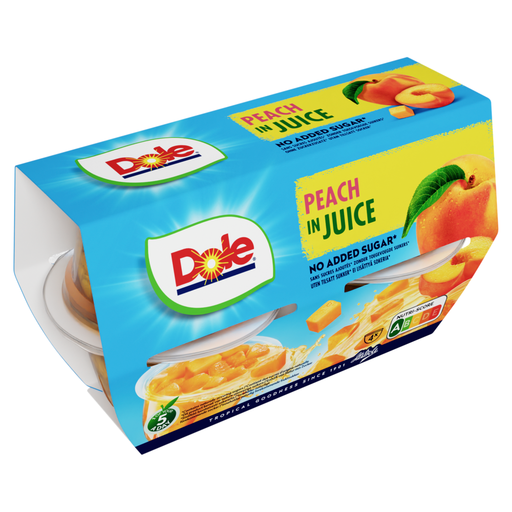
The separate portions suit a visit when opening a large tin would leave too much fruit. This is a four-pot pack, not a conventional tin; refrigerate an opened pot and use it within 2 days.
 No image available
Consider the stated two-serving format when planning fruit for a stay. Transfer unused contents to a sealed container, refrigerate and use within 2 days of opening.
 No image available
For a visit when pear halves suit the meals you have planned, check the drained weight on the pack to judge how much fruit you will have. After opening, transfer leftovers to a non-metallic container, cover, refrigerate and use within 3–4 days.
 No image available
Choose this format if peach halves fit your plans for the stay, and compare its label with other fruit-in-juice options before buying multiples. After opening, transfer leftovers to a non-metallic container, cover, refrigerate and use within 3–4 days.
No. Specific fruit-in-juice listings from Tesco, Princes and M&S show salt values from below 0.01g to 0.10g per 100g. Compare the nutrition panel on the exact product rather than treating its packing liquid as a salt guarantee.
NHS inform describes 0.3g salt or less per 100g as low. Use the per-100g declaration to compare products; the benchmark does not establish the value of a tin whose label you have not checked.
Follow the directions on that product and refrigerate leftovers where instructed. For example, M&S grapefruit segments specify a non-metallic container and use within 2 days, while a Morrisons listing for Del Monte peach slices specifies use within 3–4 days.
If limiting added sugar is important to you, the British Heart Foundation suggests fruit canned in water or natural juice rather than syrup. Still check salt separately, and choose a pack size you can finish after opening.