School-week household planners
You want cupboard fruit for breakfasts, packed-lunch preparation and after-school snacks. The drained quantity helps you judge how many usable portions a tin provides.


For regular back-to-school use, consider fruit in natural juice or water with no added sugar or salt, as the NHS advises, then check the drained fruit quantity and how many portions your household will use. A standard tin suits repeated servings if you can store leftovers as its label directs; individual pots avoid opening a full tin for one lunch.
You want cupboard fruit for breakfasts, packed-lunch preparation and after-school snacks. The drained quantity helps you judge how many usable portions a tin provides.
You want a convenient option that follows the NHS advice to choose canned fruit in natural juice or water with no added sugar or salt. The individual ingredients label still matters.
You need a portion that fits one eating occasion, or a plan for the rest of an opened tin. Pack format and the labelled storage instructions both affect that choice.
For school-week use, compare the fruit you can serve after draining, the packing liquid and whether the pack size fits your plans.
| Concern | What to check | Who this matters to |
|---|---|---|
| Usable fruit quantity | Check drained weight as well as net weight; compare similar fruits and packing liquids. | When I plan several breakfasts or packed lunches from one tin, I want to know how much fruit remains after draining. About 40% of consumers would put usable fruit quantity first. |
| Packing liquid | Read the ingredients and nutrition panel rather than relying on the words “in juice” alone. | If the fruit is for regular school-week snacks, I want its packing liquid to fit the NHS advice on canned fruit. About 30% of consumers would make that their primary concern. |
| Portions and leftovers | Check the pack format and the product’s directions for storage after opening. | One packed lunch could leave most of a tin open, so I need portions my household can finish. About 30% of consumers would prioritise portion and leftover handling. |
Fruit in syrup is not the same choice as fruit in natural juice or water. The NHS advises choosing canned fruit in natural juice or water with no added sugar or salt.
Check the packing liquid and ingredients on the particular tin before choosing it for regular school-week use.
Opened-storage directions vary. Tesco Peach Slices in Juice directs you to transfer leftovers to a non-metallic container, cover, refrigerate and consume them within two days; ASDA Pineapple Chunks in Fruit Juice gives a four-day period.
Choose a format you can use within its own labelled timeframe, and follow that product’s storage directions.
The physical package is the relevant check when an ingredient, dietary requirement or school restriction affects what you can pack.
Read the label on the product you receive before using it.
These ranges offer different fruits, packing liquids and formats. Check the individual product rather than treating a brand name as a pack specification.
The Sainsbury's range includes Del Monte peach slices in juice and a separate light-syrup variant.
Princes lists Peach Slices with Juice in 410g and 220g sizes.
Tesco’s own-label range includes standard fruit-in-juice tins and smaller formats.
The checked own-label range includes peach slices in fruit juice in 411g and 213g formats.
Asda’s own-label fruit-in-juice range includes a 432g tin of pineapple chunks.
M&S Food offers grapefruit segments packed in grapefruit juice for shoppers who specifically want that fruit.
These selections include full-size fruit-in-juice tins for households planning several servings and individual peach pots for portion-by-portion use. Check each pack’s label and the drained quantity where it matters to your plans.
 No image available
Consider this full-size tin if pineapple slices can be shared across several servings. It is labelled 435g and packed in juice; check the drained weight and follow the pack’s directions for any leftovers.
 No image available
This 415g tin is a mixed-fruit option for a household that can use several servings. If added colours affect your choice, read the physical ingredients label rather than relying on a general description; store leftovers according to the pack.
 No image available
Choose this standard tin when peach halves fit several planned servings rather than one lunch. The product name specifies 415g and juice; check its drained weight and opened-storage directions on the pack.
 No image available
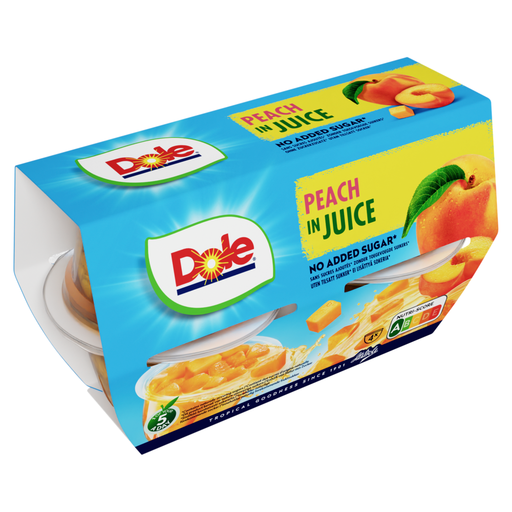
Four individual pots suit a plan to open one peach portion at a time rather than a full tin. The listed ingredients include steviol glycosides; check the label if added sweeteners affect your choice.
 No image available
This full-size tin suits a household planning to use pear halves across several servings. It is labelled 415g and in juice; check its drained weight for portion planning and follow the pack’s opened-storage directions.
Yes. The NHS says 80g of canned fruit counts as one 5 A Day portion and advises choosing fruit in natural juice or water with no added sugar or salt. Check the amount of fruit you serve rather than assuming a whole tin is one portion.
No. “In juice” describes the packing liquid, not everything in the ingredients list. Check the particular product’s ingredients and nutrition panel against the NHS advice to choose canned fruit in natural juice or water with no added sugar or salt.
Follow that product’s label. Tesco says to transfer unused Peach Slices in Juice to a non-metallic container, cover, refrigerate and consume within two days. ASDA gives the same transfer-and-refrigerate direction for its Pineapple Chunks in Fruit Juice but says to use them within four days.
The Department for Education’s school food standards guidance applies to England; it should not be treated as a UK-wide packed-lunch rule. For food prepared at home, check your child’s school packed-lunch policy.