One-serving planners
If one child will have the fruit, a compact tin may leave less to store after opening. Sainsbury’s lists 213g peaches, while Princes identifies a 220g peach tin and Tesco lists 227g pineapple.


Choose a compact tin of around 213g to 227g when you want fruit for one child or one serving with less left over. A tin of around 410g or more makes more sense when you plan to share it or use it across meals; check the chosen tin’s storage directions before relying on that plan. For fruit in juice, read the ingredients and nutrition panel rather than assuming every tin has the same contents.
If one child will have the fruit, a compact tin may leave less to store after opening. Sainsbury’s lists 213g peaches, while Princes identifies a 220g peach tin and Tesco lists 227g pineapple.
If the packing liquid matters to you, start with the NHS advice to choose canned fruit in natural juice or water with no added sugar or salt. Then check the ingredients and nutrition panel on the particular tin.
If the fruit will be divided between servings, a larger tin may fit that plan. Princes lists a 410g peach tin and gives storage directions for leftover peaches in one of its recipes; follow the directions for the product you choose.
Decide how much fruit you intend to use when the tin is opened, then check its packing liquid and the amount of fruit after draining. These checks matter more to a school routine than the tin’s size alone.
| Concern | What to check | Who this matters to |
|---|---|---|
| Portion fit and leftovers | Compare the net and drained weights. Consider a compact tin for one serving and a larger one when the remainder has a planned use. | If I only need fruit for one child, I want an amount I can serve without managing much leftover fruit. About 42% of consumers would put portion fit and leftover control first. |
| Packing liquid and label | Check whether the fruit is in natural juice, water or syrup, then read the ingredients and nutrition panel on the exact tin. | For an everyday fruit option, I want to know what the fruit is packed in rather than judge it by the front label alone. About 33% of consumers would make the packing liquid and label their primary concern. |
| Fruit quantity for sharing | Compare drained weight where it is shown, and check the opened-tin storage directions if you plan several servings. | When fruit is going into more than one breakfast or snack, I need a tin whose contents I can use as planned. For about 25% of consumers, planned sharing would be the main priority. |
The packing liquid is a useful starting point, but it does not describe the full contents. Princes lists peaches, grape juice made from concentrate and water for its Peach Slices with Juice.
Check the ingredient list and nutrition panel for the exact fruit and tin size you are considering.
A larger tin may suit shared meals, but an opened remainder needs to be used or stored according to that product’s directions.
Work out the intended servings before choosing the size, and check the label for what to do after opening.
A single tin still needs opening and serving. In a recipe using its peaches, Princes directs users to put the portion being stored in a sealable container in the fridge; that instruction should not be applied to every tin.
Portion the fruit into a suitable container at home, follow the chosen product’s storage directions and check the school’s food-container policy.
Whether a particular container or food item is suitable for school can depend on the school’s own arrangements.
Check its packed-lunch and allergy policies before making tinned fruit a regular lunchbox item.
Princes lists Peach Slices with Juice in 220g and 410g tins, giving a choice between a compact format and one intended for more servings.
Tesco’s own-label listings include 227g pineapple in juice and 410g peach slices in juice.
Sainsbury’s lists peach slices in fruit juice in 213g and 411g sizes, alongside other tinned-fruit formats.
UK retailer listings include compact Del Monte peach formats and larger fruit tins, with both juice and light-syrup products represented.
Marks & Spencer lists 540g grapefruit segments and 560g rhubarb chunks, formats to consider when a larger quantity has a planned use.
These single tins include a compact peach option for portion-led planning and larger fruit options for households planning to share or use more than one serving. Check each product’s label and opened-tin directions for your intended use.
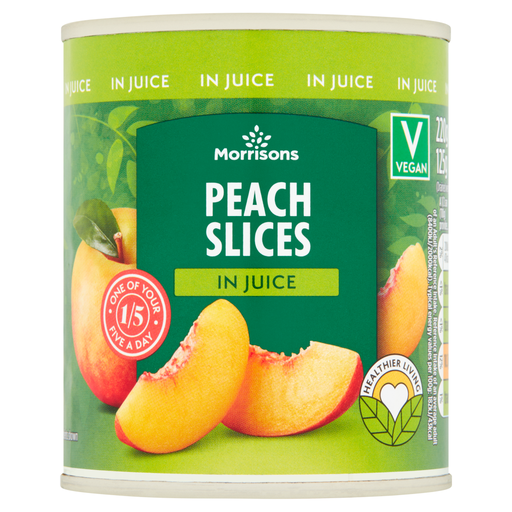 Image unavailable
The 220g tin is a compact choice when one serving is the priority. If any peaches remain after opening, transfer them to a non-metallic container, refrigerate and use within two days according to the product directions. The product information also warns that an occasional stone fragment may remain.
 Image unavailable
This 435g pineapple tin is suited to a plan involving more than one serving rather than a compact portion. The product directions call for unused contents to be transferred to a suitable non-metallic container, sealed, refrigerated and used within three to four days.
 Image unavailable
The 415g tin offers mixed fruit for planned shared servings. Its ingredient declaration includes cherries with colour E127, so check the full label for relevant dietary requirements. Transfer unused contents to a suitable non-metallic container, cover, refrigerate and use within three to four days according to the product directions.
 Image unavailable
This 415g tin of peach halves fits a plan to divide the fruit between servings. For unused contents, the product directions specify a non-metallic container, refrigeration and use within three to four days after opening.
 Image unavailable
The 415g pear tin is a larger single-tin option for planned sharing. If the amount of fruit after draining matters to your choice, check its drained weight on the label. The product directions say to transfer unused contents to a suitable non-metallic container, cover, refrigerate and use within three to four days.
Yes. The NHS says 80g of fresh, canned or frozen fruit and vegetables counts as one portion of 5 A Day. For canned fruit, it advises choosing products in natural juice or water with no added sugar or salt.
If you are following NHS selection guidance for canned fruit, look for natural juice or water with no added sugar or salt. Check the chosen tin’s ingredients and nutrition panel: the word “juice” alone does not tell you everything in it.
You can plan several servings if you follow the storage directions for the exact product. For a recipe using its peaches, Princes says to keep half of the prepared fruit in a sealable container in the fridge for up to three days; do not apply that timescale to other tins without checking their instructions.