Solo breakfast portion planners
If you want to finish one tin at breakfast rather than store the remainder, look at the small juice-packed formats listed by Tesco Groceries and Sainsbury's.


For one weekday breakfast, a roughly 220g to 230g tin in juice is a practical starting point if you want to finish it without storing leftovers; Tesco Groceries and Sainsbury's list small tins alongside larger formats. Choose a larger tin when you can share or use the remainder, and compare a light-syrup option by its ingredients and nutrition label rather than treating it as equivalent to fruit in juice. The NHS advises choosing canned fruit in natural juice or water with no added sugar or salt.
If you want to finish one tin at breakfast rather than store the remainder, look at the small juice-packed formats listed by Tesco Groceries and Sainsbury's.
If packing liquid and added sugar guide your choice, check the exact tin's ingredients. The NHS advises choosing canned fruit in natural juice or water with no added sugar or salt.
If another person will share the fruit, or you have a planned second use, a larger tin may be practical. Compare its drained weight with the amount you expect to use.
Decide whether you will finish the tin at breakfast, then compare the packing liquid and the amount of drained fruit. Tesco Groceries and Sainsbury's list both small and larger formats; the right size depends on how you will use them.
| Concern | What to check | Who this matters to |
|---|---|---|
| Size for one breakfast | Compare the tin size and drained weight with the fruit you expect to eat. | If I eat breakfast alone, I want a tin I can finish without storing leftovers. About 42% of consumers put that portion need first. |
| Packing liquid | Check for natural juice or water, added sugar in the ingredients, and nutrition values per 100g. | I want to choose by what is in the tin, not assume that every fruit-in-juice label means the same thing. For about 33% of consumers, that label check is the primary concern. |
| Amount of usable fruit | Compare drained weights and decide whether you will use a larger tin after opening. | When my household can share a tin or use it again, the quantity of fruit matters more than finishing it at once. Roughly 25% of consumers make that their first consideration. |
Tesco Groceries and Sainsbury's list tins from small formats to cans above 400g. The weight on the front also includes the packing liquid, so it does not tell you how much fruit you will eat.
Check the drained weight and choose a larger tin when you have another eater or a planned use for the remainder.
Otherwise, you will need to store leftover fruit or risk wasting it.
Both packing options appear in Tesco Groceries listings. For shoppers following the NHS advice to choose canned fruit in natural juice or water with no added sugar or salt, the packing medium is an initial filter, not the whole label check.
Read the ingredients and nutrition panel on the particular tin, especially if you are comparing it with a light-syrup version.
GOV.UK distinguishes best-before dates, which concern quality, from use-by dates, which concern safety, and gives tinned food as a best-before example.
Read the date marking and storage directions on the product. Do not apply best-before guidance to food marked with a use-by date.
Tesco Groceries lists 220g fruit cocktail and peach slices with juice, as well as larger Princes tins.
Tesco Groceries lists small light-syrup options; Sainsbury's lists Del Monte fruit in juice, including pineapple.
Tesco Groceries lists a 227g pineapple-in-juice tin alongside larger own-label fruit tins.
Sainsbury's lists 213g peach slices in fruit juice and larger own-label fruit tins.
These tins include one small peach option for breakfast alone and larger fruit-in-juice options to consider when you can share or use the remainder. Check each pack for drained weight and after-opening instructions.
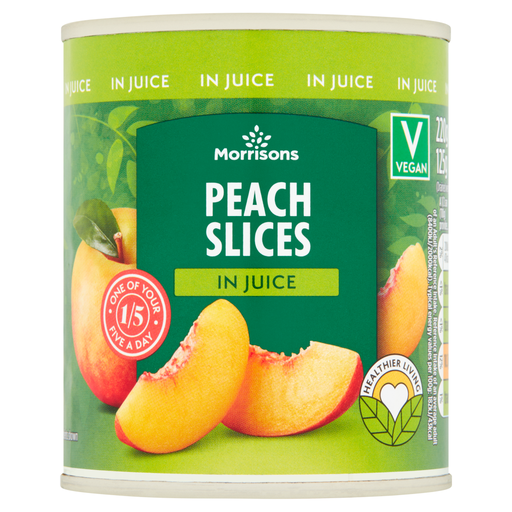 Image unavailable
Consider this smaller tin if you want peach slices with one breakfast. The 220g weight includes juice; check the pack's drained weight to judge the amount of fruit. Product information warns that an occasional stone fragment may remain.
 Image unavailable
This larger tin is worth considering when someone else will share the peaches or you have a planned second use. It contains 415g including juice; follow the pack's instructions for any remainder.
 Image unavailable
Choose this larger pineapple tin when you can share it or use it again after breakfast. Its stated 435g weight includes juice, so check the drained weight on the pack if the quantity of fruit affects your choice.
 Image unavailable
This 415g tin offers fruit cocktail in juice for a breakfast you can share or follow with another use. Check its drained weight for the fruit quantity and follow the after-opening directions if any remains.
 Image unavailable
Consider this larger pineapple tin if breakfast is shared or you have a use for what remains. Its 432g weight includes juice; check the drained weight on the pack when comparing fruit quantities.
Yes. The NHS says 80g of canned fruit or vegetables counts as one portion of 5 A Day. It advises choosing canned fruit in natural juice or water with no added sugar or salt.
If you are following NHS advice on canned fruit, look for natural juice or water with no added sugar or salt. Check the ingredients and nutrition panel of the exact tin: the words “in juice” alone do not describe its full contents.
Start with a small tin if you want to finish it at one breakfast. Tesco Groceries and Sainsbury's list small fruit-in-juice formats; a larger tin makes more sense when you can share it or have a planned use for the remainder. Compare drained weights rather than relying on tin size alone.
GOV.UK says a best-before date concerns quality, whereas a use-by date concerns safety. Read the marking and storage directions on your tin; do not treat a use-by date as a best-before date.
Follow that product's after-opening storage instructions, including any stated time limit. If you are choosing a larger tin for breakfast alone, check those directions before relying on a second use.