Hosts checking added sugar
If you want fruit after a roast without assuming ‘no added sugar’ means sugar-free, compare the claim with the ingredients and total sugars on the exact tin.


For a Sunday-roast dessert, start with the fruit format you need, then check the exact tin’s ingredients, packing liquid and sugar label rather than assuming fruit in juice has no added sugar. Peach or pear pieces suit a simple fruit pudding; fruit cocktail offers a mixed-fruit option for a trifle. A ‘no added sugar’ claim does not mean the fruit contains no sugars, so compare the nutrition panel and drained weight before choosing.
If you want fruit after a roast without assuming ‘no added sugar’ means sugar-free, compare the claim with the ingredients and total sugars on the exact tin.
A trifle may call for mixed fruit, while a simple pudding may work better with consistent peach slices or pear halves. Check the format before planning portions.
If you are planning several servings or keeping fruit for later desserts, distinguish the tin’s total weight from its drained weight: the latter tells you how much fruit is available.
Check the packing liquid and label wording, choose pieces that suit the dessert, then use drained weight to plan how much fruit you need.
| Concern | What to check | Who this matters to |
|---|---|---|
| Added sugar and total sugars | Check the packing liquid, ingredients, any ‘no added sugar’ claim and total sugars per 100g and per serving. | If avoiding added sugar is my priority, I need to know what the claim says without overlooking sugars already in the fruit and juice. About 42% of consumers put that need first. |
| Dessert format | Choose slices or halves for consistent pieces, or a fruit cocktail when a mixed-fruit dessert calls for it. | For a trifle, I may want several fruits in one tin; for simple serving, I may need pieces of one fruit. Matching the fruit to the pudding comes first for about 33% of consumers. |
| Usable quantity | Compare drained weights with the quantity your recipe or planned servings require. | When I am making pudding for several people, I need enough fruit after the packing liquid is drained. Roughly 25% of consumers prioritise that usable quantity. |
The claim does not mean zero total sugars. Tesco Groceries lists Nature’s Finest peaches with a ‘No Added Sugar’ claim and 12.1g sugars per 100g.
Read the total-sugars figure and serving information on the tin alongside its claim and ingredients.
Some of a tin’s stated weight is packing liquid, so the total weight alone does not tell you how much fruit a dessert will contain.
Use the drained weight, where stated, to check it against the quantity your recipe needs.
Princes lists different fruit formats and sugar figures: its peach slices with juice have 11.8g sugars per 100g, pear halves with juice 10.0g, and fruit cocktail with juice 9.0g. The cocktail’s fruit proportions can vary.
Compare the exact tin’s ingredients and nutrition panel, then decide whether single-fruit pieces or a mix suits the pudding.
Princes lists peach slices, pear halves and fruit cocktail with juice, giving a choice between single-fruit pieces and a mix for a trifle.
Tesco Groceries and Sainsbury’s list Del Monte fruit in juice, including peach and fruit-cocktail formats.
Tesco Groceries lists tinned peaches in juice and in light syrup, including own-label and branded products.
Sainsbury’s lists own-label fruit-in-juice formats alongside branded tinned fruit.
Marks & Spencer lists tinned grapefruit segments and rhubarb chunks for shoppers seeking those particular formats.
These tins cover single-fruit pieces in juice for simple puddings and a fruit cocktail in juice for mixed-fruit desserts. Check each pack’s sugar wording and drained weight against your plans for the Sunday-roast dessert.
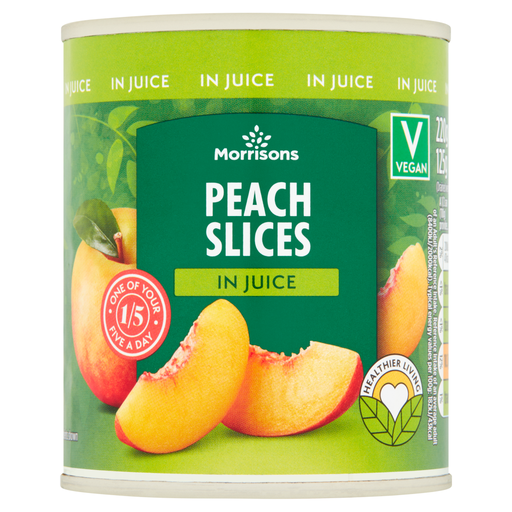 Image unavailable
Peach slices offer single-fruit pieces for a simple pudding. The tin is labelled 220g; check its drained weight and sugar information for the servings you intend to make.
 Image unavailable
Fruit cocktail suits a mixed-fruit dessert rather than a recipe needing uniform peach or pear pieces. The tin is labelled 415g; check its ingredients, sugar panel and drained weight for the exact dessert.
 Image unavailable
Peach halves give you recognisable single-fruit pieces for serving after a roast. The tin is labelled 415g; check the drained weight and sugar wording when deciding how many tins your dessert needs.
 Image unavailable
Pineapple chunks are an option when your dessert calls for pineapple pieces rather than peaches, pears or a fruit mix. The tin is labelled 432g; check its sugar information and usable quantity on the pack.
 Image unavailable
Pear halves suit a pudding that needs pieces of one fruit. The tin is labelled 415g; check the sugar panel, any added-sugar wording and the drained weight before planning portions.
No. A ‘no added sugar’ claim does not mean zero total sugars. The Food Standards Agency states that, when naturally present sugars exist, the claim must be accompanied by ‘Contains naturally occurring sugars’. Tesco Groceries lists Nature’s Finest peaches with that wording and 12.1g sugars per 100g.
No. Compare the exact products’ nutrition panels rather than relying on ‘in juice’: Princes lists 11.8g sugars per 100g for its peach slices with juice, 10.0g for pear halves with juice and 9.0g for fruit cocktail with juice. The fruits and formats differ, so those figures alone do not decide which dessert suits you.
Choose peach pieces when you need a consistent single-fruit format for simple serving. A fruit cocktail works when you want a mix for a trifle-style dessert; Princes describes its cocktail as suitable for trifle and says the fruit proportions vary.
Follow the storage instructions on the individual tin, including any refrigeration and use-by-after-opening directions. Do not apply one product’s stated timeframe to every tin.