Shoppers avoiding added sugar
If cupboard fruit is a regular breakfast, snack or pudding ingredient, check the packing liquid and ingredients as well as the nutrition panel. Fruit in juice can still contain sugars from the fruit and juice.


For a weekly shop focused on avoiding added sugar, start with tinned fruit in juice rather than syrup, as the NHS advises, then check the ingredients and total sugars on the exact tin. A reduced-sugar claim is a separate comparison with a similar product; neither fruit in juice nor a no-added-sugar label establishes that claim. Check drained weight and the instructions for opened fruit before choosing a pack size.
If cupboard fruit is a regular breakfast, snack or pudding ingredient, check the packing liquid and ingredients as well as the nutrition panel. Fruit in juice can still contain sugars from the fruit and juice.
When several meals will use the same cupboard stock, the number of tins and the drained weight can matter more than the net weight alone. Check how much fruit each pack provides before deciding on a quantity.
If a tin will last beyond one meal, choose a size your household can use within its after-opening period. Follow that product's directions for transferring, refrigerating and using the remainder.
For a weekly cupboard shop, let your main concern determine the first label check, then consider how much fruit you will use after opening.
| Concern | What to check | Who this matters to |
|---|---|---|
| Packing liquid and sugar wording | Look for juice or syrup in the ingredients, then compare total sugars per 100g. Check whether a reduced-sugar claim appears on the exact tin. | If avoiding syrup is my priority, I need to know what the fruit is packed in without mistaking juice for a reduced-sugar claim. About 50% of consumers put that label distinction first. |
| Usable fruit quantity | Compare net weight with drained weight where stated, and check the number of tins in a multipack. | When I am buying fruit for several meals, I want to know how much fruit remains once the liquid is drained. For about 30% of consumers, usable quantity is the primary concern. |
| Portions and leftovers | Check serving information where given and follow the exact product's after-opening storage instructions. | If we will not finish a tin at once, I need a format that fits the meals planned before its stated storage period ends. Managing opened portions comes first for about 20% of consumers. |
The NHS recommends tinned fruit in juice rather than syrup when cutting down sugar, but that does not make every juice-packed tin a reduced-sugar product. The reduced-sugar claim definition published on legislation.gov.uk requires at least a 30% reduction against a similar product.
Use the packing liquid to narrow your choice, then read the exact tin's ingredients, claim wording and total sugars per 100g.
Net weight includes the packing liquid. For example, Tesco Groceries lists Del Monte Peach Slices in Juice at 415g net and 250g drained; those figures describe different quantities.
Check drained weight where available when planning how many tins your household will use.
After-opening instructions differ by product. The checked Del Monte peach listing gives 3–4 days under its stated refrigerated-storage instructions, while the Princes Pineapple Chunks With Juice listing gives two days.
Plan portions before opening a tin, transfer leftovers as directed, refrigerate them and follow the time limit on the exact product label.
These brands and retailer ranges offer starting points for checking packing liquid and pack format; judge each tin by its own label.
Its tinned-fruit range includes peaches, pears, pineapple and other fruit in juice.
Princes has juice-packed pineapple options relevant to a weekly cupboard shop.
Tesco Groceries lists both fruit-in-juice and light-syrup products in its tinned-fruit category.
Its range includes own-label fruit in juice, alongside syrup-packed options.
Asda lists Del Monte Peach Slices in Juice 415g with product-specific ingredients and nutrition details.
The M&S tinned-fruit category includes products such as rhubarb chunks and grapefruit segments.
These tins are fruit-in-juice options for stocking the cupboard for a weekly shop. Choose between the listed fruit types and pack formats, and check any reduced-sugar wording on the exact pack rather than inferring it from the packing liquid.
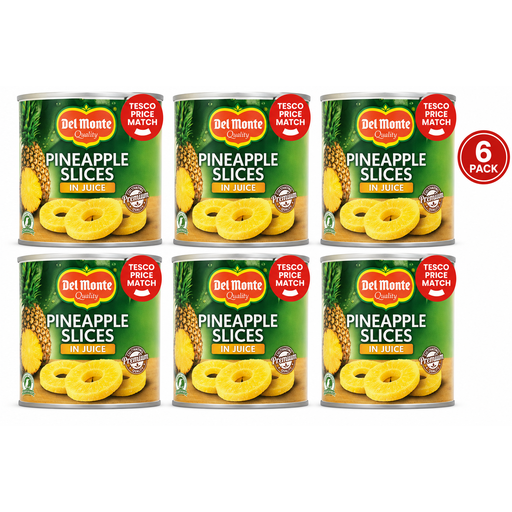 Image unavailable
Consider this format if pineapple slices will be used across several meals. The product name specifies 435g and a six-pack; confirm the pack contents and after-opening directions on the current label.
 Image unavailable
This listing is for pineapple slices in juice in a 435g tin, rather than the separately listed six-pack. Check its drained weight and storage directions when deciding how many tins to buy.
 Image unavailable
If peach halves suit your planned breakfasts or puddings, this is a 415g fruit-in-juice option. Check the drained weight on this exact tin; figures for Del Monte peach slices do not identify the quantity of peach halves.
 Image unavailable
Consider the chunk format if it fits meals planned soon after opening. The Joybuy listing states two servings, 10.0g sugars per 100g and a two-day period for refrigerated leftovers; check the current label and availability before buying.
Image unavailable
This mixed-fruit option is labelled as a 415g six-pack for meals across the week. Confirm the pack contents and drained quantity on the exact listing or label when planning portions.
No. The reduced-sugar claim definition published on legislation.gov.uk requires at least a 30% reduction against a similar product. No added sugar is different wording, and neither description tells you the total sugars in a tin; read the ingredients and nutrition panel of the product you are considering.
If cutting down sugar is your reason for choosing, the NHS advises tinned fruit in juice rather than syrup. Light syrup is not the same description as juice. Whichever tin you choose, check its total sugars per 100g rather than assuming juice-packed fruit contains none.
Not necessarily: net weight includes the liquid. Tesco Groceries lists Del Monte Peach Slices in Juice at 415g net and 250g drained. Use the drained weight of the exact product, where stated, to plan the fruit quantity you need.
Follow the instructions on that product. The checked Del Monte peach listing directs shoppers to transfer unused contents to a suitable non-metal container, refrigerate and use within 3–4 days; the Princes Pineapple Chunks With Juice listing gives two days for refrigerated leftovers.
Yes. Tesco, Sainsbury's and Asda advise shoppers to check the physical label because product details can change. Confirm the ingredients, nutrition, pack contents and storage directions on the tin you receive.