Hosts watching for added sugar
You want to distinguish fruit in juice or labelled no added sugar from fruit in syrup, while still checking the sugars figure on each tin.


For a street party where avoiding added sugar is the priority, start with tinned fruit in juice or an option labelled no added sugar rather than choosing light syrup by default. Check the ingredients and sugars per 100g on the exact tin: no added sugar does not mean sugar-free. Drained weight and the label’s instructions for opened fruit also matter when planning a shared dessert.
You want to distinguish fruit in juice or labelled no added sugar from fruit in syrup, while still checking the sugars figure on each tin.
You need fruit that can be divided into planned portions for children and adults, rather than choosing solely by a front-of-pack claim.
You need a way to serve fruit at a shared table and keep its packaging available so guests can check ingredients they need to avoid.
Choose the packing medium and read the sugar information before working out how much drained fruit to serve. Plan how opened tins will be handled at the party, too.
| Concern | What to check | Who this matters to |
|---|---|---|
| Added sugar | Read the packing medium, ingredients and sugars per 100g; do not treat no added sugar as sugar-free. | If avoiding added sweeteners comes first, I need to know what is in the fruit as well as what the front label says. About 33% of consumers put added-sugar clarity first. |
| Serving yield | Use drained weight to plan the fruit portions; the total tin weight includes liquid. | When planning a bowl for several guests, I need enough fruit after the liquid is drained. Serving yield is the main concern for about 27% of consumers. |
| Easy portioning | Match slices, halves, chunks or segments to the way you intend to serve them; check any product-specific stone or seed warning. | For a mixed-age table, I want pieces I can divide and serve without holding up the queue. About 20% of consumers prioritise easy portioning. |
| Shared-table handling | Check the tin’s after-opening instructions and keep its ingredient information available during service. | If fruit will sit on a shared outdoor table, I need a plan for serving it and putting leftovers away. Safe service and leftover handling come first for about 20% of consumers. |
The claim concerns added sweetening, not the absence of sugars. Tesco Groceries lists 12.1g sugars per 100g for Nature’s Finest Peach In Juice labelled no added sugar.
Check the ingredients and the nutrition panel on the tin you intend to serve.
Liquid contributes to the total weight, so it is not the same as the amount of fruit available for a bowl.
Use the drained weight when working out portions. Tesco Groceries lists 235g drained weight for Del Monte Peach Halves In Juice 415G.
After-opening instructions differ between products. Tesco Groceries specifies consumption within 2 days for its Peach Slices In Juice and within 3–4 days for Del Monte Peach Halves In Juice.
Open tins close to service, refrigerate leftovers promptly and follow each tin’s own storage instructions.
Guests may need to check ingredients when fruit has been transferred to a shared bowl. GOV.UK and the Food Standards Agency advise keeping prepacked food information available at community events.
Keep the relevant can or label with the serving plan until guests have finished.
Own-label tinned fruit in juice, including peach slices, for shoppers comparing sharing tins.
Branded fruit in juice, including peach halves.
Own-label fruit offered in different packing media.
Branded tinned pineapple offered with juice.
A Foodhall tinned-fruit range that includes fruits beyond peaches and pineapple.
These pineapple, peach and pear options are for hosts considering fruit packed in juice. Compare each tin’s label and serving format against your planned dessert; a juice-packed product is not automatically sugar-free.
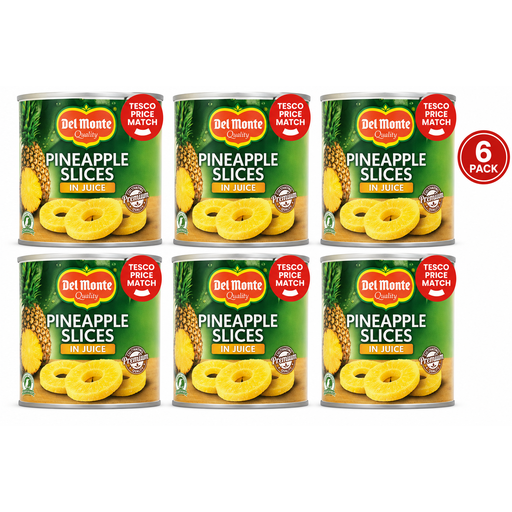 Image unavailable
A six-pack to consider when preparing pineapple slices for a shared dessert. Each tin is labelled 435g; check the drained weight and sugars per 100g on the pack when planning servings.
 Image unavailable
A single tin of pineapple slices for a fruit bowl or dessert topping. Check the drained weight to work out how many portions it will provide, and follow the tin’s instructions after opening.
 Image unavailable
Peach halves offer a defined format for dividing a shared dessert. Tesco Groceries lists 235g drained weight for this 415g product and identifies clarified pineapple juice from concentrate in its ingredients; check the can if those details affect your serving plan.
 Image unavailable
Chunks are an option when you plan to spoon pineapple into portions. The tin is labelled 432g; check its drained weight before estimating how much fruit will reach the table.
 Image unavailable
Pear halves provide another fruit and serving format for a shared dessert. The tin is labelled 415g; use the label’s drained weight, ingredients and sugars per 100g to decide whether it fits your portions and added-sugar priority.
No. The no added sugar claim concerns added sweetening ingredients, while the fruit or juice can still contain sugars. Tesco Groceries lists 12.1g sugars per 100g for Nature’s Finest Peach In Juice labelled no added sugar, so read the nutrition panel as well as the claim.
If avoiding added sugar is your priority, start with fruit in juice or an option explicitly labelled no added sugar, then check its ingredients and sugars per 100g. Fruit in light syrup remains an option if its packing medium suits your recipe, but do not assume two tins of the same fruit have the same ingredients.
Follow that tin’s storage instructions and refrigerate leftovers promptly. Tesco Groceries specifies consumption within 2 days for Tesco Peach Slices In Juice, while its Del Monte Peach Halves In Juice listing states 3–4 days; neither period should be applied to every product.
Keep the packaging available so guests can check ingredients they need to avoid. GOV.UK and the Food Standards Agency state that food provided at community events in England, Northern Ireland and Wales must comply with food law and be safe to eat; organisers in Scotland should confirm applicable requirements with their local authority.