Parents checking the packing liquid
If fruit is part of a school-holidays lunch, you may want to follow NHS advice to choose canned fruit in natural juice or water with no added sugar or salt.


Choose a smaller tin when one lunch is unlikely to use a regular tin; choose a larger one when the fruit will be shared or you have a plan for the remainder. For a fruit portion aligned with NHS 5 A Day guidance, look for natural juice or water with no added sugar or salt, then compare the fruit format, drained weight where stated and instructions for storing leftovers.
If fruit is part of a school-holidays lunch, you may want to follow NHS advice to choose canned fruit in natural juice or water with no added sugar or salt.
If only one person will eat the fruit, the tin size and instructions for storing opened contents matter as much as the fruit variety.
Slices, chunks or segments may be easier to divide between portions than halves. Check the format on the tin rather than assuming a particular fruit comes ready to serve in the shape you need.
For a school-holidays lunch, start with the packing liquid, then decide how much fruit you will use and whether its shape suits the way you intend to serve it.
| Concern | What to check | Who this matters to |
|---|---|---|
| Packing liquid | Read the ingredients for natural juice, water, syrup and added sugar; do not treat 'in juice' as meaning sugar-free. | If I want the lunch fruit to follow NHS advice, I will look for natural juice or water with no added sugar or salt. About 42% of consumers put that packing-liquid choice first. |
| Tin size and leftovers | Compare net weight with drained weight where stated, and read the tin's instructions for opened contents. | When one lunch will use only part of a tin, I need to know what to do with the remainder. Keeping leftovers manageable is the primary concern for about 33% of consumers. |
| Fruit format | Check whether the fruit comes as halves, slices, chunks or segments, and read any notices about pips. | If lunch needs assembling quickly, I would rather divide ready-cut fruit than cut larger pieces. Easy portioning comes first for about 25% of consumers. |
Juice-packed fruit can still show sugars in its nutrition information. The NHS advises choosing canned fruit in natural juice or water with no added sugar or salt; the wording on the front of a tin does not replace its ingredients list.
Check the ingredients and nutrition information on the exact product.
Net weight includes packing liquid. Tesco Groceries lists 235g drained fruit for its 415g Del Monte peach-halves tin, so the two figures answer different portion-planning questions.
Check drained weight where it is given, and choose a tin size that fits the number of people eating.
Any fruit left after opening needs to be stored and used within the period stated on its label.
Instructions differ by product. Marks & Spencer instructs buyers to transfer its grapefruit segments to a non-metallic container, refrigerate them and eat them within two days of opening.
Move leftovers to a covered, suitable container, refrigerate them and follow the instructions on the tin you bought.
Food-safety advice published by Health Well warns that a deep dent can conceal damage to a can's seal.
Choose an undamaged tin rather than using one with a deep dent.
These examples show different fruit shapes and tin sizes; check the label of the particular product you choose.
Tesco Groceries lists Del Monte peach halves in juice in a 415g tin with 235g drained weight.
Princes lists its Peach Slices with Juice in 220g and 410g sizes.
Tesco Groceries lists own-label tinned-fruit formats including mandarin segments in juice and pineapple chunks in juice.
Marks & Spencer lists a 540g grapefruit-segments tin among its tinned-fruit products.
Asda Groceries has an online tinned-fruit category.
These single tins include a smaller peach-slice format and regular-sized peach and pineapple formats. Choose by the fruit you will serve, its shape and your plan for any leftovers.
 Image unavailable
The 220g sliced-peach tin is a smaller format to consider when lunch does not call for a regular-sized tin. The product listing warns that an occasional stone fragment may remain, so check portions before serving.
 Image unavailable
Consider this 435g pineapple-slice tin when the fruit will be shared or you can use the remainder. Check the tin's instructions for storing any fruit left after opening.
 Image unavailable
Chunks may suit a lunch where you want to divide the pineapple without cutting slices. This is a 432g tin; check its label for the drained quantity if the amount of fruit matters to your plan.
 Image unavailable
The 415g peach-halves tin is worth considering for a shared lunch or planned leftovers. Tesco Groceries gives 235g as the drained weight for this product; halves may need dividing before serving.
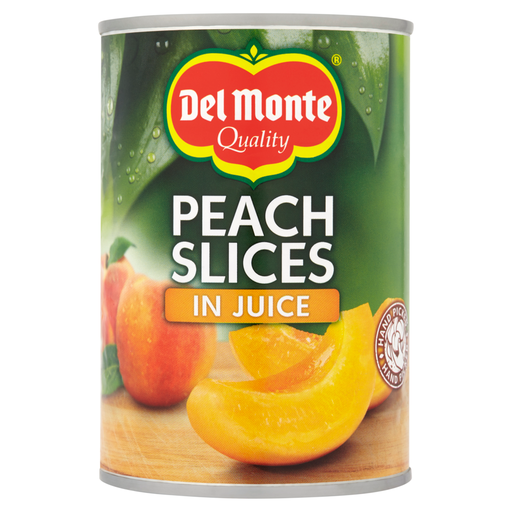 Image unavailable
The 415g tin combines a regular size with peach slices that can be divided between portions. If you are comparing how much fruit you will get, check the exact tin for its drained weight and instructions for leftovers.
Yes. The NHS says 80g of canned fruit or vegetables counts as one 5 A Day portion and advises choosing canned fruit in natural juice or water with no added sugar or salt.
Transfer leftovers to a suitable container and refrigerate them rather than leaving them in the opened tin. Follow the particular product's instructions: the Del Monte peach-halves product listed by Tesco Groceries specifies use within three to four days, while Marks & Spencer specifies two days for its grapefruit segments.
No. GOV.UK explains that best-before dates concern quality, while use-by dates concern safety. Also check the tin's condition and follow its storage instructions.
A deep dent is a reason to avoid it: food-safety advice published by Health Well warns that deep denting can conceal a split or damaged seal. Choose an undamaged tin for lunch.