Shared-dessert hosts
You need enough fruit for several people after a Sunday roast and plan to serve it in one dessert rather than open individual portions.


For a dessert served from one bowl, start with a larger tin and check its drained weight against the recipe and number of diners; choose individual pots when separate servings matter more. Fruit cocktail suits a mixed-fruit dessert, while a named fruit and cut are easier to match to a specific recipe. Check whether juice or light syrup suits the finished pudding rather than treating the two as interchangeable.
You need enough fruit for several people after a Sunday roast and plan to serve it in one dessert rather than open individual portions.
You are making a trifle, crumble or pie and need the fruit type, cut and packing liquid to fit the recipe.
You plan to serve fruit with yoghurt, custard or cream and want to choose the packing liquid deliberately, particularly if the recipe does not call for syrup.
For a Sunday-roast dessert, decide how the fruit will be served, then check the usable quantity, fruit format and packing liquid.
| Concern | What to check | Who this matters to |
|---|---|---|
| Enough fruit to share | Compare the recipe quantity with the drained weight, where stated; net tin weight includes liquid. | If fruit is going into one dessert for several diners, I need to know how much I can actually serve. About 36% of consumers put shared quantity first. |
| Juice or light syrup | Read the packing liquid, ingredients and nutrition panel for the exact variant. | When the rest of my pudding is already sweet, I want to choose the fruit's packing liquid deliberately. Packing liquid is the primary concern for about 29% of consumers. |
| Fruit type and cut | Check whether the recipe needs a named fruit and cut or allows a mixed cocktail. | For a pie, crumble or trifle with a specified fruit, I need pieces that fit the recipe rather than an unpredictable mix. About 21% of consumers prioritise recipe fit. |
| Separate portions | Match the number and size of pots to the diners instead of assuming a multipack serves the same purpose as a shared tin. | If everyone wants their own portion, individual pots make serving straightforward without opening a large tin. Separate portions come first for about 14% of consumers. |
Net weight includes the packing liquid, so similarly sized tins need not provide the same amount of fruit.
Check drained weight where it is shown, then compare it with the quantity your dessert needs.
The packing liquid changes the ingredients and the dessert's sweetness. Princes lists 9.0g sugars per 100g for its Fruit Cocktail with Juice and 15.0g per 100g for its Fruit Cocktail in Light Syrup; those figures apply to these variants, not every tin of fruit.
Read the exact product's ingredients and nutrition panel, and choose syrup when its sweeter liquid suits the recipe.
Princes states that the fruits in its cocktail occur in variable proportions, so a tin cannot provide a predictable amount of each fruit.
Choose a named fruit and cut, such as peach slices, when the recipe calls for them; use cocktail where a variable mix is acceptable.
Food-safety guidance carried by Health Well says not to store food in an opened tin.
Transfer leftovers to a covered food-safe container, refrigerate them and follow the pack's instructions for use after opening. Check the tin for visible damage before use.
Princes lists both 410g and 220g formats for its Peach Slices with Juice and Fruit Cocktail with Juice.
Tesco Groceries lists Del Monte fruit cocktail and named-fruit tins in approximately 415–420g formats.
Tesco Groceries lists own-brand larger tins alongside Pear and Peach Pieces in a 4 x 120g pot format.
M&S describes its tinned rhubarb as an ingredient for pies and crumbles.
These selections cover larger tins for a shared Sunday dessert and a four-pot option for separate servings. Choose by the fruit your recipe needs, the packing liquid and the quantity you can serve.
 No image available
Consider this 415g tin when a shared dessert calls for pear halves rather than mixed fruit. Check the drained weight against your recipe and whether the juice suits the finished pudding.
 No image available
This 432g tin is an option when the dessert needs pineapple chunks served together. If the recipe specifies a quantity of fruit without liquid, check the drained weight on the product label.
 No image available
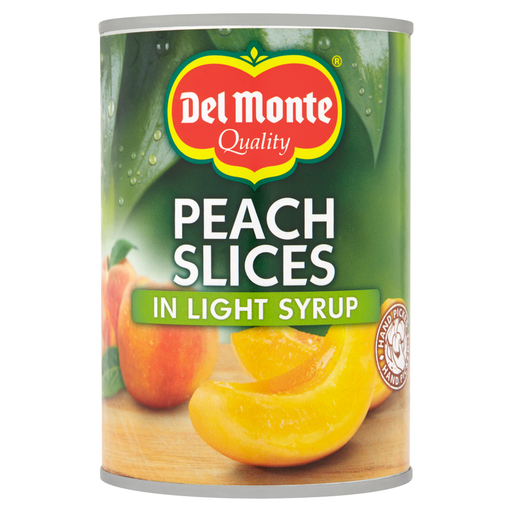
Choose this 420g tin if a shared dessert needs peach slices and light syrup suits the recipe. Check the drained weight for the usable quantity of peaches; do not substitute it for a juice-packed tin without considering the liquid.
 No image available
This 415g tin suits a shared dessert where a fruit mix is welcome. For a recipe needing a set amount of one fruit, choose a named-fruit tin instead and check its drained weight.
 No image available
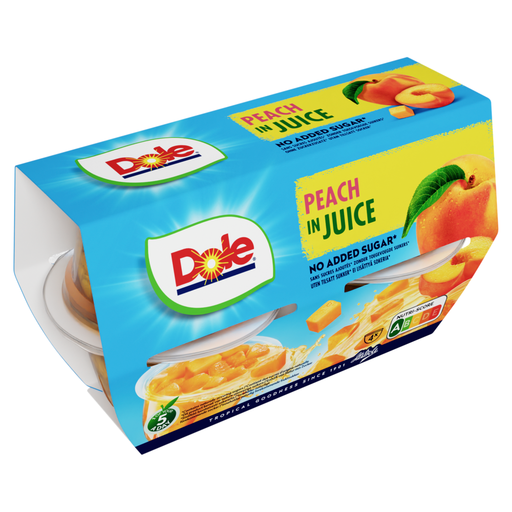
Choose the four 113g pots when separate peach portions suit the diners better than one shared tin. Check the ingredients and the fruit quantity per pot if either matters to your dessert.
Start with your recipe and the number of diners, rather than assuming one tin will be enough. Princes and Del Monte list shared-tin examples around 410–425g; check drained weight where stated because net weight includes the liquid.
Choose according to the sweetness and liquid your dessert needs. Princes lists 9.0g sugars per 100g for its Fruit Cocktail with Juice and 15.0g per 100g for its Fruit Cocktail in Light Syrup, but check the nutrition panel of the exact product you buy.
Yes, Princes describes its fruit cocktail as suitable for trifle. Its fruits are present in variable proportions, though, so use a named-fruit tin if the recipe requires a particular amount of one fruit.
Transfer leftovers out of the opened tin into a covered food-safe container and refrigerate them. Follow the product's instructions for how soon to use the fruit after opening.