Vegan label-checkers
Shoppers who want to establish whether a particular product fits their diet by checking its current label, rather than relying on the fruit category alone.


For everyday vegan storecupboard shopping, start with fruit packed in natural juice or water, then check the current pack’s ingredients and vegan information rather than assuming every tinned fruit is suitable. Syrup-packed fruit may suit a particular dessert, while the fruit format, pack size and instructions for opened leftovers determine which option is practical for your household.
Shoppers who want to establish whether a particular product fits their diet by checking its current label, rather than relying on the fruit category alone.
People keeping fruit for breakfasts, snacks or cooking who prefer to look for natural juice or water instead of choosing syrup by default.
Shoppers who need a pack size they can use within that product’s instructions for storage after opening.
Choose a fruit format and packing medium that suit the intended meal, then check the current pack for dietary information and opened-storage instructions.
| Concern | What to check | Who this matters to |
|---|---|---|
| Vegan suitability and allergens | Check the current pack’s vegan information and ingredients. If you have an allergy, read its allergen and precautionary wording separately. | When vegan suitability is my deciding factor, I want information for the exact product rather than an assumption about fruit. About 33% of consumers put product-level dietary checks first. |
| Juice, water or syrup | Read the packing-medium and ingredient labels; check whether the product has added sugar. The NHS advises choosing canned fruit in natural juice or water with no added sugar or salt. | For routine breakfasts or snacks, I would choose the packing medium deliberately rather than treat syrup and juice as the same choice. Around 27% of consumers prioritise a juice-or-water option. |
| Fruit format and usable quantity | Match chunks, slices, halves or segments to the recipe, and compare the stated drained weight and servings where available. | If I am preparing a recipe or portioning snacks, the amount of fruit I can use matters more than the can’s overall size. About 27% of consumers put format and usable quantity first. |
| Leftovers after opening | Check the product’s refrigeration, container and use-by instructions before choosing a larger pack. | In a small household, I need to be able to finish an opened pack within its stated storage period. Roughly 13% of consumers make leftover management their primary concern. |
A vegan statement addresses a different question from allergen information. It cannot establish whether a product is suitable for someone with a particular food allergy.
Read the ingredients, highlighted allergens and relevant precautionary wording on the current pack, even when it is marked vegan.
The packing medium changes the choice when avoiding added sugar is a priority, although syrup may be wanted for a dessert recipe.
For routine cupboard use, look for natural juice or water and check the ingredients for added sugar; choose syrup deliberately when the recipe calls for it.
Opened-storage periods vary by product. Asda instructs shoppers to use its 432g pineapple chunks within four days of opening, while M&S specifies two days for its grapefruit segments.
Choose a size you can use in time, and follow that pack’s directions for transferring and refrigerating any remaining fruit.
A listing is useful for narrowing down fruit types and formats, but the product in hand carries the information you need when making a dietary or allergen check.
Read the current pack’s ingredients, vegan information and allergen wording before use.
These examples show why it is worth comparing individual products within a range: packing media, ingredients and storage instructions differ.
A reference point for shoppers comparing familiar tinned-fruit formats, including pineapple, peaches and pears.
A branded range to compare when choosing a fruit type for snacks or recipes.
An own-label range to inspect alongside branded tinned fruit when matching fruit type and format to a recipe.
An own-label option for shoppers comparing fruit in juice with a syrup-packed alternative.
Its pineapple chunks in fruit juice provide a specific example for planning a shared dish or fruit salad.
A reference for shoppers who want an explicit vegan marking on a particular tinned-fruit product.
These juice-packed choices cover pineapple, mixed fruit, peaches and pears in tins, plus a mandarin pot for shoppers who do not require a metal can. Check each current pack for vegan suitability and any allergen information relevant to you.
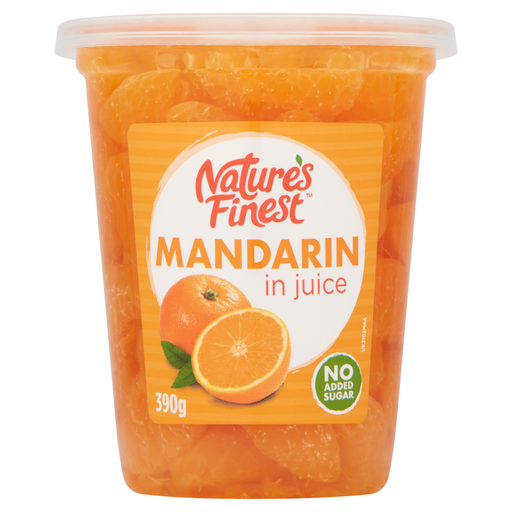 No image available
Consider this mandarin option for snacks or fruit salads if a pot, rather than a metal tin, suits your cupboard. The 390g product is described as packed in pear juice; check the current pack’s vegan and allergen information.
 No image available
Choose the slice format when it fits a fruit salad or dessert. This is a 435g juice-packed pineapple product; check the current pack for vegan suitability and allergen information.
 No image available
This 415g mixed-fruit tin suits a recipe that calls for several fruits together rather than one type. Its listed ingredients include colour E127; check the current pack’s ingredients and vegan information against your dietary requirements.
 No image available
Peach halves offer a different cut for snacks or desserts. This 415g product is packed in juice; check the current pack for vegan information and its instructions for opened leftovers.
 No image available
Consider these pear halves when a juice-packed fruit is needed for a snack, salad or dessert. The tin is 415g; check its current vegan and allergen information and follow the pack’s opened-storage directions.
Do not assume suitability from the category alone: check the ingredients and any vegan information on the current product. M&S, for example, explicitly marks its Grapefruit Segments as vegan; that marking applies to that product, not every tinned fruit.
If avoiding added sugar is your priority for everyday cupboard fruit, follow NHS advice to look for canned fruit in natural juice or water with no added sugar or salt. Syrup-packed fruit is a separate, recipe-led choice when you want that packing medium for a dessert.
No. Check the current pack’s allergen declaration and relevant precautionary wording separately; vegan suitability does not establish suitability for a person with a food allergy.
Follow that product’s storage instructions rather than applying one time limit to every can. Asda says to transfer leftover pineapple chunks to a suitable non-metallic container, cover and refrigerate them, and use them within four days; M&S says to transfer its grapefruit segments to a non-metallic container, refrigerate and eat them within two days.
Yes. The NHS counts 80g of canned fruit as one portion of fruit or vegetables and advises choosing canned fruit in natural juice or water with no added sugar or salt. Check the product’s serving information rather than assuming a whole can is one portion.