Salt-conscious festival campers
If the rest of your festival food includes salty convenience foods, the salt figure on the fruit tin matters more than a vague reduced-salt search term. Compare the current label per 100g.


For a festival without reliable refrigeration, choose a tin you can finish or share when opened, and compare its salt figure per 100g with nidirect’s low-salt threshold of 0.3g or less. Fruit in juice offers an alternative to syrup, but the packing liquid alone does not establish the salt or sugars value: check both lines on the exact tin.
If the rest of your festival food includes salty convenience foods, the salt figure on the fruit tin matters more than a vague reduced-salt search term. Compare the current label per 100g.
Choose a portion you expect to finish when you open it. A larger tin creates a storage decision if fruit is left over and you cannot refrigerate it.
A group eating together can consider a larger tin, then choose between juice and syrup according to the intended dish and the exact product’s ingredients and sugars value.
Check salt per 100g first, then choose a quantity you can use when opened. Packing medium and sugars are separate choices.
| Concern | What to check | Who this matters to |
|---|---|---|
| Salt on the exact tin | Compare salt per 100g on the current label. Nidirect describes 0.3g or less per 100g as low salt. | If other food in my festival bag is salty, I want the fruit’s salt value to be clear before I pack it. About 45% of consumers put that label comparison first. |
| A usable portion | Compare drained weight and stated servings with how many people will eat it; check the opening method. | Without a cooler, I need to finish the tin when it is opened rather than manage leftovers in a tent. That is the primary concern for about 33% of consumers. |
| Juice or syrup | Read the packing-medium ingredients and sugars per 100g; a low salt figure does not answer the sweetness question. | For fruit eaten on its own or used in a dessert, I want to decide whether juice or syrup suits the occasion. Roughly 22% of consumers make that choice their first priority. |
Salt values belong to individual products, not the tinned-fruit category or a particular packing medium.
Use the current per-100g label rather than relying on a search term or brand name. Nidirect’s low-salt figure is 0.3g or less per 100g.
Asda’s pineapple chunks and Del Monte fruit cocktail have post-opening instructions involving covered, refrigerated storage. That is awkward without reliable chilling.
Choose a tin you can finish, or arrange for your group to share a larger one at the same meal. Follow the selected tin’s storage instructions if any remains.
Net weight includes the packing liquid, so it need not represent the amount of fruit you intend to eat. Tesco lists 136g drained weight for its 227g pineapple slices in juice.
Check drained weight and stated servings when deciding between a solo portion and a tin for sharing.
Sainsbury’s lists fruit in juice alongside light-syrup options. The salt line does not tell you which packing medium or sugars value you are buying.
Read the ingredients and sugars per 100g on the exact tin as well as its salt figure.
These examples show different fruit and pack-size choices; check the individual product rather than extending one tin’s label to an entire range.
Own-label tinned fruit includes pineapple in juice.
Princes lists pineapple chunks in juice in 227g and 432g sizes.
The Asda pineapple chunks in fruit juice are a 432g tin labelled as three servings.
Del Monte fruit cocktail in juice and pear halves in juice are among the fruit choices shown in the supplied retailer and manufacturer information.
M&S lists tinned fruit such as grapefruit segments and rhubarb chunks.
These Joybuy tins are fruit in juice in 410g to 435g sizes. For camping without a cooler, decide whether you or your group can finish a tin when opened; compare the current nutrition label and opening method before packing.
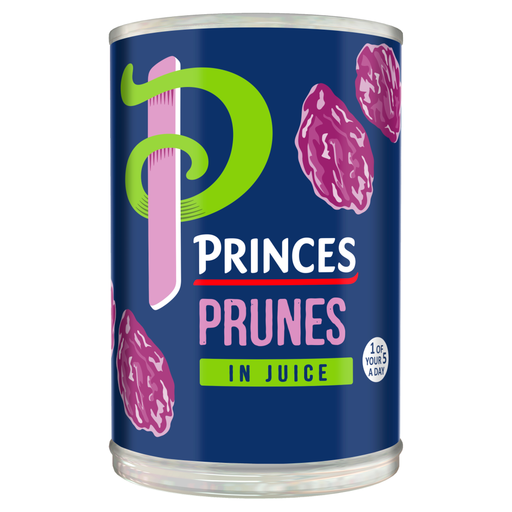 No image available
Consider this 410g tin if prunes suit the fruit you want to share or finish at one sitting. The product information warns that it contains plum stones; take care when serving, and plan for refrigeration if you expect leftovers.
 No image available
These pineapple slices in juice come in a 435g tin. If you are camping alone without chilled storage, check whether that is an amount you can eat when opened rather than keeping the remainder in your tent.
 No image available
This 415g fruit cocktail offers mixed fruit in juice for a shared serving. If any remains after opening, follow the tin’s refrigerated-storage instructions rather than leaving it at the campsite without chilling.
 No image available
Choose these 415g peach halves if that fruit and packing medium suit your planned meal. For a no-cooler trip, decide in advance who will eat the opened tin and check its current salt and sugars figures.
 No image available
These pear halves in juice are supplied in a 415g tin. Check the labelled salt value for the low-salt decision, and make sure the amount works for the people eating together if you cannot refrigerate leftovers.
Nidirect describes 0.3g salt or less per 100g as low. Use the per-100g figure on the exact tin you plan to take; being packed in juice does not establish its salt value.
Tesco lists less than 0.01g salt per can for its 227g pineapple slices, while Asda lists less than 0.01g per 100g for its 432g pineapple chunks and Princes lists 0.05g per 100g for its pineapple chunks in juice. Tesco’s figure uses a different quantity, so compare the per-100g labels directly before choosing between tins.
Do not plan to keep leftovers in an unchilled tent. The Asda pineapple and Del Monte fruit-cocktail instructions call for suitable covered, refrigerated storage after opening. Without reliable refrigeration, choose an amount you can finish or share at the same meal.
No conclusion about sugars follows from a low salt figure. Juice, light syrup and syrup are different packing choices; compare the ingredients and sugars per 100g on the particular tins you are considering.