Carers choosing fruit for packed lunches
For a school-holiday lunch, the packing liquid is an early decision. NHS lunchbox guidance suggests a small pot of tinned fruit in juice, rather than syrup.


For a school-holiday lunch, choose tinned fruit in juice rather than syrup if you want to follow NHS lunchbox guidance. Individual pots make it easier to pack one portion at a time; a larger tin makes more sense when you can portion the fruit and use any leftovers according to its label. Check the packing liquid, ingredients, drained weight where shown, and instructions after opening.
For a school-holiday lunch, the packing liquid is an early decision. NHS lunchbox guidance suggests a small pot of tinned fruit in juice, rather than syrup.
When fruit will be served more than once, the choice between a larger tin and separate pots affects portioning work and how much opened fruit needs storing.
Drained weight, where displayed, helps distinguish the amount of fruit from the total weight of fruit and liquid.
Choose the packing liquid for the intended lunch, then pick a format your household can portion and use within the product’s after-opening instructions.
| Concern | What to check | Who this matters to |
|---|---|---|
| Packing liquid | Check whether the fruit is in juice, water or syrup; compare the ingredients and sugars per 100g on the exact product. | If I am packing fruit for lunch, I want to distinguish juice from syrup without relying on the word “light”. About 36% of consumers put that packing-liquid choice first. |
| Portioning and storage | Compare individual pots with tins you would need to portion, and read the instructions for any fruit left after opening. | When several lunches need preparing, I would rather open a separate pot than store part of a tin. That convenience is the primary need for about 29% of consumers. |
| Amount of fruit | Use drained weight where shown to compare fruit content, not just the total weight including liquid. | If a tin will serve several people, I need to know how much of it is fruit. Roughly 21% of consumers make usable fruit quantity their main concern. |
| Fruit and cut | Check the fruit type, whether it comes as slices or smaller pieces, and the ingredients for the exact product. | For a lunch that is likely to be eaten, I want a fruit and cut that suit the child and the meal. About 14% of consumers put that fit ahead of the other concerns. |
NHS lunchbox guidance specifically suggests a small pot of tinned fruit in juice, not syrup. A light-syrup label does not mean the fruit is juice-packed.
Read the packing-liquid description and ingredients before comparing the nutrition panels of products you are considering.
The stated total includes liquid, so tins of similar size need not contain the same amount of fruit.
Where drained weight is displayed, use it to compare similar fruit formats and consider whether you will use the opened tin.
Tesco’s listings include both juice-packed and light-syrup Del Monte peaches. The brand alone cannot tell you which liquid is in a particular tin.
Check the full product name, ingredients and nutrition panel for the variant you intend to serve.
A larger tin needs a plan for any fruit not served immediately; after-opening directions are product-specific.
Choose a pack size you can use within its stated storage and use instructions.
Tesco’s tinned-fruit listings include Del Monte peach slices and halves, with both juice-packed and light-syrup peach variants.
Princes lists Peach Slices with Juice in 410g and 220g sizes on its product page.
Tesco’s own-label range includes tinned fruit in juice and smaller fruit formats.
These juice-packed peach, mixed-fruit and pineapple options cover smaller lunch portions and tins to portion at home. Match the format to how many servings you need and how you will handle opened fruit.
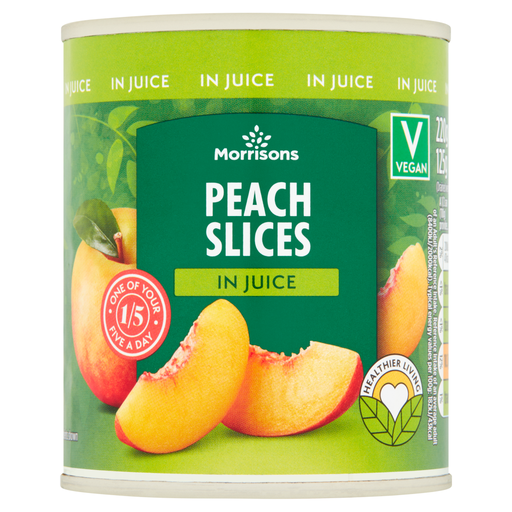 Image unavailable
The 220g tin is a smaller option when you do not need to open a larger tin for lunch. Its product description says stone fragments may occasionally remain, so check the fruit when serving it, particularly to younger children. It directs you to transfer leftovers to a non-metallic container, refrigerate them and use them within two days.
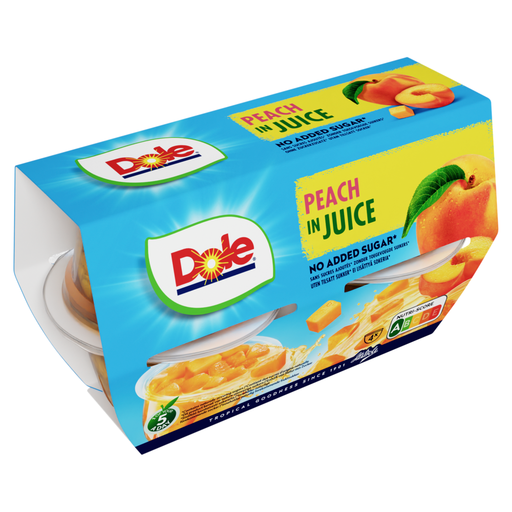 Image unavailable
Four separate peach pots suit lunches prepared one portion at a time. The ingredients include white grape juice and steviol glycosides; check the nutrition panel if comparing them with another juice-packed product. The product description says to refrigerate an opened pot and use it within two days.
 Image unavailable
This tin suits a shared serving when a mixture of fruit is wanted. It contains peaches, pears, pineapple, grapes and cherries in clarified pineapple juice; the stated drained weight is 235g. The ingredient list includes colour E127 in the cherries. The product description directs you to cover and refrigerate unused contents in a suitable non-metallic container and use them within 3–4 days.
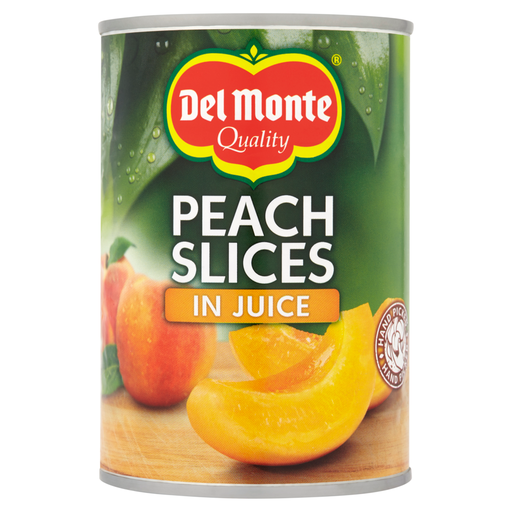 Image unavailable
The 415g tin provides peach slices in clarified pineapple juice to portion for several servings. To compare how much fruit it contains with another tin, check the drained weight on the product label. The product description directs you to transfer unused contents to a non-metallic container, refrigerate them and use them within 3–4 days.
 Image unavailable
This 432g tin offers pineapple chunks in juice when you want a different fruit to portion into lunches. Check the label’s drained weight if comparing fruit quantities. The product description directs you to transfer leftovers to a sealed container, refrigerate them and use them within two days.
Yes. NHS guidance says 80g of fresh, canned or frozen fruit and vegetables counts as one portion of 5 A Day. For canned fruit, it advises choosing fruit in natural juice or water with no added sugar or salt.
For this lunchbox use, NHS guidance suggests a small pot of tinned fruit in juice, not syrup. Syrup may be a deliberate choice for a dessert or recipe, but check the packing liquid rather than treating “light syrup” as another name for juice.
Follow that product’s instructions for transferring, refrigerating and using the leftovers. Check them before choosing a larger tin, as the directions can differ between products.