People arranging a meal for one
If the recipient cannot store or use a leftover portion, a smaller tin may be easier to manage. Tesco lists Heinz spaghetti in a 200g tin, while the Sainsbury's 400g rings are labelled as two servings.


Choose a 200g tin when one person needs a smaller amount and storing leftovers would be difficult. A 400g or 410g tin makes more sense when two portions are planned, or someone can refrigerate and use the remainder as the label directs. Check the amount actually served, ingredients, allergens, salt and heating instructions against the recipient’s meal plan; one tin should not automatically be treated as a complete meal.
If the recipient cannot store or use a leftover portion, a smaller tin may be easier to manage. Tesco lists Heinz spaghetti in a 200g tin, while the Sainsbury's 400g rings are labelled as two servings.
For an older or vulnerable recipient, consider what else is being served rather than judging the meal by the tin alone. Compare the label for the portion actually served; the NHS advises adults to have no more than 6g of salt a day.
Check that the available hob or microwave suits the tin's directions, and read the current ingredient and allergen declaration before serving. The researched tomato-pasta examples include wheat-based products.
Start with the recipient's dietary requirements and the portion you intend to serve, then check whether the available equipment allows the food to be heated as directed.
| Concern | What to check | Who this matters to |
|---|---|---|
| Dietary fit and meal planning | Read the current ingredients and allergens; compare salt and nutrition for the portion served with the recipient's meal plan. | If I am planning food around someone's dietary requirements, I need to know whether this tin fits alongside the rest of their meal. About 42% of consumers put that dietary fit first. |
| Portion and leftovers | Compare tin size with labelled servings, and check the storage directions before planning a split portion. | When I am serving one person, I want an amount they can use without leaving food they cannot store. Portion fit is the primary concern for about 33% of consumers. |
| Heating | Check the tin's hob or microwave directions against the equipment available; follow its instructions for decanting and heating. | If a carer has limited preparation time or only one appliance available, I need a heating method they can follow. About 25% of consumers prioritise that practical need. |
Sainsbury's and Stamford Street Co. label their 400g spaghetti rings as two servings. Opening either tin for one person leaves a portion to manage if the whole contents are not needed.
Choose a smaller tin when that better matches the planned serving, or decide how the remainder will be stored before opening a larger one.
A leftover portion may go to waste if no one can refrigerate and use it as directed.
Sainsbury's lists 0.77g of salt per half-can of its 400g rings. Serving more than half changes the amount of salt in the meal; the NHS adult daily maximum is 6g.
Use the label to work out the salt in the amount served, and consider other food in the recipient's day.
A vegetarian claim does not establish that pasta is free from wheat or suitable for a particular dietary requirement. Ingredients and recipes can change.
Read the current tin's ingredient and allergen declaration for the person who will eat it.
The researched Sainsbury's products direct users to empty the contents into a suitable dish for microwave heating or a saucepan for hob heating.
Follow the directions on the particular tin, including stirring or standing where specified, and check that the food is piping hot before serving.
Tesco lists Heinz tomato spaghetti in a 200g tin, while the researched range also includes a 400g format.
Its own-label spaghetti rings come in a 400g tin labelled as two servings.
Sainsbury's lists this range's tomato spaghetti rings in a 400g, two-serving tin.
M&S lists spaghetti hoops in tomato sauce in a 410g tin.
Tesco's tinned-pasta range provides a place to compare own-label products and other brands, including different tin sizes.
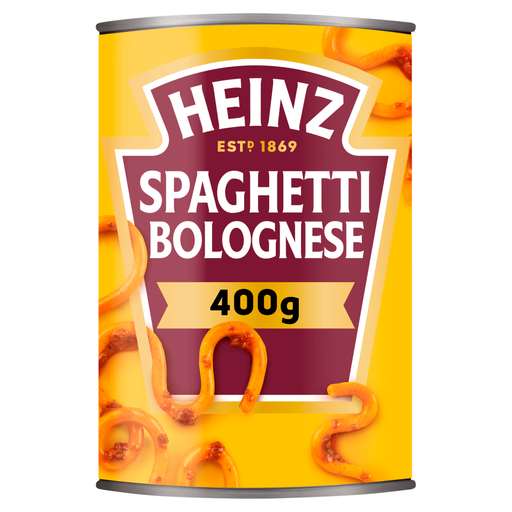
This selection is a single 400g tin of spaghetti Bolognese. Consider it where that format fits the planned portion and the recipient's dietary requirements.
 No image available
This 400g tin is worth considering when the serving size and any remainder can be planned before opening. Check the current ingredients and allergens against the recipient's requirements, and follow the tin's heating and storage directions.
Do not assume that it is. The NHS Eatwell Guide considers balance over a day or week, while the Heinz 200g tomato spaghetti listing gives 124 kcal and 3.3g of protein per can. Consider the tin alongside the recipient's other food and any individual meal plan.
Check the planned portion and the particular product label first. Sainsbury's and Stamford Street Co. label their 400g rings as two servings; a whole tin of the Sainsbury's rings would contain 1.54g of salt, based on its label value of 0.77g per half-can.
Follow the product's directions rather than putting the tin in the microwave. The researched Sainsbury's pasta instructions say to empty the contents into a microwaveable dish, then follow the stated heating, stirring and standing steps.
Follow the storage directions on that tin. The researched Sainsbury's and Stamford Street Co. examples direct users to transfer unused contents to a non-metallic container, refrigerate them and use them within two days.
A vegetarian description does not establish wheat-free suitability. Check the current ingredients and highlighted allergens on the exact tin before serving it to someone who needs to avoid wheat.