Cupboard top-up shoppers
If you want one tin of pasta in sauce for the Easter food shop, canned pasta lets you avoid buying separate pasta and sauce.


Choose a tin of pasta in sauce if you want one cupboard item that needs little preparation. A chilled pasta meal serves a different need and must be stored as its label directs; dried pasta suits a dish you plan to cook, but it is not a substitute for a literal tin. For an Easter food shop, check the pack size, ingredients, allergens and storage instructions before choosing.
If you want one tin of pasta in sauce for the Easter food shop, canned pasta lets you avoid buying separate pasta and sauce.
If the aim is a quick meal rather than a tin, a ready-to-heat pasta product may fit. Check whether the particular product needs refrigeration before bringing it home.
If pasta is part of a cooked dish for guests, choose the pasta and accompanying ingredients together. Check the exact packs for allergens and any dietary requirements.
Decide whether you need a tin, an individual ready meal or an ingredient for a cooked dish; then compare packs within that format.
| Concern | What to check | Who this matters to |
|---|---|---|
| Format and preparation | Check whether the item is canned pasta in sauce, a ready-to-heat meal or dried pasta. For a chilled meal, check its storage instructions. | If I want a cupboard fallback, a dry pack or a refrigerated meal will not do the same job. About 40% of consumers put choosing the right format first. |
| Quantity for the meal | Compare net weights and any serving guidance with the number of people eating. | One tin might be for my own meal or part of a meal for others, so I need an amount I can use. For about 30% of consumers, usable quantity is the primary concern. |
| Ingredients and allergens | Read the current pack's ingredient and allergen information; check sauces and toppings separately. | When cooking for someone with a dietary requirement, I cannot judge suitability from the pasta's appearance. About 20% of consumers prioritise ingredient and allergen checks. |
| Cooking flexibility | For a cooked dish, check the dry pasta's cooking instructions and whether you have the other ingredients needed. | If I am making an Easter pasta course, I want to choose the sauce and prepare the dish myself. That flexibility comes first for about 10% of consumers. |
Sainsbury's lists canned pasta in both 200g and 400g formats. The number of tins alone does not tell you whether there is enough for the intended meal.
Compare net weight and any serving guidance with how you plan to use it.
A tin of pasta in sauce, a ready-to-heat meal and dried pasta call for different preparation or storage. M&S, for example, instructs shoppers to refrigerate its tomato-and-basil spaghetti meal at 0°C to +5°C.
Choose the format for the job first, then follow the selected product's storage and preparation instructions.
Tomato sauce does not establish what is in the pasta or the complete meal. M&S lists durum wheat semolina in its dry spaghetti, while ready meals and sauces have their own ingredients.
Check the current label on every component. If gluten-free pasta is required, look for an explicitly labelled product and check its sauce and toppings too.
Ingredients, storage directions and dates need to be checked on the product you receive, particularly when buying for someone with an allergy.
Use listings to narrow your choice, then read the pack before preparing or serving the food.
Its canned-pasta category is relevant if you mean a literal tin; the listing includes own-label spaghetti rings, spaghetti and ravioli.
A canned-pasta option for shoppers considering spaghetti, hoops, ravioli or other pasta in sauce.
Relevant if one ready-to-heat meal, rather than one tin, would meet the need. Tesco lists a 250g Dolmio rigatoni bolognese meal.
A dry-pasta route for a cooked Easter dish, not a single-tin option.
Offers examples of two distinct routes: dry spaghetti for cooking and a refrigerated spaghetti meal.
For a literal single-tin purchase, this canned pasta in sauce fits the cupboard top-up route. Check its pack size and ingredients against the Easter meal you have in mind.
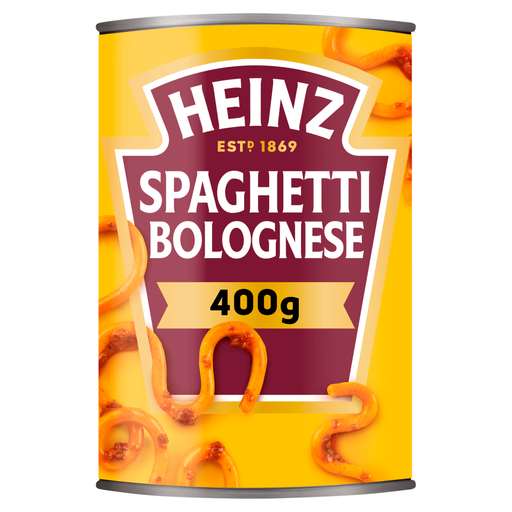 Image unavailable
Consider this tin if you want pasta in sauce as one cupboard item, rather than dry pasta for a recipe. Its 400g size does not establish how many people it will serve. It contains beef, wheat and soya; check the current pack for full ingredients, allergens and instructions for any leftovers.
No. Sainsbury's lists canned pasta in both 200g and 400g formats, and one tin does not define a serving. Check the net weight and any serving guidance against the role it will play in your Easter meal.
Yes, if a ready-to-heat meal meets your need and you can follow its storage and date instructions. For example, M&S specifies refrigeration at 0°C to +5°C for its tomato-and-basil spaghetti meal; check the label on the product you choose.
Read the ingredient and allergen information on the exact pasta product, then check any sauce or toppings separately. Do not assume that standard wheat pasta and an explicitly labelled gluten-free product have the same ingredients, or that a tomato-based meal is suitable without checking its full label.