Older adults eating alone
If opening a 400g tin regularly leaves an unused portion, a smaller format may make meals easier to plan. Research by the University of Hertfordshire identified minimising food waste as a concern among older shoppers.


Choose a smaller tin of prepared pasta if one person is unlikely to eat a second portion; a 400g tin makes sense when the remainder can be transferred, refrigerated and used as its label directs. Compare the nutrition and allergens on the exact pack rather than assuming either size meets an older adult's needs. For someone with a prescribed texture-modified diet, follow their clinician's advice instead of judging ordinary tinned pasta by appearance.
The useful pack size depends on how much the person will eat, whether a remainder will be used and whether they have requirements that a standard prepared meal cannot address.
If opening a 400g tin regularly leaves an unused portion, a smaller format may make meals easier to plan. Research by the University of Hertfordshire identified minimising food waste as a concern among older shoppers.
When appetite or weight has changed, check the calories and protein in the portion likely to be eaten, not just the size of the tin. NHS information identifies older adults as a group at particular risk of malnutrition; individual concerns need assessment rather than a general rule based on age.
If the person has dysphagia or a prescribed texture-modified diet, an ordinary pasta tin is not automatically suitable. The International Dysphagia Diet Standardisation Initiative says food should be assessed under its intended serving conditions and individual recommendations are the clinician's responsibility.
For consumers choosing prepared tinned pasta for an older adult, start with any prescribed texture requirements, then consider the portion they will actually eat and the work involved in keeping leftovers.
| Concern | What to check | Who this matters to |
|---|---|---|
| Texture and swallowing | Check for a prescribed texture level and follow the clinician's advice on the food as served, including its pasta pieces and sauce. | If someone needs a prescribed food texture, I cannot choose by how soft the pasta looks in the tin. About 25% of consumers put texture suitability first. |
| Calories and protein | Read the figures for the portion the person is likely to eat; seek individual advice if appetite or weight changes are a concern. | When a small portion is all that will be eaten, its calorie and protein figures matter to the meal decision. Roughly 25% of consumers prioritise this nutrition check. |
| Portions and leftovers | Compare net weight with a usual portion and read the exact tin's instructions for storing any remainder. | Living alone can make a second portion easy to overlook, so I want a pack that fits a realistic meal plan. Around 20% of consumers put portion and leftover handling first. |
| Salt and labels | Compare salt per intended portion and per 100g; check ingredients and allergens on the exact pack. | If I am comparing tins with different serving sizes, the label helps me see what the intended portion contains. About 15% of consumers make label comparison their primary concern. |
| Preparation effort | Check how the tin opens and how the food must be heated, particularly if the person prepares meals independently. | When opening tins or using the kitchen is difficult, a prepared meal only helps if its handling is manageable. Approximately 15% of consumers prioritise preparation effort. |
A 200g and a 400g tin are pack-size choices, not interchangeable meal plans. Sainsbury's lists both sizes for Heinz Spaghetti Bolognese. Its checked 400g pack describes half a can as a serving, so using that size for one person calls for a workable plan for the other half. Jarred pasta sauce is a different route: it still requires separately prepared pasta and any chosen accompaniments.
Older adults do not all have the same appetite, allergies or dietary requirements. A convenient tin cannot answer an individual concern about unintentional weight loss or swallowing.
Check the person's circumstances and seek appropriate clinical assessment where those concerns arise.
The checked Heinz Spaghetti Bolognese 400g pack treats half a can as a serving. Its instructions say to put unused contents in a suitable covered container, refrigerate them and use them within two days.
Choose a smaller tin if the second portion is unlikely to be eaten; otherwise, follow the storage directions on the tin bought.
A larger tin also means handling and storing an opened portion, with potential food waste if it goes unused.
A claim about fat or sugar does not show the calories, protein or salt in the portion the person will eat. Government guidance describes traffic-light labels as an at-a-glance indication of fat, saturates, sugars and salt where those labels appear.
Use the detailed nutrition panel, ingredients and allergen information on the exact pack for the decision at hand.
Pasta pieces and sauce need to be considered as they will be served. The International Dysphagia Diet Standardisation Initiative calls for assessment under intended serving conditions.
Follow the individual clinician's texture recommendations rather than relying on the product description.
These examples help distinguish a prepared tin from sauces that require a separately cooked meal; they are not substitutes for checking the exact product label.
Sainsbury's lists Heinz Spaghetti Bolognese in 200g and 400g tins, providing two prepared-pasta sizes to compare.
The Dolmio Original Bolognese example is a pasta sauce, not a prepared tin of pasta.
Barilla's checked Basilico product is a 400g sauce intended for cooked pasta, rather than a prepared pasta meal.
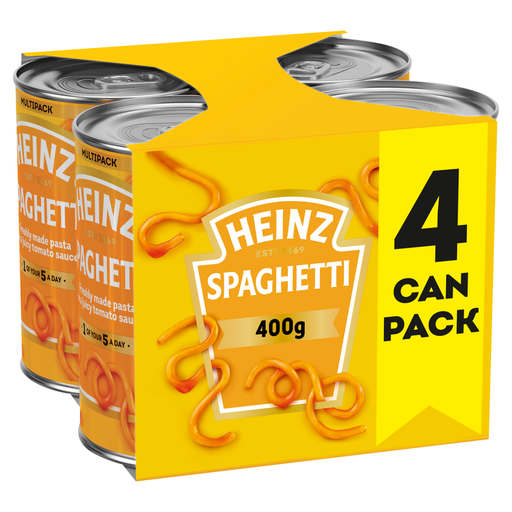
The selection below is a four-can pack of prepared spaghetti, relevant when keeping unopened tins for later meals is useful. It is not a single-tin purchase or a substitute for checking the serving and storage directions on each can.
 No image available
This prepared-spaghetti multipack suits a plan to keep separate unopened cans for later meals, rather than buying one small tin for a single eating occasion. Each can is 400g; check its label for the intended portion, nutrition, allergens and instructions for any opened remainder. Do not assume ordinary spaghetti meets a prescribed texture requirement.
Choose the smaller format if the person is unlikely to use a remainder. A 400g tin can work when two portions are planned and the second can be stored according to that product's label; the checked Heinz Spaghetti Bolognese 400g pack identifies half a can as a serving.
Do not judge that from the tin size alone. Compare the portion likely to be eaten with the pack's calorie, protein, ingredient and allergen information, taking the person's wider diet and any individual advice into account.
Do not assume it meets a prescribed texture level. The International Dysphagia Diet Standardisation Initiative says food should be assessed under intended serving conditions, while a clinician makes recommendations for the individual.
No. The checked Dolmio Original Bolognese and Barilla Basilico products are sauces for use with separately cooked pasta. Consider them when preparing and portioning the rest of the meal is realistic, rather than as a direct replacement for a ready-prepared tin.