Choose larger 400g tins for a back-to-school cupboard if you expect to serve or split them at home; smaller 190g to 205g units make more sense when a separate portion is the priority. Individual tins let you buy fewer meals at a time. Before packing any tinned pasta for school, check the current label, the child’s dietary needs and the school’s arrangements: the Heinz spaghetti and hoops examples here contain wheat.
Who is choosing tinned pasta?
Families checking allergy arrangements
Parents and carers need to establish whether a product fits the child’s dietary needs and the individual school’s arrangements before treating it as a packed-lunch option. The Food Standards Agency and NHS identify wheat-containing pasta as relevant to gluten avoidance; the Department for Education’s allergy guidance applies to covered schools in England.
Households stocking the cupboard
Larger tins may suit meals served or shared at home. Multipacks with the same number of tins can contain different total quantities, so compare net weights before choosing how much to store.
People choosing separate portions
A 190g or 205g unit may be more practical than opening a 400g tin when one smaller serving is wanted. Whether it belongs in a school lunch still depends on the child’s needs and the school’s serving arrangements.
What matters when choosing a tin size?
Check dietary and school requirements before deciding how much pasta to keep in the cupboard or which unit size suits a meal.
| Concern |
What to check |
Who this matters to |
| Allergens and school rules |
Read the current pack’s ingredients and allergen statement. Check the school’s policy and any plan for the child. |
If I am packing lunch for a child who must avoid wheat or gluten, I need to establish whether the food is suitable before considering its tin size. About 42% of consumers put allergen and school-policy fit first. |
| Cupboard quantity |
Compare the number of tins and total net weight; a four-pack of 400g tins contains more pasta than a four-pack of 190g or 205g units. |
When I am stocking meals to serve at home, the amount the household can use matters more than having separate small units. For about 33% of consumers, cupboard quantity is the primary concern. |
| Separate portions |
Match each tin’s net weight to the intended meal. For school use, confirm how the food can be served or heated. |
If one eater needs a smaller, separate unit, I would rather avoid opening a larger tin and managing what remains. Portion convenience comes first for about 25% of consumers. |
Checks that are easy to miss
-
Assuming tomato sauce makes pasta suitable for someone avoiding gluten
The Food Standards Agency identifies pasta as a food that often contains cereals with gluten, and the Heinz spaghetti and hoops examples here declare wheat.
Check the current pack’s ingredients and allergen statement. Where gluten must be avoided, look for a product explicitly labelled gluten-free rather than judging by the sauce.
-
Treating every four-pack as the same amount of food
Four 400g tins contain a different total quantity from four 190g or 205g units. The smaller unit may still be the more practical format for a separate portion.
Compare both the total net weight and the weight of each tin against the meals you intend to serve.
-
Relying on an online ingredient listing alone
M&S cautions that ingredients and allergen information can change. An earlier listing should not decide whether the pack in hand meets a child’s dietary requirements.
Read the physical pack label when buying and again before packing it for school.
-
Assuming every school handles packed lunches alike
The Department for Education’s allergy safety guidance addresses covered schools in England, but the practical arrangements for a particular child and lunch need checking with their school.
Confirm the school’s current allergy and packed-lunch arrangements, including any relevant individual healthcare plan and whether the food can be served or heated there.
Relevant brands and retailer ranges
Heinz
The tinned spaghetti and hoops examples include 4 x 400g multipacks and smaller 190g to 205g units.
- Different unit sizes allow a choice between larger tins for home serving and smaller separate units.
- The spaghetti and hoops examples checked contain wheat; assess the specific pack against dietary needs and school arrangements.
Sainsbury's
Its tinned-pasta range includes individual 400g own-label spaghetti or rings alongside branded multipacks.
- Individual tins offer a way to buy only a few meals rather than a multipack.
- Check the specific product and pack size rather than assuming an individual tin represents a multipack.
Tesco
Its tinned-pasta range includes a 410g own-label spaghetti-rings tin and branded multipacks in several unit sizes.
- The individual tin and multipack formats provide different quantities to compare for cupboard use.
- Check the current product label and listing for the particular format you intend to use.
M&S
M&S lists a 410g Spaghetti Loops tin. Its separately listed gluten-free pasta options are dry pasta, not the same tinned format.
- The individual tin provides another format to consider when a multipack is unnecessary.
- M&S advises reading the physical label because ingredients and allergen information can change.
Joybuy multipacks for the cupboard
These Heinz 4 x 400g tinned-pasta multipacks suit cupboard stocking and meals served or split at home. Check the intended eater’s dietary needs and the school’s arrangements before considering either for a packed lunch.
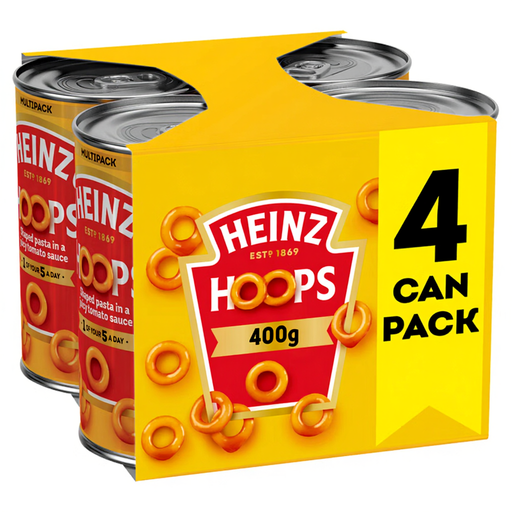 Image unavailable
Heinz Spaghetti Hoops 4 x 400g
The four larger tins suit a household planning to serve or split pasta at home. This product contains wheat, so check the current label and school arrangements before packing it for a child. Follow its instructions for refrigerating unused contents and using them within two days of opening.
View on Joybuy
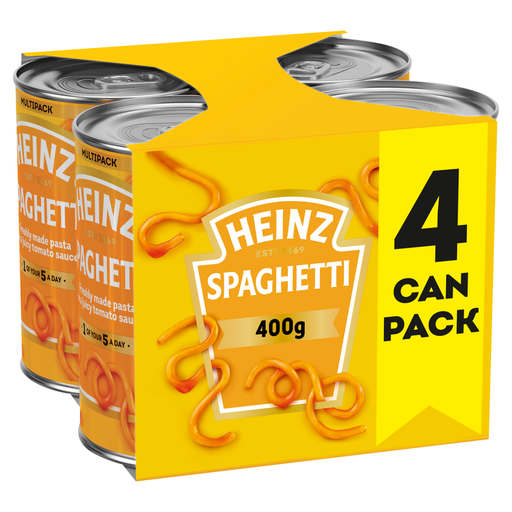 Image unavailable
Heinz Spaghetti in Tomato Sauce 4 x 400g
This four-tin format suits meals served or split at home rather than a separate small portion. The product contains wheat; check the current label and any school requirements before packing it. Follow its instructions for refrigerating unused contents and using them within two days of opening.
View on Joybuy
Questions about tinned pasta for school
Does tinned pasta contain gluten?
The Heinz spaghetti and hoops examples here contain wheat. The Food Standards Agency identifies pasta as a food that often contains cereals with gluten, while the NHS identifies wheat-containing pasta as unsuitable for someone who needs to avoid gluten. Read the current label of the particular product rather than assuming all tinned pasta has the same ingredients.
Can I put tinned pasta in a school packed lunch?
Check the individual school’s allergy and packed-lunch arrangements, the child’s dietary needs and any relevant healthcare plan before packing it. The Department for Education’s allergy safety guidance applies to covered schools in England; it does not establish that a wheat-containing product is suitable for every pupil or school.
How do I compare multipacks with different tin sizes?
Check both the weight of each tin and the total net weight. A four-pack of 400g tins provides larger units than a four-pack of 190g or 205g units; choose according to whether you expect to serve a larger tin at home or want separate smaller portions.
What should I do with pasta left in an opened tin?
Follow the instructions on the specific pack. A Heinz spaghetti listing instructs users to transfer unused contents to a non-metallic container, refrigerate them and use them within two days of opening.


