Visitors with limited cooking equipment
If the second home has few ingredients or utensils, tinned pasta containing both pasta and sauce avoids having to stock the two separately. Check how the tin must be heated if you plan to serve it hot.


If one container must provide both pasta and sauce, choose ready-to-eat tinned pasta and check its size, ingredients and heating instructions. Dry pasta with a cupboard sauce offers more control over portions when the second home has a hob, pan and water, but it requires at least two products; opened sauces and tins also need to be handled according to their individual labels.
If the second home has few ingredients or utensils, tinned pasta containing both pasta and sauce avoids having to stock the two separately. Check how the tin must be heated if you plan to serve it hot.
With a hob, pan and water available, dry pasta and a separate cupboard sauce let you decide how much of each to prepare. This route needs more than one stock item.
The exact recipe matters if an eater needs to avoid an ingredient or follow a particular diet. Pack size and instructions for opened food also matter when visits are short or refrigeration is limited.
Start by deciding whether the item must contain a complete pasta meal, then check whether its size and ingredients suit the people staying.
| Concern | What to check | Who this matters to |
|---|---|---|
| Minimum preparation | Check that the tin contains pasta and sauce, rather than sauce alone, and that its heating directions suit the available equipment. | Arriving at an unstocked kitchen, I want one item that does not require a separate pasta pack or sauce; about 40% of consumers would put minimal preparation first. |
| Portions and leftovers | Compare the net weight and stated servings with your stay, then read the instructions for storing any unused contents. | For a short visit or one eater, I need a container I can finish or store as directed; roughly 30% of consumers would make portion fit their primary concern. |
| Ingredients and recipe | Read the current pack’s ingredients, allergen information and dietary statements; do not assume products in the same category share a recipe. | If someone staying needs to avoid particular ingredients or wants a meat-free recipe, the exact product matters; about 30% of consumers would prioritise dietary and recipe fit. |
Ready-to-eat tinned pasta, dry spaghetti and a jar of sauce serve different purposes. Sauce alone still needs pasta or another serving base.
For a single-tin backup meal, check that the pack contains pasta and sauce together before buying.
Pack sizes and stated servings vary. Tesco lists a 450 g Dolmio Original Bolognese sauce as serving four, while opened tins and sauces have product-specific storage instructions.
Match the pack to the number of eaters and choose a size whose leftovers you can refrigerate and use within the label’s stated period.
The checked recipes differ: Sainsbury’s lists wheat in Heinz tinned pasta, ASDA Groceries lists milk in a Dolmio mascarpone sauce, and Marks & Spencer says its arrabbiata sauce is unsuitable for people with milk or egg allergy despite its vegan label.
Read the ingredients and allergen information on the exact pack, particularly when dietary suitability affects the choice.
GOV.UK distinguishes best-before dates, which concern quality, from use-by dates, which concern food safety.
Check which date the product carries and follow its storage instructions. Do not use smell or appearance to override a use-by date.
Sainsbury’s lists Heinz tinned pasta containing pasta and sauce together, including 205 g pasta shapes in tomato sauce and 400 g spaghetti bolognese.
The checked Dolmio products are pasta sauces, not tins containing a complete pasta meal.
The checked Barilla product is dry spaghetti for a kitchen with cooking equipment, rather than a ready-to-eat tin.
The checked M&S product is a 340 g arrabbiata pasta sauce, not pasta and sauce together.
This option is for stocking pasta and sauce in one tin at a second home. Check its pack instructions against your heating equipment and plans for any leftovers.
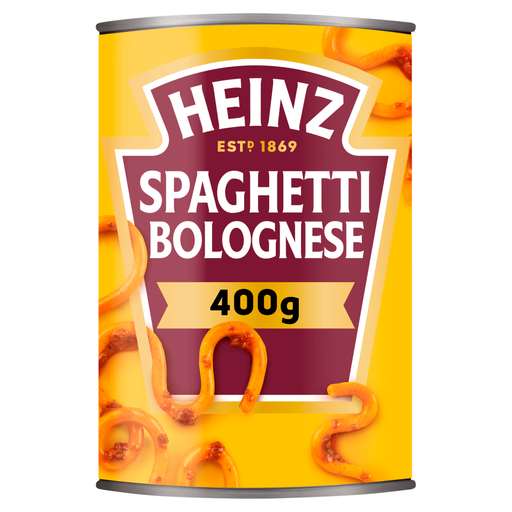 No image available
This single tin contains spaghetti and sauce, so it suits a second home where you do not want to stock those items separately. Sainsbury’s listing for the same 400 g product identifies wheat and beef; check the current pack for ingredients and allergens. Its instructions say to transfer unused contents to a suitable covered container, refrigerate and use within two days. Check the tin’s heating directions if equipment at the property is limited.
No, not if you need one container to provide both pasta and sauce. The checked Dolmio and M&S jars contain sauce, while dry pasta must be prepared separately; choose that route only if you have the other ingredients and cooking equipment.
Follow the instructions on the exact product. The checked Heinz tinned-pasta listings say to transfer unused contents to a suitable covered container, refrigerate and use within two days; the checked Dolmio and M&S sauces say to refrigerate and use within three days.
Not necessarily. Marks & Spencer marks its checked arrabbiata sauce as vegan and vegetarian but also says it is unsuitable for people with milk or egg allergy. Check the current allergen information on the exact pack.
A best-before date concerns quality rather than safety, according to GOV.UK, so food may remain usable after that date but may have changed in quality. Check the product’s date marking and storage instructions; this distinction does not apply to a use-by date, which concerns food safety.