Everyday cupboard stockers
You want 400g tins on hand for family desserts or quick snacks, and need a quantity your household will use while the tins are stored as directed.


For a cupboard reserve, choose 400g tins when your household will use an opened tin within the time stated on its label. Consider a lower-fat recipe when that specific formulation matters, a cream-containing recipe when you prefer its ingredients, or separate portions when an opened tin would leave food unused. Check dates, ingredients and after-opening directions on each pack before buying several.
You want 400g tins on hand for family desserts or quick snacks, and need a quantity your household will use while the tins are stored as directed.
You want a tin with an explicitly lower-fat formulation. Fat is only one part of the label: check sugars, serving size, ingredients and milk allergens for the product you choose.
You may prefer separate portions to avoid opened-tin leftovers, or choose a cream-containing recipe for an occasional dessert. Those are different needs, so check the format and ingredients rather than treating the products as interchangeable.
For a bulk purchase, start with how often you will open a tin, then consider the recipe and whether its portion format fits your household.
| Concern | What to check | Who this matters to |
|---|---|---|
| Regular cupboard use | Check each tin’s best-before date and whether its size suits your usual servings. | If I am stocking up for regular family desserts, I want tins that will be used rather than left in the cupboard indefinitely. About 36% of consumers put dependable cupboard use first. |
| Recipe profile | Compare fat and sugars per 100g and per serving; read any reduced-content claim against its stated comparison product. | When choosing several tins, I want the lower-fat formulation to be the deciding feature, without assuming it tells me everything about the recipe. For about 29% of consumers, that recipe need comes first. |
| Portions and leftovers | Read the after-opening directions and decide whether separate portions would be more practical. | If an opened tin usually leaves a portion behind, I need a format whose contents I can use as directed. Avoiding leftover waste is the primary need for about 21% of consumers. |
| Flavour and serving | Read the ingredients for cream or vanilla and follow the product’s hot or cold serving directions. | For an occasional dessert, I may care most about the particular creamy recipe or how I can serve it. About 14% of consumers put that preference first. |
Standard, lower-fat and cream-containing rice puddings have different ingredient profiles. A familiar tin size does not establish which recipe you will prefer.
Compare the current ingredients and nutrition panel before committing to several tins.
GOV.UK distinguishes best-before dates, which concern quality, from use-by dates, which concern safety. Instructions for an opened tin are product-specific.
Check dates and storage directions on each can, and plan to use opened contents within its stated period.
A partly used tin also needs refrigerator space and any transfer specified on its label.
A lower-fat description addresses fat, not every other nutritional value or allergen. A reduced-sugar claim can also be relative to a particular standard recipe.
Read sugars and fat per 100g and per serving, alongside the current ingredients and allergen statement.
Tesco notes that food formulations and product information can change. The label on the tin you receive is the relevant one for its ingredients and allergens.
Check that physical label before serving, particularly when milk or another ingredient matters to your household.
Its range includes standard 400g tins, Ambrosia Light, cream-containing Deluxe tins and smaller pots.
Tesco lists own-label standard and reduced-fat 400g rice pudding tins.
Its 400g options include regular creamed rice pudding and the Be Good To Yourself low-fat recipe.
Sainsbury's lists a Stamford Street Co. rice pudding in a 400g tin.
M&S lists a 400g Creamy Rice Pudding made with whole milk and whipping cream.
This Joybuy selection is a cupboard-stored, individual-pot rice pudding made for babies aged 6 months and over. It is not a substitute for a shared 400g tin when stocking up for general household desserts.
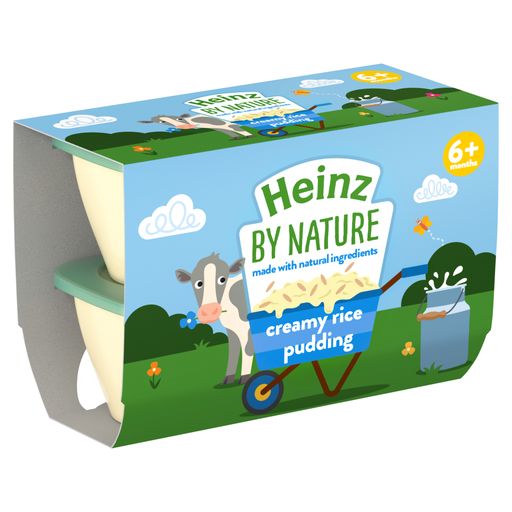 Image unavailable
Separate pots may suit an age-appropriate portioning need rather than a shared tinned dessert. This baby product contains four 100g pots and is described for ages 6 to 36 months; it contains whole milk. Its product description says to store it in a cool, dry place and that it can be served from the cupboard, chilled or warmed. Refrigerate any unused opened portion and use it within 24 hours, following the pack directions.
Choose a quantity that fits your usual use of opened tins, then check each can’s date and storage directions. If your household seldom finishes a two-serving tin within its stated after-opening period, separate portions may avoid leftovers.
A best-before date concerns quality rather than safety, according to GOV.UK. Follow the tin’s storage directions and assess its condition before use; do not treat that date as an instruction for storing an opened product.
Follow the directions for that product. Sainsbury's says to transfer its Be Good To Yourself 400g rice pudding to a non-metallic container, refrigerate it and use it within two days. Joybuy’s Ambrosia 400g listing specifies removing the contents, refrigerating them and consuming them within three days; the periods are not interchangeable.
No such conclusion follows from a lower-fat description. The listed Sainsbury's low-fat rice pudding contains cows’ milk, so check the current ingredients and allergen statement for the exact product before serving it to someone with a milk allergy.
Some listed products give both options, but use the directions on your particular tin. Sainsbury's instructs shoppers to heat its low-fat 400g product until piping hot and not to reheat it once cooled.