Texture-sensitive meal planners
You know that visible skin or bones could put someone off the meal, so the exact format matters more than the colour of the salmon.


For someone put off by visible skin or bones, start with salmon explicitly labelled skinless and boneless. If they accept flaked fish and small bones, a standard tin may work in fishcakes or pasta bakes; either way, choose a pack size you can use and check its label for ingredients and leftover-storage instructions.
You know that visible skin or bones could put someone off the meal, so the exact format matters more than the colour of the salmon.
You want to try salmon in one or two meals without opening more than you are likely to use.
You are planning repeat meals such as fishcakes or pasta bakes and need a pack size that fits the portions you will make.
If skin or bones are a known refusal point, settle the format first. Then match the amount you buy to the meals you expect to serve.
| Concern | What to check | Who this matters to |
|---|---|---|
| Visible skin and bones | Look for an explicit skinless-and-boneless description; check the current pack for bone warnings. | If visible skin or bones would put someone off before they try the meal, I need a format that avoids them. About 42% of consumers put avoiding skin or bones first. |
| Waste from a first trial | Check the pack size and its instructions for storing any leftovers. | When trying salmon in just one meal, I want an amount we can finish rather than leftovers we may discard. Roughly 33% of consumers prioritise limiting trial-meal waste. |
| Amount for planned meals | Compare pack sizes with the portions you intend to make and the format your recipe calls for. | For repeated fishcakes or pasta bakes, I need enough salmon for the meals we have planned. About 25% of consumers put meal yield first. |
Some standard tins contain bones. Sainsbury's identifies small edible bones in its 212g pink salmon, while Tesco's listing for John West Pink Salmon 213g warns that it contains bones.
If bones or skin are a known refusal point, choose a product explicitly labelled skinless and boneless rather than relying on the words 'pink salmon'.
A larger tin may suit several planned meals but leave unused salmon after a single trial. A smaller format may fit a first taste yet provide too little for a family recipe.
Decide how much salmon the intended meal needs before choosing between a small pot, a single tin and a multipack.
Pack instructions differ: Sainsbury's says to use leftovers from its 212g pink salmon within one day, while Tesco's John West 213g listing gives two days.
Follow the storage container, refrigeration and use-by-opening instructions on the exact pack you serve.
An online description may not reflect the tin currently in your cupboard, which matters when ingredients or allergens affect the meal.
Read the physical pack's current ingredients, allergen information and safety instructions before serving.
Its 213g Wild Pacific Pink Salmon is presented by John West for meals including fishcakes and pasta bakes.
Its range includes standard wild Pacific pink salmon and prepared skinless-and-boneless variants.
Tesco's own-label range includes standard pink-salmon tins in several sizes and a skinless-and-boneless pink-salmon format.
Its range includes a standard 212g wild Pacific pink-salmon tin and smaller prepared options.
Asda describes its 170g Wild Alaskan Pink Salmon as skinless and boneless.
M&S describes its 170g Wild Alaskan Red Salmon as skinless and boneless.
These options include 213g pink-salmon tins for planned meals and a smaller 80g salmon pot for trying a modest portion. Check each pack's bone and skin information if texture is the deciding factor.
 Image unavailable
The four-tin pack is an option when several salmon meals are planned, rather than a single first taste.
Each tin is labelled 213g. Check the pack for skin, bones and instructions for any leftovers.
 Image unavailable
A single tin avoids committing to the four-pack when planning one salmon meal.
The stated size is 213g. Check the current pack for bone and skin information and for how to store any unused contents.
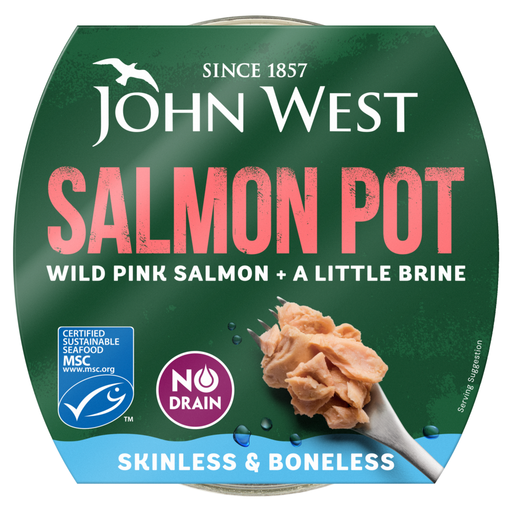 Image unavailable
The 80g pot is a smaller-quantity option for trying salmon without opening a 213g tin.
It is a pot, not a conventional tin. Check its label for skin, bones and storage instructions.
Choose a product explicitly labelled skinless and boneless. Asda describes its 170g pink salmon and M&S its 170g red salmon that way; do not assume a standard pink-salmon tin has the same preparation.
Yes. Sainsbury's says its 212g Wild Pacific Pink Salmon contains small edible bones. If seeing bones could cause the meal to be refused, check for an explicitly boneless alternative.
Follow the exact pack's instructions rather than applying one period to every product. Sainsbury's directs shoppers to transfer and refrigerate leftovers from its 212g pink salmon and use them within one day; Tesco's John West Pink Salmon 213g listing gives two days for unused contents kept refrigerated in a covered non-metallic container.