Protein-focused meal planners
If you are working out what a tin contributes to a meal, look at the protein figure, its stated measurement basis and the drained quantity you plan to eat. A front-of-pack description cannot replace that calculation.


For wild-caught tinned salmon, check the individual pack for the blue Marine Stewardship Council (MSC) label if independently assessed sourcing is a priority; “wild” alone does not establish certification. For a protein-focused meal, compare figures on the same per-100g drained basis where available, then consider how much salmon you will eat. Check whether the tin contains bones or skin if texture and preparation matter to you.
If you are working out what a tin contributes to a meal, look at the protein figure, its stated measurement basis and the drained quantity you plan to eat. A front-of-pack description cannot replace that calculation.
If sourcing determines your choice, check the MSC label on the particular wild-caught salmon product. The Marine Conservation Society distinguishes certification from descriptions such as “wild”; the Marine Stewardship Council says its labelled products are traceable to independently assessed fisheries.
For sandwiches, salads or other meals where texture matters, check whether the pack explicitly says skinless and boneless. Standard tins can contain bones, so the format matters as well as the salmon itself.
Check sourcing on the individual pack, compare nutrition figures on a like-for-like basis, then choose a format that works for the meal.
| Concern | What to check | Who this matters to |
|---|---|---|
| Sourcing evidence | Look for the MSC blue label on the exact product; check its species and source details. | If I want evidence behind a wild-caught salmon tin’s sourcing, “wild” or “responsibly sourced” does not answer whether this product is MSC-certified. About 42% of consumers put product-level sourcing evidence first. |
| Protein and portion | Compare protein per 100g drained where stated, alongside the drained quantity you intend to eat. | When I plan a meal around a protein figure, the amount of salmon I will actually eat matters more than the tin’s total weight. About 33% of consumers make measurable protein contribution their primary concern. |
| Bones and format | Check whether the salmon is skinless and boneless, and read the pack’s instructions for leftovers. | For a quick sandwich or salad, I may want a portion that needs little preparation and leaves no awkward remainder. Convenience and bone handling come first for about 25% of consumers. |
Wild-caught describes how the fish was obtained; MSC certification is a separate, product-level claim. A brand’s general sourcing statement does not establish certification for every tin.
Look for the blue MSC label on the pack you intend to buy, and check its species and source details.
Protein per 100g and protein per 100g drained are not automatically like-for-like figures. The portion you eat may also differ from the tin’s total weight.
Use matching label bases where available, check the drained quantity, and consider salt on the same stated basis.
A bone-in tin may be suitable for a dish where the salmon will be mashed, but less convenient when you want a particular texture in a quick salad or sandwich.
Choose an explicitly labelled skinless and boneless product if that format matters to you; read any product-specific warning as well.
Post-opening instructions can differ between products. Food Standards Scotland advises checking the label for storage directions once food has been opened.
Follow the tin’s instructions for transferring, refrigerating and using any leftovers.
A reference for shoppers comparing wild Pacific pink salmon with other tinned formats.
Offers formats in the reviewed range that include a small Fridgepot portion, a standard tin and a skinless and boneless multipack.
A reference for red salmon: its Wild Alaskan Red Salmon is sold as a 213g product.
A retailer whose tinned-salmon range includes own-brand, Princes and John West products in different formats.
A retailer to consider when checking individual seafood packs for sourcing information.
These selections offer an 80g pink salmon pot, a four-pack of 213g pink salmon tins and a single 213g tin. Check each pack’s sourcing label and nutrition basis against the requirements that matter to you.
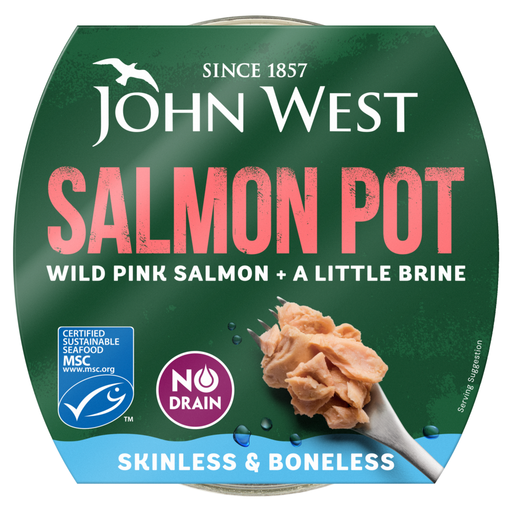 Image unavailable
The 80g pot is a smaller-format choice for a meal addition. Joybuy describes this product as MSC-certified and lists 23g protein per 100g; check the pack’s drained quantity and nutrition basis before comparing that figure with drained-weight values. Check the pack if skin or bones affect your choice.
 Image unavailable
The four-pack suits shoppers planning to use more than one 213g tin. If MSC certification is a deciding factor, check the label on these tins; compare the stated protein basis and drained quantity before using them in a meal calculation. Check whether the format contains skin or bones.
 Image unavailable
The single 213g tin lets you choose this pack size without selecting a four-pack. Read its own label for MSC certification, protein measurement basis, drained quantity and bone information; the pack weight alone does not give the amount of salmon you will eat.
Look for the blue MSC label on the individual product. The Marine Conservation Society explains that MSC certification applies to wild-caught seafood; the Marine Stewardship Council says a labelled product is traceable to a fishery independently assessed against its Fisheries Standard. A “wild” description alone is not the certification.
Use protein per 100g drained when both products state it, then account for the drained portion you expect to eat. Princes lists 22.3g per 100g drained for its Wild Pacific Pink Salmon, while a Joybuy listing gives 20.4g per 100g drained for John West Pink Salmon 213g. Check each variant’s basis rather than comparing those figures with an unspecified per-100g value.
Choose one if avoiding skin and bones is important for your intended dish. A standard tin may contain bones: the John West Pink Salmon 213g listing explicitly warns of them. Read the warning on any skinless and boneless product too, rather than assuming the format settles every texture concern.
Follow the storage and use instructions on that product’s label. Food Standards Scotland advises checking the label after opening because storage directions vary; transfer and refrigerate leftovers when the pack instructs you to do so.