Shared-meal campers
A larger tin is practical when two or more people can use its contents in one meal, or when any remainder can be refrigerated as the label directs.


Choose a tinned salmon pack you can use promptly at camp: a larger tin suits a shared meal, while a smaller portion can avoid opened leftovers on a solo trip. Check the exact pack for bones and unopened storage instructions; once opened, follow its refrigeration instructions rather than assuming it will keep in a cool box.
A larger tin is practical when two or more people can use its contents in one meal, or when any remainder can be refrigerated as the label directs.
A smaller pack can make it easier to use the salmon in one meal without carrying an opened container afterwards.
These shoppers need an exact pack labelled skinless and boneless rather than assuming that all tinned salmon has the same preparation requirements.
Start with the amount you can use at camp, then check storage and bone information on the exact pack.
| Concern | What to check | Who this matters to |
|---|---|---|
| Using a shared-meal tin | Check net weight against the portions planned, and read the after-opening storage instructions. | If I am making salmon for several people, I want a tin we can finish rather than leave open at camp. About 42% of consumers put using a shared-meal pack fully first. |
| Keeping portions compact | Check the pack weight and whether its unopened storage instructions suit your trip. | For a solo meal, I would rather carry a smaller portion than manage leftover fish without dependable cooling. Around 33% of consumers primarily want a compact, single-meal amount. |
| Avoiding bones | Look for an explicit skinless and boneless label; read any bone warning on the exact pack. | If I plan to add salmon straight to a camp meal, I may want to avoid sorting through bones. Roughly 25% of consumers make bone-free convenience their primary concern. |
Sainsbury's and Asda warn of edible bones in their standard pink-salmon tins, while skinless and boneless products are identified separately.
If bones are unsuitable for your meal, look for those words on the exact product rather than relying on the fish type or brand.
The Food Standards Agency advises keeping chilled food at 5°C or below and notes that a cool box is unlikely to maintain chilled conditions for an extended period. Opened salmon also has product-specific refrigeration instructions.
Without dependable cooling, plan a portion you can finish in one meal and follow the pack's instructions after opening.
Salmon left over after a meal may have to be discarded if it cannot be refrigerated as directed.
Formats include a 213g wild Pacific pink-salmon tin and an 80g salmon pot.
Princes lists standard wild Pacific red salmon in 105g and 213g sizes and a separate 170g skinless and boneless red-salmon product.
Tesco's own-label listings include pink and red salmon in several pack sizes, including 105g, 170g, 212g and 418g formats.
Its 212g wild Pacific pink-salmon tin is labelled as serving two; separate skinless and boneless listings are available.
Asda lists an own-label 213g Wild Alaskan Pink Salmon tin.
Its 170g wild Alaskan red-salmon product is labelled skinless and boneless.
These selections include 213g pink-salmon tins for shared meals and an 80g pot for a smaller portion. Check the pot's unopened storage instructions before relying on it for a trip without cooling.
 No image available
Consider the four-pack when planning several camp meals or feeding a group. Each tin is 213g; check the exact pack for its bone warning. After opening a tin, transfer any remainder to a non-metallic container, refrigerate it and use it within two days.
 No image available
A single 213g tin is a choice to assess for a shared meal without buying a multipack. Check its bone warning before use. Transfer any contents left after opening to a non-metallic container, refrigerate them and use them within two days.
 No image available
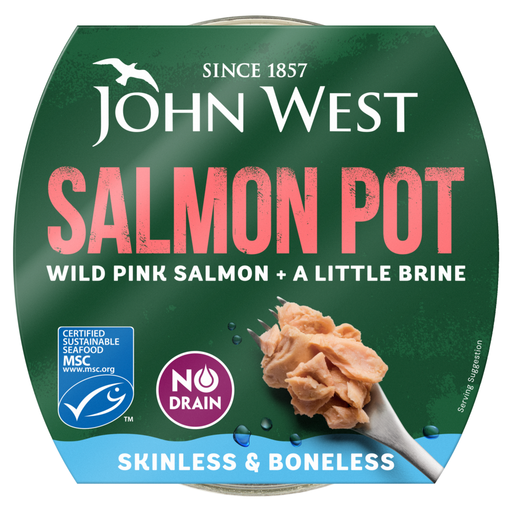
The 80g pot offers a smaller amount to consider for one meal. Check its unopened storage instructions before packing it without reliable cooling, and read the exact pack for bone information. Refrigerate any remainder after opening and use it within two days.
Some tins, including the checked Asda salmon products, are labelled for ambient storage before opening. Follow the exact pack's storage instructions and best-before date; do not assume the same conditions apply to a salmon pot.
Transfer leftovers to a suitable non-metallic container, refrigerate them and follow that pack's use-by-after-opening instruction. The checked labels differ: Sainsbury's 212g pink salmon says one day, John West 213g pink salmon says two days, Asda 213g pink salmon says three days, and M&S 170g red salmon says 24 hours. Without dependable cooling, plan to finish the contents in one meal.
Yes. GOV.UK identifies fish as an allergen that food businesses must declare. Read the ingredient and allergen information on the exact pack if you need to avoid fish.