Cooking for several meals
If a tin needs to cover fishcakes, pasta or sandwiches, a larger pink-salmon format is a starting point. Check that you can use and store any remainder as directed on the pack.


For several meals, start with a larger pink-salmon tin if its portion size works for you and soft bones are acceptable. Choose red salmon when its colour matters to the dish, or a skinless-and-boneless format when less preparation matters more; neither description removes the need to check the exact pack for bone warnings, ingredients and storage instructions.
If a tin needs to cover fishcakes, pasta or sandwiches, a larger pink-salmon format is a starting point. Check that you can use and store any remainder as directed on the pack.
For a salad or another dish where the fish stands out, you may prefer the appearance of red salmon. Check the species and any bone warning rather than assuming that red salmon has been deboned.
A small tin or pot can be easier to finish at one meal. Check the quantity and format so that convenience does not leave you with too little salmon for the recipe.
Decide how many portions you need, whether the salmon will be prominent in the meal and how much preparation you want to do. Then check the exact pack.
| Concern | What to check | Who this matters to |
|---|---|---|
| Quantity for several meals | Check the net weight, stated servings and instructions for opened contents. | If I am making fishcakes or pasta for several people, I need enough salmon to use the larger format without leaving it open too long. About 36% of consumers put multi-meal quantity first. |
| Salmon type and bone texture | Check whether the fish is pink or red salmon, whether skin and bones have been removed, and any remaining-bones warning. | When the fish is visible in a salad, its appearance or an easier-to-eat texture may decide my choice. About 29% of consumers put that presentation or preparation need first. |
| A manageable single portion | Check the quantity in each tin or pot and whether it can be finished at one meal. | For one lunch, I would rather open a smaller portion than plan around leftovers. Roughly 21% of consumers make portion convenience their primary concern. |
| Pack information | Read the current ingredients, fish allergen declaration, salt information and after-opening directions. | If an ingredient requirement or the way I will store leftovers determines what I can use, the physical label comes first. About 14% of consumers put those pack details ahead of the other factors. |
Red salmon is a type of fish, not a preparation guarantee. Sainsbury's warns that small edible bones may remain in its skinless-and-boneless red salmon.
Read the bone warning on the exact pack, particularly if bone fragments would be unsuitable for the intended eater.
A larger tin is less convenient if you cannot use its contents within the product's after-opening instructions.
Choose a quantity you can use and follow the pack's directions for transferring and refrigerating leftovers.
Ingredients and product details can change, so an earlier listing is not a substitute for the label in your hand.
Check the physical pack each time an allergen, ingredient or salt declaration matters to your purchase.
Its listed salmon formats include pink and red varieties and smaller skinless-and-boneless options.
Its range includes wild Pacific pink and red salmon, including a listed skinless-and-boneless red format.
Tesco Groceries lists own-label pink, red and prepared salmon formats.
Its listed range includes a 212g wild Pacific pink tin and a 170g skinless-and-boneless red salmon product.
ASDA Groceries lists a 418g wild Alaskan pink salmon tin.
Its listed 105g Wild Alaskan Red Salmon contains red sockeye salmon, according to Marks & Spencer.
These selections cover pink salmon in a multipack, a single tin and a smaller pot. Choose by the quantity you will use, and check the pack if bone texture matters.
 No image available
Consider this four-pack if you will use separate cans across several meals. Each can is 213g; check its bone warning and after-opening directions for your recipe.
 No image available
A single tin is an option when you need 213g rather than a multipack. Check the pack for bone information and instructions for any unused contents.
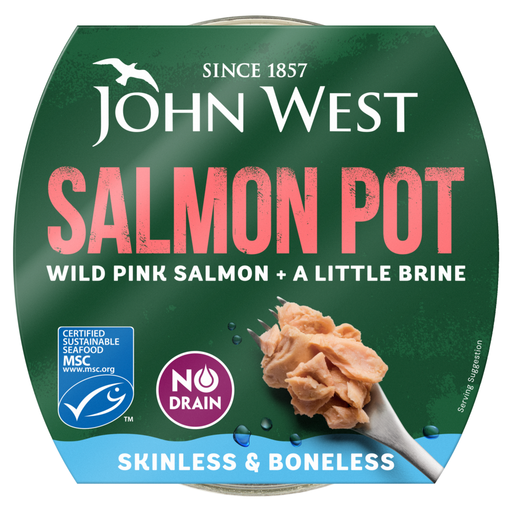 No image available
The 80g pot offers a smaller quantity than either Morrisons tin shown here; it is a pot, not a conventional tin. Check its bone information and storage directions before use.
No. Red salmon may suit the appearance you want, but the right format also depends on portion size and preparation. Check the exact species, quantity and bone warning; red salmon is not necessarily boneless.
No. Sainsbury's warns that small edible bones may remain in its skinless-and-boneless red salmon despite efforts to remove them. Read the warning on the particular pack if bone fragments matter to the intended eater.
Follow the instructions on your pack rather than applying one storage period to every product. The listed John West skinless-and-boneless multipack directs you to transfer unused contents to a non-metallic airtight container, refrigerate them and consume them within two days.
No: salmon is fish. Check the current pack's allergen and ingredient information rather than relying on an older online listing.
No. GOV.UK explains that best-before dates concern quality, including on tinned foods, whereas a use-by date concerns safety. Follow the product's storage instructions as well as its date marking.