Cooks checking listed sugars
You want to keep the fish component’s listed sugars as low as possible, while checking the curry sauce separately. Plain salmon is the starting point; compare the nutrition panels of the exact products you might buy.


For curry night, start with the exact tin’s ingredients and listed sugars rather than assuming you need a product labelled “reduced sugar”: Princes lists 0.0g sugars per 100g drained for its plain red-salmon examples. Choose a skinless-and-boneless format if preparation matters most, or consider a larger standard tin for a shared curry, checking its bones warning and the sauce’s nutrition separately.
You want to keep the fish component’s listed sugars as low as possible, while checking the curry sauce separately. Plain salmon is the starting point; compare the nutrition panels of the exact products you might buy.
You would rather stir salmon into the curry without removing skin or sorting through a standard tin. A skinless-and-boneless format addresses that preference, although the pack’s bones warning still matters.
You need enough salmon for several people and are weighing tin size against the preparation involved. Check the quantity and whether the selected product contains skin or bones.
For a curry, compare the fish’s nutrition label first, then decide how much preparation and salmon your meal calls for.
| Concern | What to check | Who this matters to |
|---|---|---|
| Listed sugars | Compare sugars per 100g on the exact tin, noting whether the figure is for drained salmon. Check the sauce separately. | If I am watching the fish component’s listed sugars, I want a plain tin whose nutrition panel I can compare directly; about 50% of consumers put that need first. |
| Bones and preparation | Look for a skinless-and-boneless description and read any warning about occasional small bones. | When I need to add salmon to the curry with less sorting, the format matters more to me than tin size. About 30% of consumers chiefly want that preparation convenience. |
| Amount for the meal | Check pack count and net or drained quantity where stated, alongside whether the salmon has skin or bones. | For a curry shared with others, I need to judge how much usable salmon to buy; roughly 20% of consumers make meal quantity their primary concern. |
Princes lists 0.0g sugars per 100g drained for its plain red-salmon examples. That figure describes the salmon, not the completed curry.
Read the exact tin’s nutrition panel and ingredients, then check the curry paste, sauce and accompaniments on their own labels.
John West’s skinless-and-boneless pink salmon information cautions that small bones may still be present.
Check the selected pack’s warning and look through the salmon as you flake it, particularly when serving someone who needs extra caution.
UK grocery listings include salmon in different pack sizes, while standard and skinless-and-boneless formats can involve different preparation.
Compare the stated quantity with the amount your curry needs, and check for skin and bones before choosing a larger pack.
Storage instructions apply to the particular product. Marks & Spencer instructs buyers of its 105g skinless-and-boneless red salmon to move unused contents to a non-metallic container, refrigerate them and eat them within 24 hours.
Follow the instructions on your selected pack rather than applying another product’s timeframe.
Princes lists a standard Wild Pacific Medium Red Salmon and a 170g Skinless & Boneless Wild Red Salmon.
John West red-salmon and skinless-and-boneless pink-salmon formats appear in the supplied UK product information.
Tesco Groceries lists own-brand red and pink salmon in several sizes, including 105g and 418g examples.
Sainsbury’s lists own-brand Wild Pacific pink and red salmon in 212g formats, alongside skinless-and-boneless options.
M&S lists a 105g Wild Alaskan Red Salmon product described as skinless and boneless.
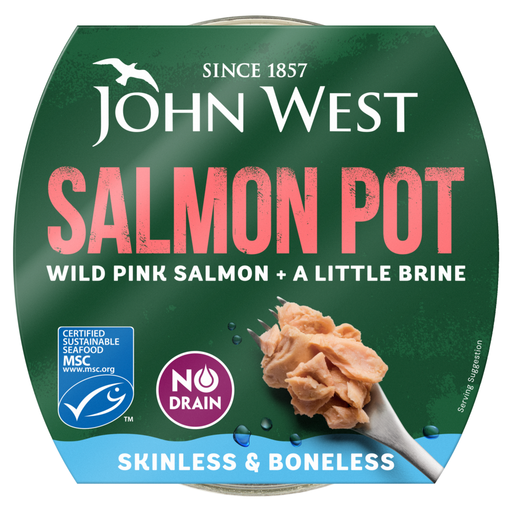
This John West fridgepot is a small-format salmon option if a tin is not essential to your curry. Its 80g quantity makes the amount needed for the meal an important check.
 No image available
Consider this 80g pink-salmon fridgepot if the container format is flexible and that quantity suits your curry. It is not a tin; compare its current nutrition label with any tinned salmon you are considering.
Start with the exact product’s nutrition panel instead. Princes lists 0.0g sugars per 100g drained for its plain red-salmon examples, while Marks & Spencer lists 0.2g per 100g for its 105g skinless-and-boneless red salmon. Compare the products you might actually use rather than relying on a phrase alone.
The salmon’s figure applies to the salmon, not the finished dish. Read the labels of the curry paste, sauce, chutney and accompaniments separately if their sugars matter to your choice.
Yes, a residual-bone warning may still appear. John West cautions that small bones may remain in its skinless-and-boneless pink salmon, so check the selected pack and take care while flaking the fish.
Follow the instructions on the specific pack. For its 105g skinless-and-boneless red salmon, Marks & Spencer says to transfer unused contents to a non-metallic container, refrigerate them and eat them within 24 hours; do not assume that timeframe applies to another product.
Salmon is fish, and the listed salmon products identify fish as an allergen. Check the current packaging and the other curry ingredients rather than relying on a product listing alone.