Low-preparation lunch buyers
If you are adding salmon to a salad or sandwich at your desk, a smaller pack and a skinless-and-boneless label may matter. Check the warning on the exact product, as the M&S label says small bones may remain.


For a desk lunch with little preparation, consider a skinless-and-boneless red-salmon tin, but read its bone warning: the M&S variant says small bones may remain. If flavour is your priority, Ocado describes M&S red salmon as rich; if pack size matters more, Princes lists pink-salmon tins in 213g and 418g sizes. Compare the exact product's nutrition label and storage instructions before choosing.
If you are adding salmon to a salad or sandwich at your desk, a smaller pack and a skinless-and-boneless label may matter. Check the warning on the exact product, as the M&S label says small bones may remain.
If salmon is the main ingredient in a simple lunch, the flavour described for M&S Wild Alaskan Red Salmon may appeal. Ocado calls it firm, flaky and rich; its description is not a reason to assume every red-salmon tin tastes the same.
If one tin needs to cover more than one lunch, compare pack size with the amount you will use and read the opened-can instructions before leaving leftovers at work.
Start with the handling and portion size your lunch allows, then compare the labels of the specific products you are considering.
| Concern | What to check | Who this matters to |
|---|---|---|
| Preparation and bones | Look for skinless-and-boneless wording and read the bone warning on the exact pack. | When lunch has to be assembled quickly at a desk, I want less handling without assuming the fish has no bones; about 33% of consumers put that need first. |
| Red-salmon flavour | Check whether the product is red or pink salmon, alongside its description and bone warning. | If salmon is the focus of my lunch, the richer flavour Ocado describes for M&S red salmon matters more to me than a low-preparation format. About 27% of consumers prioritise that eating experience. |
| Portion and leftovers | Compare pack sizes and the product's instructions for unused contents. | I want enough salmon for my planned lunch without leaving an opened tin I cannot refrigerate; roughly 20% of consumers put portion planning first. |
| Nutrition and ingredients | Compare the exact labels per 100g and check the ingredients and fish-allergen information. | When choosing between tins, I need the label to fit my ingredient or dietary requirements before flavour or pack size; about 20% of consumers make those checks their primary concern. |
The M&S skinless-and-boneless salmon label warns that some small bones may remain, which matters if you cannot spend time checking fish at your desk.
Read the warning on the particular pack before choosing it for a low-preparation lunch.
A pack that covers more than one lunch also leaves you with opened fish to store. The checked John West Red Salmon instructions say to transfer unused contents to a covered, non-metallic container, refrigerate them and use them within two days.
Choose a size you expect to finish, or check that you can store the remainder as the product instructs.
Without suitable refrigeration, the unused portion may go to waste.
Pack size, ingredients and declared nutrition belong to the particular product and serving basis shown on its label.
Compare the products you are considering on the same per-100g basis, then check what each pack contains.
The Wild Alaskan Red Salmon line includes a 105g skinless-and-boneless format for a smaller, lower-preparation lunch.
Its Wild Pacific Pink Salmon offers a standard-tin option in 213g and 418g formats.
Tesco Groceries lists own-label red and pink salmon formats, including a 170g skinless-and-boneless wild red salmon product.
The checked Red Salmon 213g product is described as ready to eat and suitable for salads or fishcakes.
For a quick desk lunch, these Joybuy selections cover a small pink-salmon fridgepot and a larger pink-salmon tin. A fridgepot is not a tinned-salmon substitute if you specifically need a tin; check its storage instructions before carrying it to work.
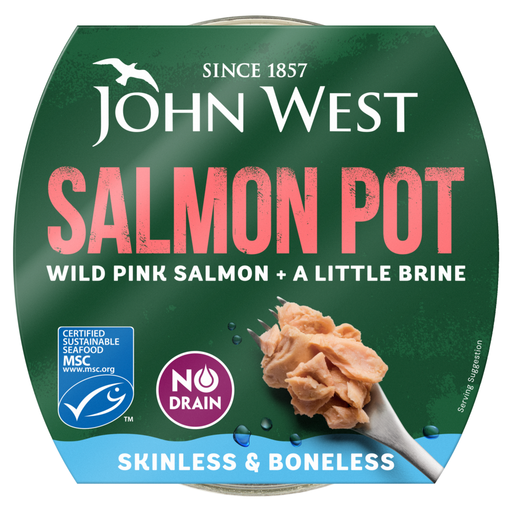 Image unavailable
Consider this 80g pink-salmon pot when a smaller addition to a desk lunch suits your plans. It is a fridgepot rather than a tin: check its unopened storage instructions if you will carry it to work, and check the pack for bone information.
 Image unavailable
Consider this 213g pink-salmon tin when you can use a larger pack across lunch portions. Check its label for preparation and bone information; after opening, transfer unused contents to a non-metallic container, refrigerate them and use them within the stated two days.
Check the exact product's instructions. The checked John West Red Salmon 213g listing says it is ready to eat, but that wording should not be assumed for a different salmon product.
Follow the opened-life instructions on your tin. For the checked John West Red Salmon 213g product, transfer unused contents to a covered, non-metallic container, refrigerate them and use them within two days.
Yes. NHS guidance identifies salmon as oily fish and advises at least two portions of fish a week, including one of oily fish. For a desk lunch, use the amount shown on your particular pack rather than treating every tin as one portion.
Yes. NHS pregnancy guidance advises no more than two portions of oily fish a week when pregnant or trying to conceive; salmon counts as oily fish. Consider your other oily-fish portions that week as well as the salmon in your lunch.
Check the ingredients and allergen statement on the exact pack before eating it. Princes lists fish in the ingredients for its Wild Pacific Pink Salmon, and GOV.UK guidance requires food businesses to tell customers when a listed allergen is an ingredient.