Solo cooks avoiding leftovers
If you use salmon for one meal at a time, compare the pack size with the amount your recipe needs. A divided pack can leave unopened portions for another day; with a larger tin, the after-opening instruction matters.


For a small one-person meal, choose an 80g to 105g format if it supplies the amount of salmon you will use; a 170g tin suits a larger recipe or two lighter servings, while a 213g tin calls for a plan for the remainder. If easy flaking matters, look for a skinless-and-boneless description, but check the bone warning and follow the particular product's instructions for storing any unused salmon.
If you use salmon for one meal at a time, compare the pack size with the amount your recipe needs. A divided pack can leave unopened portions for another day; with a larger tin, the after-opening instruction matters.
For sandwiches, salads or pasta, a skinless-and-boneless description may help you choose a format you find convenient to flake. Read the bone warning too: Tesco and Asda caution that some bones may remain.
If ingredients, protein or salt figures influence your choice, check whether each label gives values per 100g, per serving or for drained salmon before comparing tins.
For one-person meals, settle on the amount you are likely to use before comparing preparation descriptions and nutrition labels.
Choose when: Salmon is a topping, sandwich filling or small meal component and you want little opened food left over.
Bear in mind: Check that the amount suits your meal; the M&S 105g red salmon tin contains bones.
Choose when: You will use a larger amount in one recipe or divide the tin between lighter meals.
Bear in mind: Sainsbury's describes its 170g tin as two servings, and skinless-and-boneless labelling does not remove every possibility of bones.
Choose when: You have a recipe needing more salmon or intend to use the tin across meals.
Bear in mind: A small meal may leave salmon to refrigerate, and the John West 213g red salmon listing states that it contains bones.
| Concern | What to check | Who this matters to |
|---|---|---|
| Amount for one meal | Compare net weight and stated servings; read the storage instruction if you expect to leave some. | If I only need salmon for one sandwich or salad, I would rather not open more than I can use. About 42% of consumers put matching the pack to their meal first. |
| Preparation and bones | Check the skinless-and-boneless description alongside any bone warning. | For a quick meal, I want salmon that is straightforward to flake, while knowing whether I still need to watch for bones. Preparation is the primary concern for about 33% of consumers. |
| Ingredients and nutrition | Read the ingredients and compare label figures on the same per-100g or per-serving basis. | When choosing between tins, I want the ingredient list and nutrition figures to be comparable. About 25% of consumers make label comparison their main concern. |
Asda and Sainsbury's describe their 170g tins as two servings; an 80g pack supplies a different amount for a meal.
Compare the net weight and stated servings with the recipe you actually plan to make before choosing a larger tin or multipack.
Tesco and Asda warn that occasional bones may remain in products described as skinless and boneless.
Read the product warning and inspect the salmon as you flake it, particularly when unexpected bones would be a problem for the intended eater.
Storage instructions vary: M&S specifies 24 hours for its 105g red salmon, while Tesco and John West listings specify two days for their cited products.
Transfer unused salmon to a covered non-metallic container, refrigerate it and follow the time limit on the product you opened.
A per-100g figure and a per-half-can figure describe different quantities, even when they appear beside the same nutrient.
Use figures with the same serving and drained-weight basis, and check the current pack label.
John West has a 3 x 80g skinless-and-boneless pink salmon pack and a 213g red salmon tin listed on Joybuy.
Princes lists wild Pacific pink salmon in 213g and 418g tins.
Tesco lists a 170g skinless-and-boneless wild Pacific pink salmon tin.
Sainsbury's describes its 170g skinless-and-boneless wild Pacific pink salmon tin as two servings.
Asda lists a 170g wild Alaskan pink salmon tin described as skinless and boneless, with two suggested servings.
M&S lists wild Alaskan red salmon in a 105g tin.
These Joybuy selections include an 80g salmon pot for a small meal component and 213g tins for recipes or planned use across meals.
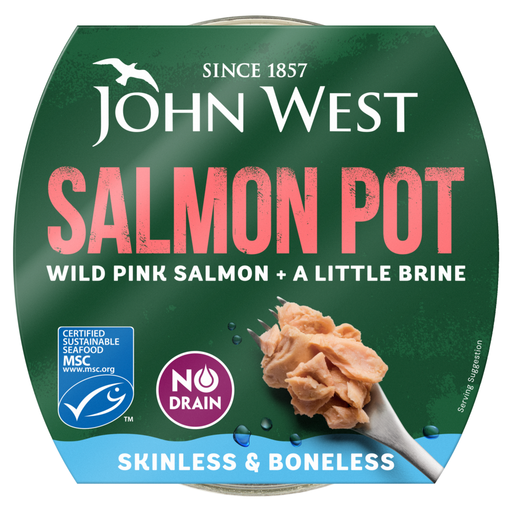 Image unavailable
The 80g pot suits a meal that calls for a small amount of salmon, such as a sandwich or salad. Check the pack's bone information if that affects your choice; refrigerate any unused salmon and consume it within the stated two days.
 Image unavailable
Consider this four-pack if you expect to use 213g tins in recipes or across planned meals. A partly used tin needs its contents transferred to a non-metallic container, refrigerated and consumed within two days; check the pack's skin and bone information if those details matter to you.
 Image unavailable
The 213g tin is an option when your recipe needs more salmon or you can plan to use any remainder. Transfer unused contents to a non-metallic container, refrigerate and consume within two days; check the pack's skin and bone information before buying if it is important for your meal.
No. The NHS describes a fish portion as around 140g, so an 80g pack is smaller than that amount. Use the pack weight to work out how much salmon your particular meal contains.
Follow the instruction on the tin you opened: transfer unused salmon to a covered non-metallic container and refrigerate it. Stated limits differ by product; M&S says within 24 hours for its 105g red salmon, while the cited Tesco and John West listings say within two days.
Yes. Tesco and Asda warn that some bones may remain despite removal efforts. Check the product warning and take care when flaking the salmon if unexpected bones would matter for your meal.