For a sustainability-led choice, check the exact pack for the blue Marine Stewardship Council (MSC) ecolabel rather than relying on a retailer's general sourcing policy. If visible skin or bones are the main obstacle, consider a skinless-and-boneless format or a small portion for a first meal; even products described as boneless can carry warnings that small bones may remain.
Who these choices suit
Households facing texture refusal
If visible skin or bones put someone off a meal, a skinless-and-boneless format offers a different starting point from a standard tin. Check and flake it before serving: Tesco Groceries and M&S Food warn that small bones may remain in their skinless-and-boneless red salmon.
Consumers prioritising certified wild fish
The Marine Stewardship Council says its blue ecolabel identifies wild-caught seafood from fisheries independently assessed against its environmental sustainability requirements. Check the label on the salmon you choose, not just the retailer's sourcing policy.
Households starting with a small serving
An 80g pot offers a smaller amount to try in a sandwich or other meal before opening a larger tin. Match the pack size to what the household is likely to use.
What to check when buying
For a fussy-eater meal, decide whether texture, product-level sustainability certification or the amount needed for the meal matters most; then check the exact pack.
| Concern |
What to check |
Who this matters to |
| Skin, bones and texture |
Look for a skinless-and-boneless description and read any warning about remaining bones. Check and flake the salmon before serving. |
If visible skin or bones could stop someone eating the meal, the format matters before the salmon goes into a familiar recipe. About 45% of consumers put texture and bone acceptance first. |
| Certified sustainability |
Look for the blue MSC ecolabel or an explicit MSC statement for the exact wild-salmon product. |
When independently assessed wild-catch sourcing is the deciding factor, a general retailer policy is not enough to identify the chosen tin. Roughly 33% of consumers make product-level certification their primary concern. |
| Portion size and leftovers |
Choose a pack size suited to a first serving or the planned recipe, and read its after-opening storage instructions. |
A first taste may use only a little salmon, while a family recipe may use a whole tin. For about 22% of consumers, matching the portion to the meal takes priority. |
Buying mistakes to avoid
-
Assuming a retailer policy certifies every tin
A responsible-sourcing policy does not establish that a particular salmon product carries MSC certification. The Marine Stewardship Council's blue ecolabel applies to seafood meeting its wild-catch certification requirements.
If MSC certification is important to you, check the exact product listing and physical pack for the label or an explicit MSC statement.
-
Treating “boneless” as a reason to skip checking
Tesco Groceries and M&S Food warn that small bones may remain in their skinless-and-boneless red salmon products.
Inspect and flake the salmon before serving it to someone who is sensitive to bones.
-
Opening more salmon than the meal needs
A large tin may leave unused fish when someone is only trying a small serving.
Choose a smaller pack for a first trial, or plan how you will use the rest and follow the pack's after-opening storage directions.
-
Overlooking fish-allergy information in a mixed meal
Mixing salmon into another food does not remove the fish allergen. West Suffolk NHS Foundation Trust warns that finned fish can cause severe allergic reactions.
Read the allergen label. If a fish allergy is suspected or diagnosed, follow clinical advice rather than trialling salmon at home.
Brands to consider
These ranges offer different pack formats and sourcing information; check the details of the individual product before choosing.
John West
Its pink-salmon range includes a standard tin and a smaller fridge pot.
- Tesco Groceries describes John West Pink Salmon 213g as MSC-certified; Joybuy describes the 80g Pink Salmon Fridgepot as MSC-certified wild pink salmon.
- Tesco Groceries states that the 213g tin contains bones. Check the pot's pack for skin and bone details if texture is a concern.
Princes
Princes has pink and red wild Pacific salmon products.
- Tesco Groceries describes Princes Pink Wild Pacific Salmon 213g as MSC-certified.
- Check certification and bone information on the particular Princes product you select; the pink product's listing does not establish those details for the red salmon.
Tesco
Tesco's own-brand range includes standard pink salmon and skinless-and-boneless red salmon.
- Tesco Groceries lists a 212g standard pink salmon tin and a 170g skinless-and-boneless red salmon tin, giving shoppers two different formats to assess.
- Tesco warns that some bones may remain in the skinless-and-boneless product. Check either exact pack for an MSC label if certification is required.
Sainsbury's
Sainsbury's publishes a responsible-seafood sourcing policy.
- J Sainsbury plc says its seafood supply base follows independent certification or an improvement pathway.
- That retailer-wide policy does not identify the certification or texture of a particular salmon tin; check the product pack.
Asda
Asda lists wild Alaskan pink salmon and publishes a seafood-sourcing policy.
- Asda says its wild-caught fish sourcing aims to use MSC-certified fisheries or registered improvement projects.
- An improvement project is not the same as an MSC label on a tin. Check the exact salmon pack for certification and bone information.
M&S
M&S Food lists standard and skinless-and-boneless Wild Alaskan red salmon formats.
- Its 170g red salmon is described as skinless and boneless, a relevant format when visible skin or bones affect acceptance.
- M&S Food says small bones may remain in that product and states that its 105g standard red salmon contains bones. Check the chosen pack for any certification claim.
Joybuy product selection
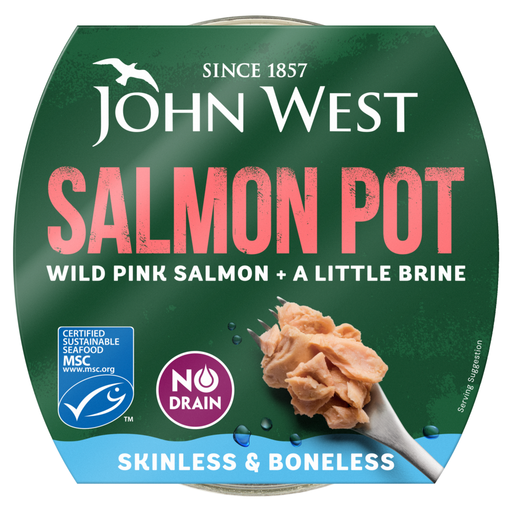
This smaller salmon portion is relevant when trying a first serving or limiting leftovers; check its skin and bone information if texture is the deciding factor.
 No image available
John West Pink Salmon Fridgepot 80g
The 80g pot suits a small first serving or a meal that needs only a little salmon. Joybuy describes it as MSC-certified wild pink salmon. Check the pack for skin and bones before serving it to a texture-sensitive eater; it contains fish.
Joybuy
Common questions
What does the blue MSC label tell me about tinned salmon?
The Marine Stewardship Council says its blue ecolabel identifies wild-caught seafood from fisheries independently assessed against its environmental sustainability requirements. It does not tell you whether the salmon is skinless or boneless, so check those details separately.
Can skinless-and-boneless salmon still contain bones?
Yes. Tesco Groceries and M&S Food warn that some small bones may remain in their skinless-and-boneless red salmon. Check and flake the fish before serving if bones are a concern.
Is tinned salmon suitable for someone with a fish allergy?
Do not serve tinned salmon to someone with a diagnosed fish allergy unless their clinical team advises otherwise. West Suffolk NHS Foundation Trust warns that finned fish can cause severe allergic reactions; read the allergen label on every pack and seek clinical advice if an allergy is suspected.
What should I do with salmon left after opening a tin?
Follow the storage instructions on the exact pack, including its refrigeration and use-by directions for opened contents. If a first meal will use only a small amount, consider the pack size before opening it.


