Batch-meal planners
People preparing several lunches or family meals need to compare the drained amount with the servings they intend to make.


For weight-management meal planning, choose tinned salmon by the portion you will use, the exact product’s nutrition label and the preparation it requires—not by pink or red colour alone. Compare calories, protein and salt on the same labelled basis, and check drained weight when planning servings; a skinless-and-boneless format may be more practical for a quick lunch.
People preparing several lunches or family meals need to compare the drained amount with the servings they intend to make.
People planning portions around labelled calories and protein need the nutrition figures for the exact tin and a clear basis for calculating their serving.
People assembling salads, sandwiches or toast toppings quickly may prefer an explicitly skinless-and-boneless product or a smaller format.
For UK consumers planning tinned-salmon meals around weight management, start with the amount you will use, then check the exact tin’s nutrition label and preparation format.
| Concern | What to check | Who this matters to |
|---|---|---|
| Usable quantity | Check drained weight and whether the tin size fits the servings you plan. | For several planned meals, I want enough drained salmon for each serving without an awkward remainder; about 45% of consumers put usable quantity first. |
| Nutrition and portions | Compare calories, protein and salt for the exact product, noting whether values refer to drained salmon. | When planning a portion, I need to know what the label’s figures mean for the amount I will eat; roughly 33% of consumers prioritise nutrition and portion planning. |
| Preparation and texture | Check for an explicit skinless-and-boneless description and a pack size that suits the meal. | If lunch needs assembling quickly, I would rather avoid handling skin or bones; around 22% of consumers place preparation and texture first. |
Nutrition belongs to the exact product, not to every pink or red salmon tin. Princes lists 143kcal, 22.8g protein and 0.91g salt per 100g drained for its Wild Pacific Red Salmon; those figures should not be applied to other tins.
Read the current label and plan the amount you will eat as part of the whole meal.
Salt and ingredients can differ between products. Fish is also an allergen, and NHS pregnancy guidance limits oily fish, including salmon, to two portions a week during pregnancy.
Check the exact pack’s ingredients and allergen information, and use the NHS guidance where its pregnancy conditions apply.
Tesco Groceries lists own-label pink and red tinned salmon in different sizes and formats.
Princes offers Wild Pacific red salmon, including a skinless-and-boneless format.
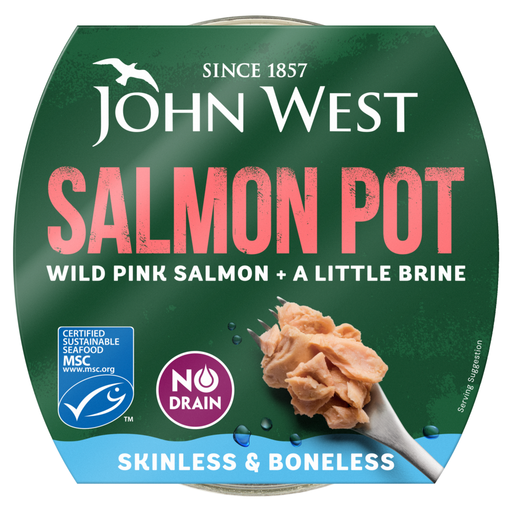
John West offers standard Wild Pacific pink salmon and a skinless-and-boneless pink-salmon format.
These selections cover pink salmon in an 80g pot and 213g tins for different meal sizes. Compare the pack labels and drained amounts before deciding which format fits your planned servings.
 No image available
The 80g pot is a format to consider for a smaller planned meal. Check the pack’s drained amount and the basis of its nutrition figures before calculating the salmon in your portion.
 No image available
The four-pack offers multiple 213g tins for meals planned across several occasions. Check each tin’s drained weight and label before working out servings; the 213g pack size alone does not establish the drained amount.
 No image available
The single 213g tin is an option when you want to plan around one tin rather than a multipack. Use its current drained weight and nutrition label to work out the portion you intend to serve.
Tinned salmon can be included in a meal plan; assess the portion and the whole meal rather than treating the tin alone as the deciding factor. Read the exact product’s calories, protein and salt figures, including whether they refer to drained salmon. NHS guidance for people trying to lose weight describes a balanced approach to eating.
Choose according to the exact tin’s label, usable portion and preparation format rather than assuming one colour suits weight-management meals better. Princes’ published nutrition figures for its Wild Pacific Red Salmon, for example, apply to that product and should not be transferred to a pink-salmon tin.
A product explicitly labelled skinless and boneless can suit a salad, sandwich or toast topping when you do not want to handle skin or bones. Check the precise product description rather than assuming every tin has that format.
Yes. NHS pregnancy guidance says not to eat more than two portions of oily fish, including salmon, a week during pregnancy; its healthy-eating-in-pregnancy guidance describes a portion as around 140g.
Salmon is fish, an allergen. Read the ingredients and allergen information on the current pack of the exact product, particularly if an allergy affects your choice.