Choose a large tin when you can use its contents promptly across a shared meal or planned lunches; separate small portions suit households that want to open only what they need. If avoiding visible skin and bones matters, look for an explicitly skinless-and-boneless product, but still check its bone warning. For any format, read the exact ingredients, allergen declaration and post-opening instructions before buying.
Who each format suits
Lunchbox planners needing easy portions
For repeat school-day lunches, separate small tins can make it easier to open one portion at a time. Tesco lists a John West 3 x 80g multipack; check the exact pack if skinless-and-boneless preparation is important.
Family meal planners
A larger tin is worth considering for fishcakes, pasta or a shared meal when the household can plan how to use it after opening. Tesco lists a 418g pink-salmon tin, while Sainsbury's labels its 212g tin as two servings.
Households checking bones and allergens
Read the exact ingredients and safety wording before choosing a tin. Sainsbury's warns that its 212g pink salmon contains small edible bones, and UK allergen guidance treats fish, crustaceans and molluscs as separate allergens.
What to check when buying
Start with the amount you can use, then decide whether separate portions or a particular preparation style matters more for school lunches and quick meals.
| Concern |
What to check |
Who this matters to |
| Usable quantity |
Compare tin and pack weights, including drained weight where stated, with the portions you have planned. |
If I am opening salmon for a shared meal, I want enough for everyone without leaving more than we can use promptly. About 33% of consumers put usable quantity first. |
| Separate lunch portions |
Check whether a multipack contains separate tins or one larger container, and read any skinless-and-boneless wording on the exact product. |
When lunches are made on different days, I would rather open a small portion each time than divide an opened tin. About 27% of consumers primarily need that portioning convenience. |
| Meal planning and nutrition labels |
Compare the stated serving size and nutrition figures on the exact products, using the same per-100g or per-serving basis. |
If salmon is part of my planned meals, I need the label figures to relate to the amount we will serve. About 20% of consumers make meal planning and label comparison their main concern. |
| Allergens, bones and leftovers |
Read the current ingredients, allergen and bone warnings, then follow the product's post-opening instructions. |
Where an allergy or bone warning affects what I can serve, those details need checking before I settle on a format. About 20% of consumers put these safety and handling checks first. |
Common buying mistakes
-
Assuming more tins means more usable salmon
Pack count does not tell you how much is in each tin or whether an opened portion fits the meals you have planned.
Compare the stated weights and plan when each tin would be opened.
An oversized opened tin can leave food unused if the household cannot finish it within the pack's stated storage period.
-
Assuming all tinned salmon is bone-free
Sainsbury's warns of small edible bones in its 212g pink salmon, and M&S says its 213g red salmon contains bones. Asda also cautions that some bones may remain in its skinless-and-boneless 105g red salmon.
If bone avoidance matters, choose a product explicitly labelled skinless and boneless and still read its current safety warning before serving.
-
Treating fish and shellfish as one allergen
UK allergen guidance lists fish, crustaceans and molluscs separately. A fish declaration does not, by itself, establish whether shellfish is present.
For an allergy, check the exact product's current ingredients, allergen declaration and advisory wording rather than relying on its category name.
-
Applying one leftover rule to every tin
Instructions differ: M&S says to eat unused contents of its 213g red salmon within 24 hours, while the Asda 213g pink-salmon listing says best within three days.
Follow the exact pack's directions for transferring, refrigerating and using leftovers.
Brands to consider
John West
Its listed formats include a 213g pink-salmon tin and a 3 x 80g skinless-and-boneless pink-salmon multipack.
- The separate 80g tins offer a portion-led option for lunches.
- Asda's listing for the 213g pink salmon warns that it contains bones; check the warning on the format you choose.
Princes
Princes lists Wild Pacific Pink Salmon in 213g and 418g sizes.
- The two stated sizes allow a choice between a standard tin and a larger format.
- A larger tin still needs a plan for its contents once opened.
Tesco
Tesco's own-label pink-salmon range includes a 418g tin.
- Tesco's 418g product gives a 105g quarter-can reference portion for meal planning.
- Its label declares fish; check the exact pack for other preparation and storage details.
Sainsbury's
Its 212g Wild Pacific Pink Salmon is labelled as containing two servings.
- The stated serving count helps when planning a meal for two.
- Sainsbury's warns that this product contains small edible bones.
Asda
Asda lists a 213g pink salmon and a 105g skinless-and-boneless red salmon.
- The two formats address different planned portion sizes.
- Asda cautions that some bones may remain in the 105g skinless-and-boneless product.
M&S
M&S lists Wild Alaskan Red Salmon in a 213g tin.
- Its ingredient information identifies red sockeye salmon and salt.
- The label says it contains bones and instructs shoppers to refrigerate unused contents in a non-metallic container and eat them within 24 hours.
Joybuy salmon selections
These selections cover a four-pack of 213g pink-salmon tins for planned meals and an 80g salmon fridgepot for a smaller lunch portion.
 No image available
Morrisons Pink Salmon 213g, four-pack
Consider this format when you can plan meals across several tins rather than opening a larger tin for each small portion.
The pack contains four 213g pink-salmon tins. Check the current label for bone warnings and directions for any contents left after opening.
Joybuy
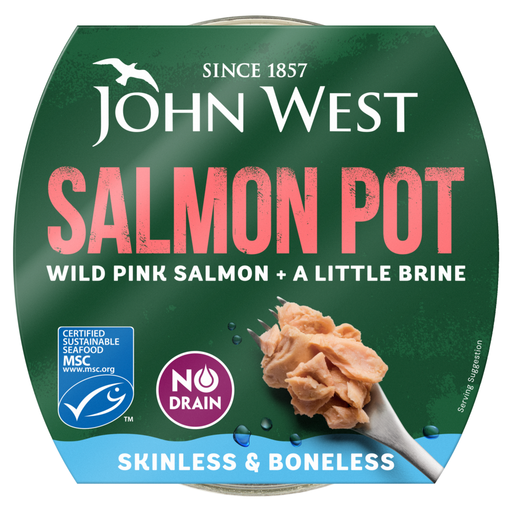 No image available
John West Pink Salmon Fridgepot 80g
Consider the smaller fridgepot when one compact portion better fits a planned lunch than a multipack of tins.
This is an 80g fridgepot, not a bulk tin. Check its current bone warning and storage directions before serving.
Joybuy
Frequently asked questions
Should I buy a 418g tin or a multipack for school lunches?
Choose a 418g tin if you can use its contents promptly after opening; separate small tins make more sense when lunches are prepared on different days. Tesco lists a 418g pink-salmon tin and a John West 3 x 80g multipack, so check the portion size and storage directions on the product you choose.
Does a fish declaration mean tinned salmon contains shellfish?
No. UK allergen guidance identifies fish, crustaceans and molluscs separately. If shellfish is a concern, read the exact tin's current ingredients and advisory wording rather than interpreting its fish declaration as an answer.
Do UK shops have to provide fish-allergen information?
Yes. GOV.UK guidance says food businesses must tell customers when a listed allergen, including fish, is used as an ingredient. Check the ingredient and allergen information for the exact product before purchase.
How long can opened tinned salmon be kept?
Follow the exact product's instructions rather than applying one period to every tin. M&S instructs shoppers to eat unused contents of its 213g red salmon within 24 hours after refrigerating them in a non-metallic container; Asda's 213g pink-salmon listing says best within three days.


