MSC-first lunch planners
Parents or carers who want an MSC ecolabel on the particular salmon they buy, rather than treating general responsible-sourcing wording as confirmation that a can is certified.


If independent fishery certification is your priority, choose tinned salmon whose exact pack carries the MSC ecolabel, then consider the portion size and whether a skinless-and-boneless format would make preparation easier. A small can or pot may leave less to store when you use it all; a larger can suits several servings if you can refrigerate the remainder as directed. Check the fish allergen information, look for possible bones and confirm the school’s packed-lunch policy before packing.
Parents or carers who want an MSC ecolabel on the particular salmon they buy, rather than treating general responsible-sourcing wording as confirmation that a can is certified.
People making sandwiches, wraps or pasta salads who favour a smaller pack or a skinless-and-boneless format, while still checking the salmon for small bones.
People using a larger can for several servings who can transfer and refrigerate what remains, following that product’s instructions for when to use it.
Start with the certification required for your purchase, then choose a workable portion and plan how the finished lunch and any leftovers will be stored.
| Concern | What to check | Who this matters to |
|---|---|---|
| MSC certification | Find the MSC ecolabel or certification statement on the exact can, pot or multipack. Do not substitute a retailer-wide sourcing statement. | If certification is the reason I am choosing this salmon, I need to see it attached to the product I will pack. About 42% of consumers put that product-specific check first. |
| Portion and bones | Compare pack size and stated servings; read any skinless-and-boneless claim alongside its warning about remaining bones. | For one child’s lunch, I want a portion that is straightforward to use and salmon I can inspect before packing. Portioning and bone handling come first for about 33% of consumers. |
| Lunch and leftover handling | Read the fish allergen and ingredient information, check the school’s policy, and follow the pack’s refrigeration and leftover instructions. | When I make several lunches from one can, I need to store the remainder correctly and check every ingredient in the finished meal. About 25% of consumers chiefly prioritise that preparation and storage routine. |
Fish is the allergen declared on the reviewed salmon listings; salmon itself is not shellfish. Bread, mayonnaise or other additions need their own label checks. If the packed lunch will wait until lunchtime without refrigeration, Tower Hamlets Council advises keeping it cool, for example with a cool bag or ice pack.
A retailer’s sourcing policy can describe its wider approach without establishing that a particular salmon can carries the MSC ecolabel.
If MSC certification decides your purchase, check the current pack or its product-specific listing for the label or an explicit certification statement.
The reviewed Asda, John West and M&S product information warns that small bones may remain despite bone-removal steps.
Inspect and flake the salmon while preparing the lunch, particularly for a younger child.
Storage directions and the time allowed after opening differ between the reviewed products.
Transfer unused salmon to a suitable container, refrigerate it and use it within the period stated on the pack you bought.
A sandwich or pasta salad may contain allergens in ingredients besides salmon, and the school may have its own packed-lunch or allergy policy.
Read the labels of every component, ask the school about its policy and keep the prepared lunch cool until it is eaten.
Certification, pack size and bone warnings differ by product, even within a brand. Check the particular version you intend to use.
Its skinless-and-boneless wild pink salmon multipack offers three 80g cans for separately prepared lunches.
The 213g Pink Wild Pacific Salmon can suits preparation across more than one serving.
Its own-label Wild Pacific Pink Salmon comes in a 212g can for preparing more than one portion.
Its 105g Wild Pacific Pink Salmon is listed in standard and skinless-and-boneless versions, each described as one serving.
Its 170g Wild Alaskan Pink Salmon is presented as a skinless-and-boneless can with two suggested servings.
Its 170g Wild Alaskan Red Salmon is described by M&S as skinless, boneless, responsibly sourced and traceable.
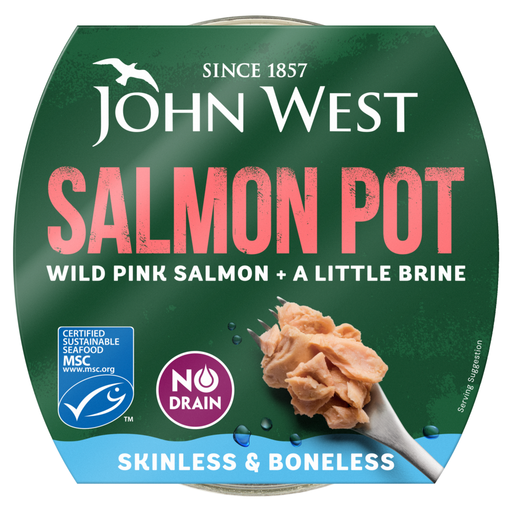
An MSC-labelled 80g salmon pot is an option for preparing a school packed lunch from a compact pack. Check its current label and decide how you will keep the prepared lunch cool.
 No image available
For a salmon sandwich or salad, this 80g wild pink salmon pot offers a compact, ready-to-eat format. Joybuy’s product description identifies it as MSC-certified and says to refrigerate after opening and use within two days. Check the current pack for bone information, and inspect the salmon before serving.
Look for the MSC ecolabel or an explicit certification statement for the exact can, pot or multipack. Reviewed listings for the Asda 170g can, John West 3 × 80g multipack and Princes 213g can state MSC certification; general responsible-sourcing wording alone does not confirm it for another product.
Salmon is fish, not shellfish. The reviewed plain salmon listings declare fish; check the current label for ingredients and any precautionary information relevant to the child, as well as the labels of other foods in the lunch.
Yes, if you can follow that product’s storage instructions. Transfer unused salmon to a suitable container and refrigerate it; the reviewed products give different periods for using leftovers, so use the time on your pack rather than another brand’s directions.
Ask about the school’s packed-lunch and allergy policy, then check the ingredients of the complete meal. If it will be held until lunchtime, Tower Hamlets Council’s packed-lunch guidance advises keeping it cool, for example with a cool bag or ice pack.