School-term meal planners
Households using salmon in sandwiches, pasta bakes, fishcakes or shared meals need a tin size that fits their planned portions and leaves manageable leftovers.


For repeated family meals, start with a standard pink-salmon tin in a size you can use after opening. Choose a skinless-and-boneless format when checking for bones would complicate preparation, or a smaller portion when a larger tin would leave unwanted leftovers. Salmon contains fish, so it is unsuitable for anyone with a fish allergy; always check the current pack label.
Households using salmon in sandwiches, pasta bakes, fishcakes or shared meals need a tin size that fits their planned portions and leaves manageable leftovers.
For a packed lunch or a fast evening meal, a skinless-and-boneless format or smaller portion may reduce preparation or the amount left after opening.
Households deciding whether a product suits their meal need to check fish-allergen information, bone warnings, ingredients and storage instructions on the current pack.
Choose the pack size around the meals you have planned, then decide whether preparation format or label details change which product is suitable.
| Concern | What to check | Who this matters to |
|---|---|---|
| Usable pack size | Net weight and whether you can use the opened contents within the pack's storage instructions. | If salmon appears in several school-term meals, I want a tin that fits those portions without leaving food unused. About 38% of consumers put usable pack size first. |
| Preparation effort | Skinless-and-boneless wording, any bone warning and the size of a smaller portion. | When making a packed lunch in a hurry, I want to know how much checking and preparation the salmon needs. For about 31% of consumers, easier preparation is the primary concern. |
| Ingredients and nutrition | The ingredient list and nutrition values on the same per-100 g or per-serving basis. | If I am comparing salmon for regular meals, I want to understand what is in each format rather than assume the tins are identical. Checking ingredients and nutrition comes first for about 23% of consumers. |
| Allergens and bones | The current fish-allergen statement and product-specific bone information. | If someone in the household has a fish allergy, salmon cannot go into their meal; bones may also rule out a particular format for others. About 8% of consumers make this safety screening their first consideration. |
A larger tin can leave salmon unused if it does not fit the number of portions you intend to make.
Match the pack size to those portions and read its instructions for storing contents after opening.
Standard tinned salmon may contain soft edible bones, which can mean extra checking when preparing a filling.
Read the bone warning on the current label. If bones are not acceptable for the intended meal, look for an explicit skinless-and-boneless description.
Product information can change. Fish is among the allergens listed in UK government guidance, and a fish allergy makes salmon unsuitable.
Check the current physical pack before serving, particularly when an allergy or school meal policy affects the choice.
Opened-salmon storage instructions differ between products, so a routine that suits one pack may not suit another.
Follow the instructions on the tin or pot you bought, including its container, refrigeration and use-by directions after opening.
Tesco Groceries lists own-label pink and red salmon, including standard and skinless-and-boneless formats.
Sainsbury's Groceries lists standard Wild Pacific Pink Salmon alongside skinless-and-boneless pink and red formats.
Asda lists a 213 g Wild Alaskan Pink Salmon tin for shoppers planning portions around a standard-sized can.
Princes lists Wild Pacific Pink Salmon in 213 g and 418 g tins.
John West offers a 213 g Wild Pacific Pink Salmon tin and a smaller 80 g Pink Salmon Fridgepot.
M&S lists Wild Alaskan Red Salmon in a 105 g format for shoppers specifically seeking red salmon in a smaller pack.
These selections cover standard pink-salmon tins for planned school-term meals and a smaller pink-salmon pot for a single meal.
 Image unavailable
Consider the four-pack if you have several meals planned. It contains four 213 g tins; check each tin's bone information and instructions after opening before using it for school meals. Contains fish.
 Image unavailable
A single tin may suit a meal planned around 213 g of pink salmon. Check the current label for bones and instructions after opening, particularly if some will be left over. Contains fish.
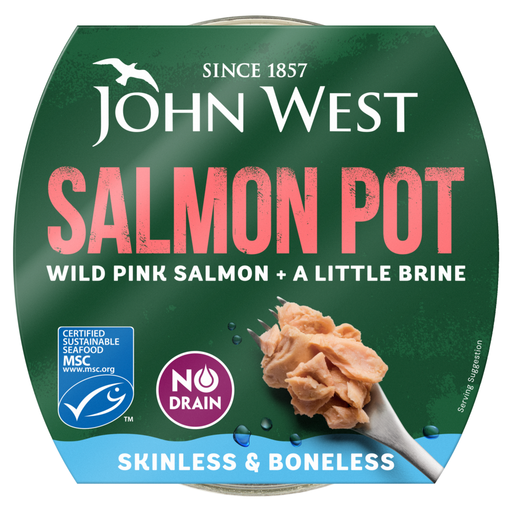 Image unavailable
The 80 g pot is an option when a smaller portion fits the planned lunch better than a standard tin. Joybuy's product information lists pink salmon, water and salt, and says to refrigerate after opening and consume within two days. Contains fish; check the current label if bones matter.
Yes. The NHS identifies salmon as oily fish. When comparing tins for regular meals, use each product's own nutrition panel rather than assuming every format has the same ingredients or values.
No. Salmon contains fish, which UK government allergen guidance lists among the allergens food businesses must identify when present as an ingredient. Do not serve salmon to someone with a fish allergy, and check the current pack label for every product.
No. Some standard products contain soft edible bones, while skinless-and-boneless products are a separate format. Read the current product label and choose an explicitly boneless format if bones are not acceptable for the intended meal.
Follow the particular product's pack instructions, because they differ. The reviewed Asda tin instructs shoppers to transfer leftovers to a covered, suitable non-metallic container, refrigerate and use within three days; the reviewed John West 213 g listing specifies use within two days after transfer and refrigeration.